

 Brian Oduti
Before the Independence Monument, just off Speke Road, white blocks of letters and the red heart sign ‘’I love Kampala,’’ stood on a concrete platform, overlooking traffic and the billboards of an insurance company and President Museveni’s election campaign. I had never seen the blocks of letters before. A few feet from the monument, a tour guide spoke to white tourists.
A woman napped at the foot of the monument, on a cloth on the cracked tarmac. People sleeping under the shade of trees or buildings in public are a common sight. Kampala lacks public spaces where people can sit and rest or eat without paying, as public parks like the Sheraton Gardens and Centenary Park, and part of the Constitutional Square, have been occupied by the private sector actors and the state, respectively.
Miti told Joshua and me that the monument is printed on all Ugandan currency notes. I might have seen this on the notes, but it never registered as something significant, like our ‘independence.’ The British colonial government commissioned the monument’s construction, and it was unveiled on the eve of Independence Day in 1962. This ironically was one of the enduring physical marks of colonial presence left behind.
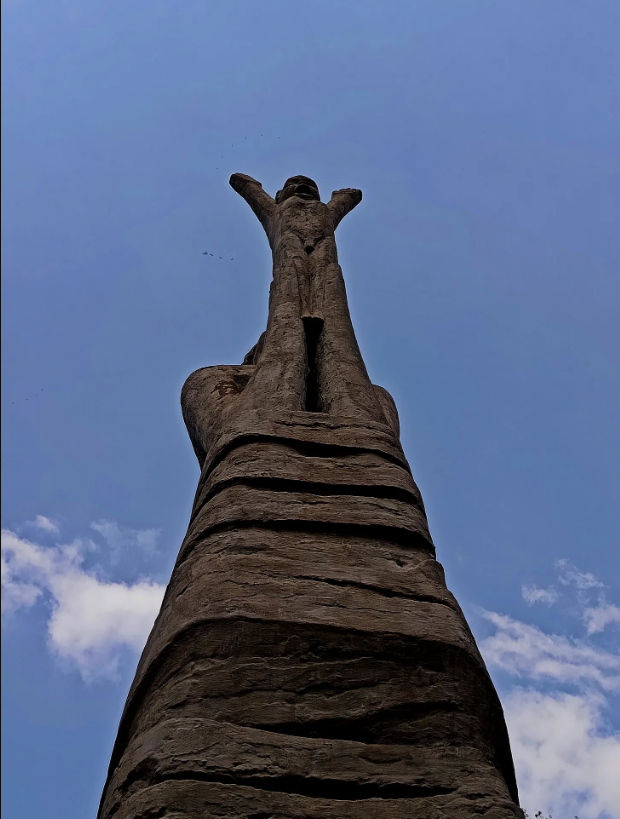
The monument is a grey 29-foot concrete Sculpture of a mother standing and hoisting a child toward the sky. The mother’s feet were bound by a tangle of straps, a symbol of colonialism. Against the blue sky, the child is smiling, arms spread in the air. A pink rosary is draped on the child’s neck. The rosary was not part of the detail commissioned by the British.
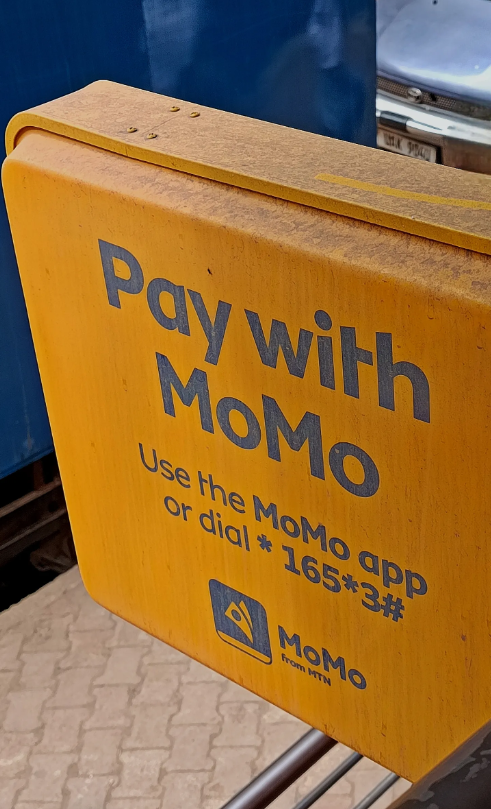
We walked along the court buildings, along Square Road. Miti stopped to photograph a mobile money stand under the trees across the road from the court houses and its attendant, a woman. The stand was a medium-sized table painted with the branding of telecoms MTN and Airtel. A yellow umbrella above the table. These stands have sprung up in every neighbourhood and village, effectively democratising banking, especially for Uganda’s large informal sector.
We crossed Square Road under the lush tunnel of large trees that house Marabou storks, whose thick white droppings painted the tarmac we walked on. The white paste had a musty scent.
Cars and army trucks were parked along both sides of Buganda Road near the Constitutional Square. Army-green tents were pitched in the upper square, and soldiers moved about, some in slippers. The upper compound of the Constitutional Square was the Temple of Justice, previously the High Court of Uganda, now with new buildings for the Court of Appeal and the Supreme Court.
We walked on the pavements along the Constitutional Square towards Kampala Road, past the mill of packed fruit vendors, mobile money agents and taxi touts. Then we walked to cross the Mapeera building (Centenary Bank), at the section just past the intersection, where the tarmac sunk into the shape of a car tyre. We moved through the phone shops in Pioneer Mall and come out on William Street. Miti told Joshua and me to watch our phones and cameras.
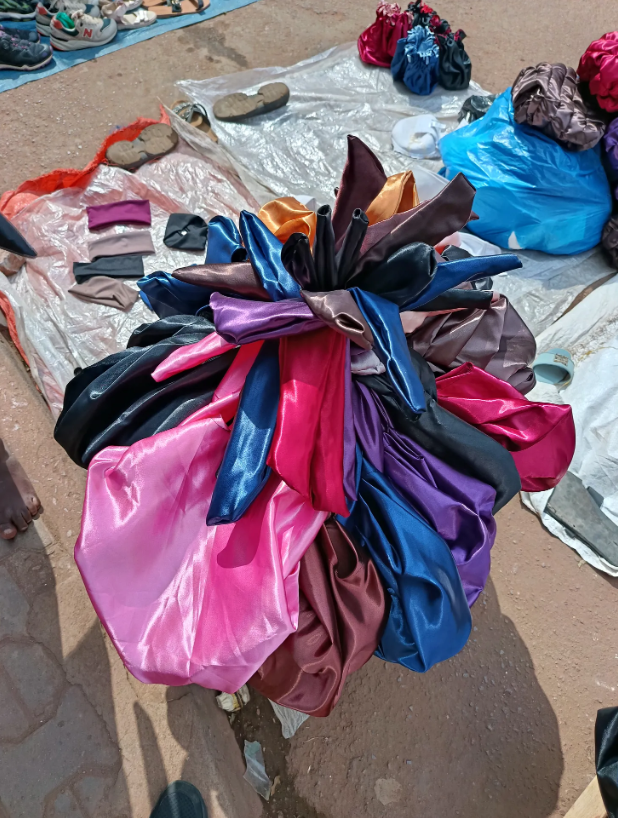
A hair bonnet vendor, a woman, held Miti by the arm and persuaded him to buy one for her hair. Unwanted touches bordering on harassment and the use of endearments such as mummy, uncle, sister and mzee. The hair vendor mentioned Joshua’s dreadlocks, too, and referenced the term ‘’rasta’’. The spectacle went on for about five minutes. Miti did not budge, smiling and saying things like ‘’ next time’’, while Joshua focused on taking photos. The bonnets were displayed on the side of the road, not on the street pavement. Shoes held down the polythene bags on the sides. Vendors and their merchandise made the road narrower and the flow of traffic squeezed through one lane. A bundle of the bonnet with the rainbows of satin parts stuck out in the sun, which I found both curiously beautiful and sensually overwhelming of the same.
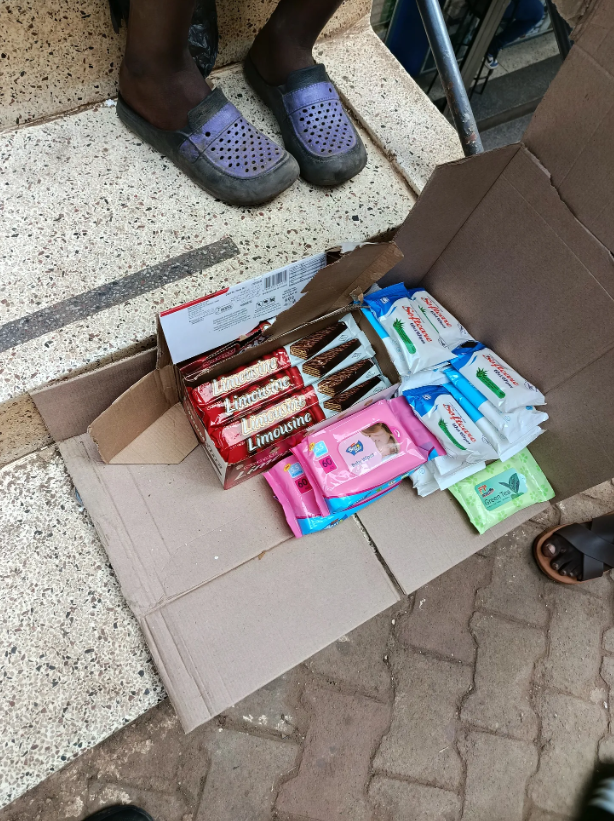
Miti spoke in Luganda to a boy about the age of twelve who sat on the terrazzo-floored steps of a building. He sold packets of wet wipes and biscuits out of a box placed at his feet. We climbed the steps and watched the street below from the balcony outside a pharmacy overlooking the building labelled Gazaland, famous for the sale of hair extensions and cosmetics. We took photos and watched.
The balconies of Gazaland and Galiraaya Commercial Complex were crowded with banners of women’s handbags, mobile money, hair accessories and an itel billboard. A white truck overflowed with garbage that men hunched over and sorted through without gloves. Above the truck, there was a clutter of crisscrossing electric cables. Around the truck, there was a sea of bodabodas and cars parked, moving, people standing, walking, selling and buying fruits, hauling a trolley. A collective blare of honks, chatter, and engine noise. The smell of exhaust and garbage. An endless trail of people, every inch of the road filled.
I did not care about street names and building names anymore. I just wanted to get through the crowds with my phone and wallet still on me. The third floor of a building we walked through, was filled with jewellery vendors and their merchandise, from the corridors to the inside of the shops. The necklaces, earrings and finger rings hang on display boards and in trays. The trays had round holes that look like omweso boards. Gold, silver, multicoloured. I liked the neat displays, the jewellery glinting under electric bulbs; the building has little natural lighting. I took photos of the display trays on a table.
The lady who manned the stand I took photos from glared at us, “You should have asked permission.” Miti apologised and explained how he had been guiding tours and taking photos of spots and merchandise in the city. Miti then properly asked a rather late permission. The conversation was in Luganda, but I picked bits of it. “But you already took photos,” she snapped. She reluctantly permitted us. I understood that Miti’s walking tours with white tourists rarely elicited such incidents with the jewellery lady. In hindsight, I thought it was proper and polite to seek permission regardless of the public display of the merchandise.
This post was created with our nice and easy submission form. Create your post!
Written by
I write personal essays and short fiction set in Uganda. My work is informed by own experiences and how they fit within policy, memory, and the idea of home.
Did this story move you? Every gift goes directly to Brian Oduti — writers on Muwado earn from reader appreciation, not algorithms. Even $1 makes a difference.




Muwado weekly chart
Get Africa’s top 10 stories every Thursday
No account needed — just your email.
Want to follow Brian Oduti and get notified every time they publish?
Create a free Muwado account →