

 Dr. Vijayakumar Parameswaran Unnithan

On Prem Ganapathy, a Railway platform at Bandra, Mumbai, India, and the career nobody could have designed.
There are careers that are planned, and there are careers that are forced into existence by a single, irreversible moment. The second kind is rarer, and almost always more instructive. Prem Ganapathy’s journey- no, pilgrimage began on a railway platform in Bandra, one of Mumbai’s great churning arrival points, a terminus where the city of dreams receives, every hour, thousands of people who have come from somewhere else with everything they own. In 1990, this seventeen-year-old boy from a village in Tamil Nadu alighted at the Bandra railway terminus, stood in a crowd that did not speak his language, with no money, no plan, and no way home. And decided, with a clarity that still astonishes, that this was exactly where his life would be made.
I — THE PLATFORM
The moment that strips everything away
He had come from Nagalapuram, a small village in the Tuticorin district of Tamil Nadu, a state at the southern tip of the Indian subcontinent, whose people speak Tamil, one of the world’s oldest living languages. He was the seventh of eight children in a family that needed every earning hand it could find. He had left school after the tenth standard. Not from lack of ability, but from the weight of responsibility that settles early on the shoulders of children born into a particular kind of poverty. His father had a tobacco business that ended in loss. The farm had failed. With seven children, his parents struggled to make ends meet. An acquaintance had promised him a job in Mumbai, India’s financial capital, the maximum city, the place where the country’s imagination of possibility is most densely concentrated, paying 1,200 rupees a month. To a boy who had been earning two hundred and fifty in Chennai, sending most of it home, this was the sound of a different future.
He left without telling his parents. He arrived at Bandra Terminus with two hundred rupees, the entirety of what he had. And on the platform, before the city had even properly begun, the acquaintance who had brought him there took his bag and melted into the crowd.
He stood there. No Hindi, No Marathi, the languages of the city’s streets. No money. No map. A stranger, a fellow Tamil speaker, recognising the particular stillness of a boy who has just had the ground removed from beneath him, took him to a nearby temple and appealed to those who gathered there to contribute enough for a train ticket back to Chennai, the capital of Tamil Nadu, six hundred miles to the south. They raised just enough.
Prem Ganapathy refused to take it.
“That emptiness became his strength. With nothing to lose, everything that came next felt like a chance — not a threat, not a setback, but the first clear morning of a life that had decided to begin.”
Not courage, though it was that too. But svabhāva, a Sanskrit word for the irreducible nature of a person, is revealed most clearly when everything peripheral has been stripped away. The bag was gone. The money was gone. The promise was gone. What remained, standing alone in that crowd, was Prem.
And Prem, it turned out, was enough.
II — THE HAND CART
The ancient dish, reinvented
The next morning, he found work washing dishes at a bakery in Mahim, a neighbourhood a few kilometres south along Mumbai’s western railway line, unremarkable, working-class, exactly the kind of place where a boy with nothing could find a floor to sleep on and a start. One hundred and fifty rupees a month. He took it. He saved every coin, picking up additional work wherever he could find it, watching, learning, quietly cataloguing what the city could teach a boy who had nothing but his own attention to spend.
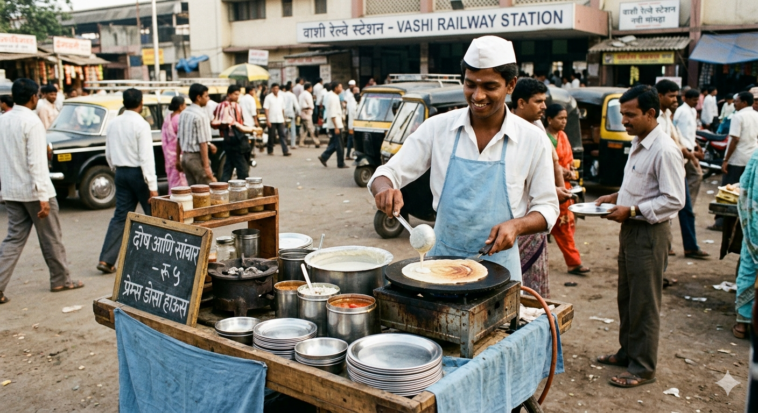
By 1992, he had saved enough. He hired a handcart for 150 rupees a month, bought a stove and utensils for 1,000 rupees, and set up outside Vashi railway station. Vashi, a township in Navi Mumbai, the planned satellite city built on reclaimed land across the harbour from the original city, was still finding its shape in the early 1990s, full of students and young families, and the particular energy of a place being invented as it goes. He began selling idli and dosa, the breakfast foods of Tamil Nadu, made from fermented rice and lentil batter, ancient in their simplicity, the dishes his mother had made every morning in Nagalapuram. The sambar, the spiced lentil broth served alongside, was made from his mother’s own masala, carried from the village. His greatest competitive asset was not acquired in Mumbai. He had brought it with him, without yet knowing it was an asset.
He called his brothers Murugan and Paramashivan to join him. He decided the cart would be the cleanest cart anyone in Vashi had seen. He and his brothers wore clean clothes and caps. In a city where roadside food stalls were plentiful and hygiene was nobody’s stated priority, cleanliness became his first and most visible statement. The food tasted of home, and the spotlessness made people trust it. Within months, the cart was generating a turnover of nearly twenty thousand rupees a month. They lived in a single rented room, using it as both kitchen and sleeping quarters, constantly facing the risk of the municipal authorities seizing the cart. He paid the fines and kept going.
His customers were mostly college students. Young, curious, connected to something new that most established business owners had not yet noticed. They introduced him to the internet. What followed is one of the quiet miracles of modern Indian enterprise. A man with no formal education beyond the tenth standard began teaching himself new recipes from across the world. Schezwan dosa, the Chinese-influenced. Paneer chilli dosa, the north Indian fusion. Spring roll dosa. American chopsuey dosa. In his first year of experimenting, he introduced twenty-six new varieties. By 2002, Dosa Plaza, as his venture had come to be called, had 105 varieties on its menu.
He had taken one of India’s most ancient dishes and made it restless. Not by abandoning its roots, the dosa is still a dosa, still the fermented rice batter, still the cast iron pan, still the particular sizzle that every South Indian recognises before they see the dish, but by asking what it could hold, how far it could travel while remaining entirely itself.
This is the move the Career Architect spends years helping people find. The capacity to be simultaneously rooted and radically alive. To draw from what is most essentially yours, the recipes from the village, the masala your mother made, and carry it forward into territory nobody has yet mapped.
III — THE MALL AND THE WORLD
The gap that finds you
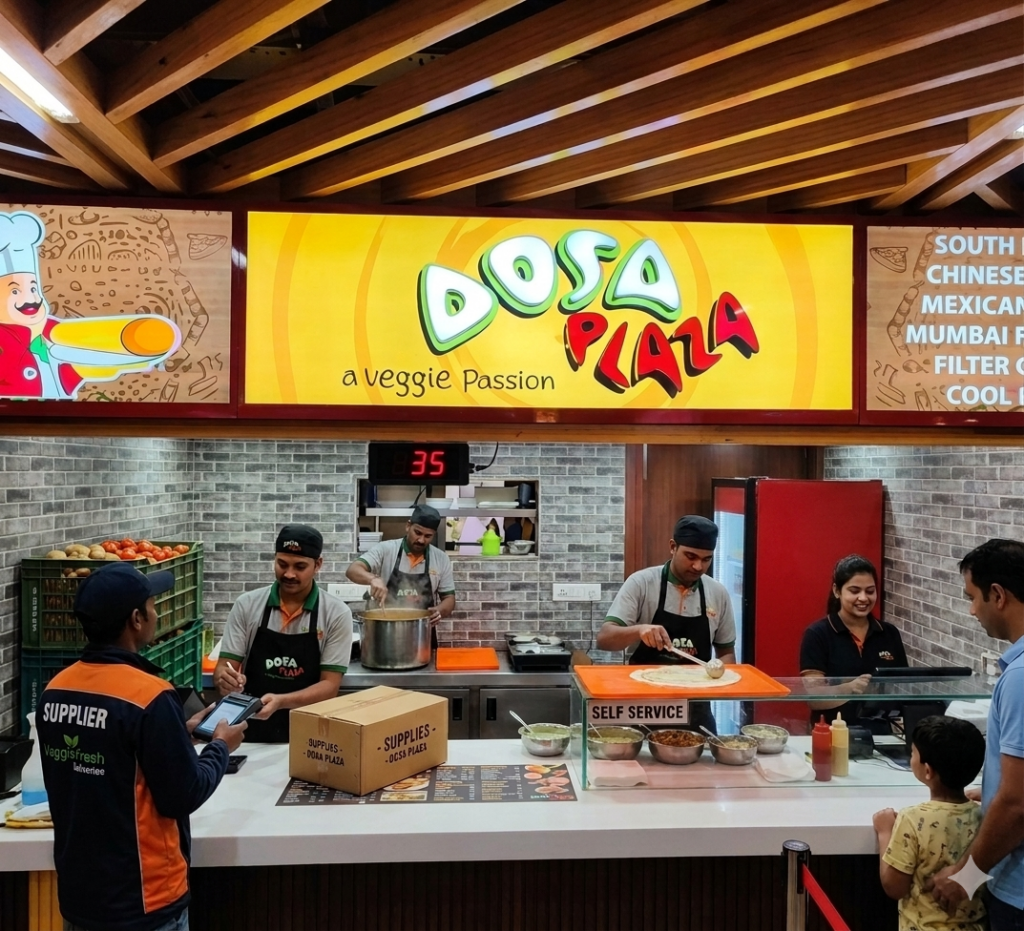
Every mall he approached said no. He was not a brand, they told him. The spaces were reserved for McDonald’s, for the international names, for the recognised. A dosa man from a hand cart in Vashi did not fit the image any mall wanted to project.
The man who was told he was not a brand went back to his restaurant and kept cooking.
Then the manager of Centre One Mall, a gleaming new shopping complex in Vashi, the kind of space that announced arrival in a way a street stall never could, called him. The management staff had been eating at Prem’s restaurant for years. They knew what the numbers had not yet confirmed. The mall outlet opened in 2003. The franchises followed. First across India, then New Zealand, then Dubai, then Oman. Dosa Plaza crossed three continents, grew to over 70 outlets, and reached revenues of more than 50 crore rupees, roughly 6 million US dollars. The former Prime Minister of New Zealand ate there.
The boy who stood on the platform at Bandra had not, in the end, needed the malls to recognise him. He had needed only to build something so genuinely, persistently, unmistakably his own that the world, eventually, as it always does with things that are truly built, organised itself around it.
He had once said in an interview that it was his father who had instilled in him the positive energy that kept him going. That energy, somewhere along the way, became a business. Then a brand. Then a case study taught in management colleges, studied by PhD students and discussed in seminar rooms, by young men and women who had never washed a dish for a living and would never need to. The boy who could not continue past the tenth standard became, without seeking it, a subject of doctoral research. The institution that once had no space for him found, in the end, that it could not stop talking about him.
He had no Career Architect. No mentor sent him to sit with a wise person for an afternoon. No framework, no roadmap, no theory of transitions. What he had was a refusal, quiet, absolute, and entirely his own to accept that the story was over when it had barely begun. And a dosa. And the internet. And twenty-six new varieties in the first year.
The Career Architect keeps Prem Ganapathy’s story close. Not as an example of hustle or resilience, those words that flatten what happened on that platform into something motivational and therefore smaller than it actually was. He keeps it close as a reminder of what becomes possible when a person encounters the absolute worst that circumstance can offer, and chooses, in that stripped and silent moment, to trust what remains. Not a plan. Not a skill. Not a certificate. Just the self, its hunger, its stubbornness, its ancient knowledge of a dish that could, it turned out, travel the world. The ordinary, attended to with love, does not stay ordinary for long. Not even on a platform at Bandra. Not even in 1990. Not even with two hundred rupees and a crowd that does not speak our language.
———————————————————————————————–
About the Author Dr. Vijayakumar Parameswaran Unnithan is a scholar- practitioner working at the intersection of career theory, employability, and organisation development. He is the originator of the Post-Skill Professional (PSP) Framework and Career Architect at Careertotus Consultants Pvt Ltd. He is the President of Asia Organisation Development Network (AODN) and publishes in leading management journals. Views are Personal. Pic credits: Nanobanana 2
This post was created with our nice and easy submission form. Create your post!

Written by
Did this story move you? Every gift goes directly to Dr. Vijayakumar Parameswaran Unnithan — writers on Muwado earn from reader appreciation, not algorithms. Even $1 makes a difference.






Thank you very much!!
Highly inspiring and motivational real time story to transcend in anyone’s life!