

 Brian Oduti
Miti Kinaawola runs Tembea Kampala Walking Tours, which conducts city walking tours of Kampala. I had followed his Instagram page for close to two years before he followed me back in January 2026, and reached out with an offer of a free walking tour. I was excited and immediately accepted the offer. His offer was based on my (quite amateur) photos of Kampala that he had seen and resonated with.
We walked on the last Saturday of January, 2026. Miti and I converged at 2pm at Cafe Javas on Parliament Avenue and were joined by Joshua Muwanguzi, a photographer. We set off walking towards Parliament buildings. Miti immediately made the distinction between downtown and uptown Kampala. ‘Did you know that Kampala Road separates uptown from downtown Kampala?’ he asked. I had never cared to make the distinction prior to this. Kampala road is the main road that runs across the city and joins two major highways out of it on opposite ends: Jinja Road which goes to the East and Kenya, and Bombo Road into the greater Northern region.
Uptown Kampala is the Kampala of tall buildings with glass windows, bank headquarters, government offices and Cafe Javas, a status symbol of the city’s middle class and youth. Parliament Avenue and its pavements are clean, with one or two Jacarandas in purple bloom, a purple that meets the white of an insurance building. Downtown, as we would find out, was a complete contrast. Another explanation of the two towns is geographical and indeed political. Uptown is up towards Nakasero Hill, one of the presidential residences, and perhaps the securest neighbourhood in the country. On the other hand, downtown is in a valley; traders in this part have lost lives and merchandise to constant flooding.
I asked Miti whether downtown or uptown Kampala is also a statement about class. He said yes. Still on Parliament Avenue, I saw a gentleman in a white football jersey, shorts and leather sandals, leading, holding his daughters’ hands to cross the road into the restaurant. Outside there was a dreadlocked young man with a goatee, wearing the on trend oversize pants, sunglasses in hand, tote bag, staring at his phone. Moments later, his ride, an electric motorcycle Safe Boda arrived. Safe Boda is one of the ride-hailing start-ups that attempted to modernise the city’s bodaboda (motorcycle taxi) transport, by making it safer and fares predictable based on time and distance. But ride-hailing apps are a private enterprise solution to failed regulation of public transport. Class here is also a statement of aesthetics and mannerisms. In uptown Kampala the restaurant is quieter and pace of life is leisurely. Safe Boda is about convenience. In downtown Kampala, it might be unheard of to wait five minutes for a ride when bodaboda are milling everywhere.
Outside the Ministry of Justice and Constitutional Affairs, Miti cautioned me against taking photos in uptown Kampala because of all the government offices with policemen. We did not want to have to explain why we were taking photos, which could be a serious ‘crime’ in Uganda even when no one has articulated its legality beyond vague ‘security’ considerations. One could end up in detention over as little as just taking photos. Miti then joked that it did not help our case that both he and Joshua were dreadlocked. We laughed. Dreadlocked men are commonly looked at with suspicion and profiled by the police in our predominantly conservative society, where colonial era myths associated African hair with dirt and justified ‘civilisation’. Many Ugandan schools still carry on this legacy of considering students with natural hair undisciplined, requiring taming. The criminal justice system has not been spared by this legacy, as men often have their hair cut off when arrested and/or detained. The reasons for this affront to identity and bodily autonomy are never clearly explained by prison authorities.
We turned onto Kimathi Avenue. Miti showed me the sculpture of an impala, nestled amidst grass. He explained the origin of the name Kampala, which comes from the Luganda phrase Kasozi Ka mpala. This means hills of impalas. Long before any contact with Europeans, the kings of Buganda hunted impalas on the hills of what we now know as Kampala. Kampala was easier for the Europeans to pronounce, hence the name.
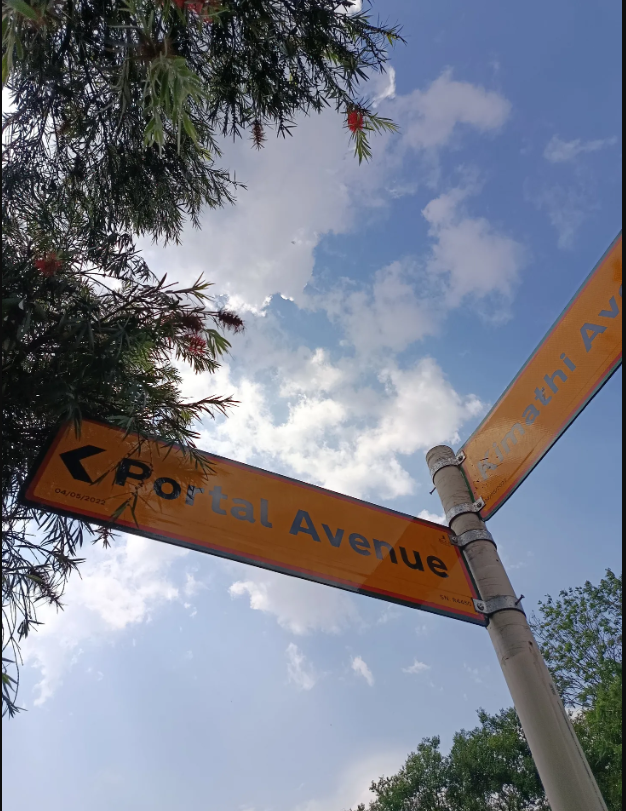
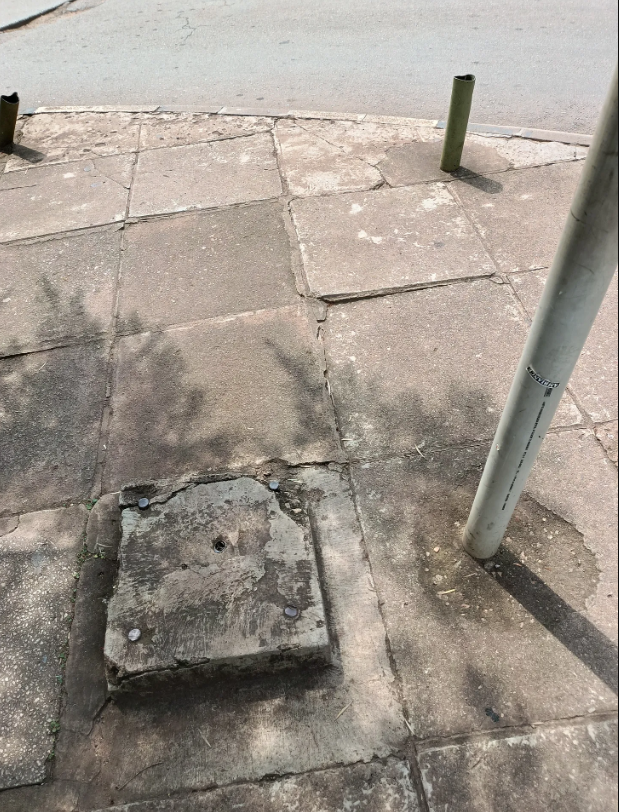
On the right of Kimathi Avenue are government buildings; Parliament and Kampala City Authority. We stopped at the intersection of Kimathi Avenue and Portal Avenue. A woman was napping under the shade of the Bottlebrush tree near the pole holding two road names. The signs of the two roads, two bright yellow panes joined off the same pole, gleamed in the sun. Miti acknowledged the irony which had never occurred to me: Dedan Kimathi was a Kenyan Mau Mau fighter who was executed in a colonial prison in Kenya in 1957, while Gerald Portal was a British Special Commissioner appointed to Uganda in 1893.
From Kimathi Avenue, we walked to Colville Road. Sir Henry Edward Colville had taken over administration of Uganda in 1893 following the failing health and eventual death of Portal. We stopped for a few minutes at the Christ the King Church, a main Catholic church in the city. The security guard, a man in a grey fading uniform, seated facing the entrance of the church, was friendly. Miti greeted him and said he did not mind photos. We took photos of the church and continued further up on Colville, into Speke Road.
Speke Road was named after John Speke, an officer in the British Indian Army, who was the first European to identify the source of the Nile. Miti asked whether we knew that the gardens of the Sheraton Kampala along Speke Road, were once a public park? I said yes. Found on public land, the gardens were previously known as Jubilee Gardens, and fenced off in 2002. The official reason advanced by the Sheraton Hotel was the security of high profile guests, including heads of state and diplomats, considering the global and regional security risks of the 1990s and early 2000s. The status of the gardens remains a long standing contention between Kampala City Council Authority and the hotel.
In June 2020, Former Buganda Kingdom Attorney General Apollo Makubuya, led a campaign to remove colonial names from Kampala streets. He led a team of elders and politicians to present their petition to Speaker of Parliament Rebecca Kadaga. The petition gathered 5,000 signatures. In February 2025, the High Court in Kampala ruled that KCCA must rename streets honouring colonial figures, with Justice Ssekaana calling for choosing names relevant to Uganda’s independence. Implementation remains uncertain due to concerns about erasing history and Uganda’s economic ties to Britain.
But whose names would replace Portal and Colville? Do street names matter in downtown Kampala where all urgency is about making the next shilling? I had passed the Kimathi-Portal intersection perhaps a hundred times before. I had never registered the irony of these two names meeting on one pole. Without Miti’s narration, I would have walked past again, seeing nothing.
As we left Speke Road and turned toward the city center, the pavements began to fill with crowds and the noises: hundreds of motorcycle engines, hawkers, and loud speakers, began to grow. We were leaving uptown Kampala.
This post was created with our nice and easy submission form. Create your post!
Written by
I write personal essays and short fiction set in Uganda. My work is informed by own experiences and how they fit within policy, memory, and the idea of home.
Did this story move you? Every gift goes directly to Brian Oduti — writers on Muwado earn from reader appreciation, not algorithms. Even $1 makes a difference.





Muwado weekly chart
Get Africa’s top 10 stories every Thursday
No account needed — just your email.
Want to follow Brian Oduti and get notified every time they publish?
Create a free Muwado account →