

 Dr. Vijayakumar Parameswaran Unnithan

The bellow took eighteen hours to make. Eighteen hours of hand-stitching leather into the focusing mechanism that connects the lens to the body of a large-format field camera — the part that breathes in and out as the photographer draws the world into focus. Eighteen hours. For one bellow. For one camera. In a small workshop in Mullackal, Alappuzha, Kerala, India. Every single time.
I— THE REPAIR SHOP
The question that planted everything
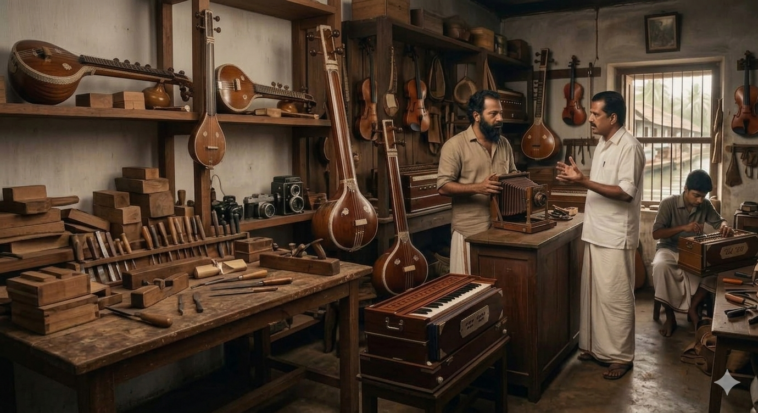
Alappuzha, the Venice of the East, sits at the edge of Kerala’s serene backwaters, a trading town that has always known the world through what passes through its canals. In the 1940s, it was also home to a repair shop run by Kunju Kunju Bhagavathar, a part-time musician who mended veenas, harmoniums, and violins. His son, Karunakaran, spent his after-school hours learning, through his hands, the physics his textbooks described in the abstract.
In 1942, a studio owner named Padmanabhan Nair arrived at the shop. He had travelled by train from Thiruvananthapuram, 160 kilometres south, carrying a broken Japanese camera. The bellows had failed. He had tried every repair shop he knew. Someone had directed him to Bhagavathar — a man who understood harmonium bellows might understand camera bellows. He had come to find out.
Bhagavathar worked on it for several days. When Nair returned, he found that the camera not only worked but also captured images better than before. The musician’s hands had found something in the bellows that the original makers had not fully solved.
Nair looked at the camera.
Then at Bhagavathar. “Why can’t you build cameras yourself? You know better than the Japanese how a camera works.”
Bhagavathar smiled.
His son Karunakaran, who was doing some repair work in the workshop, heard the question. He said nothing either.
But something had been planted.
This is how most vocations begin — not with a declaration but with a question asked in passing, by someone leaving a repair shop, that lands in a particular mind and refuses to leave. The career was not announced. It was heard.
II— THE MAKING
Teak, brass, and eighteen hours of leather
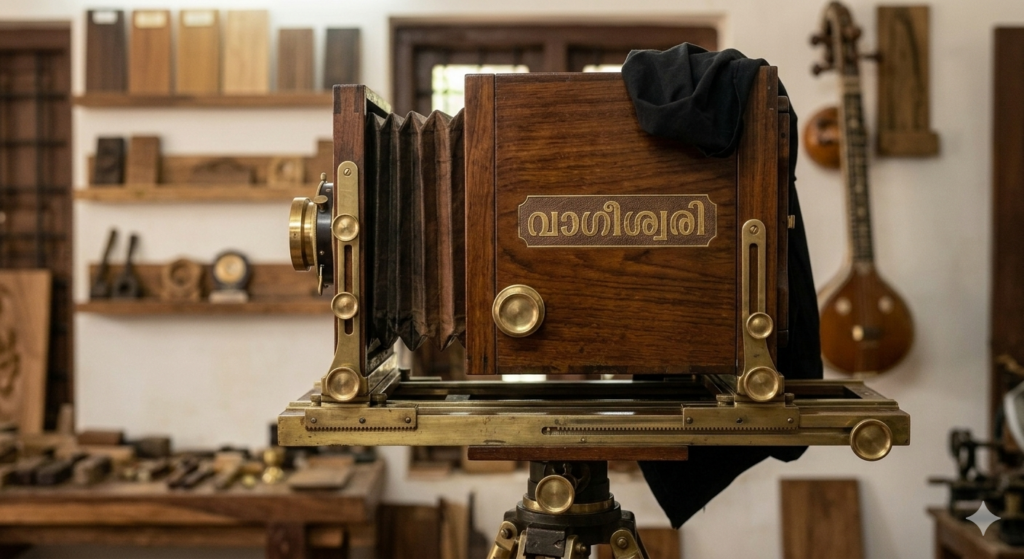
Karunakaran had a high school education, a meticulous eye for details, and the intelligence that comes from learning by taking things apart. He began by dismantling a camera, holding each component and asking what it was for. He ordered books and magazines from England and Germany. He travelled to Bombay and Madras to meet experts and purchased equipment. He drew diagrams. He sourced Kerala teak, brass, aluminium, and Nettlefold screws. The only thing he could not make himself was the lenses, imported from Germany. Everything else, his hands.
By 1945, the first camera was complete. He named it after Vageeswari — another name for Saraswati, the goddess or Devi of learning, music, and the arts, the deity his family worshipped. The name connected the camera to the workshop full of veenas and harmoniums, where his intelligence had first been formed.
It was the first indigenous, mass-produced professional field camera ever made in India. Not assembled from imported parts. Not an adaptation of a foreign design. Conceived, built, and named in a workshop in Alappuzha by a young man who had learned everything he needed from the instruments in his father’s repair shop.
It sold for Rs. 250. A fraction of imported cameras. And it was, by every account, better.
“Karunakaran could never deliver on time,” remembered one collector. “But people waited. Because the quality was incomparable.
“The eighteen hours in the bellow were not inefficiency. They were the reason the camera worked the way it did. The waiting was the price of incomparable quality. Paid in time rather than money.
III— THE FLOURISHING AND THE LONG EVENING
A hundred cameras a month. Then silence
By the early 1950s, 30 people worked in the Mullackal workshop, producing 50 to 100 cameras a month. British officers took them to London. An Anglo-Indian named Edward de Mello managed international sales. Shipped cameras to Ceylon, Singapore, Malaysia, Nepal, Thailand, and Germany. Forensic departments used them. Government agencies. Studios across India. Eight variants, from passport-sized to 20×16 group portraits. Each is assembled entirely by hand. Each bellow, eighteen hours.
So great was the Vageeswari’s influence that imitations appeared in Alappuzha and Thrissur. Japanese manufacturers studied the design. The intelligence that began with a question in a repair shop had, without anyone intending it, become the standard against which cameras were measured across the subcontinent.
Then the 35mm camera arrived. Then digital. The large-format field camera, which was slow and deliberate and required the photographer to think before pressing the shutter, became obsolete. Not because it was worse, but because the world had decided it no longer had time for it. The Vageeswari could not be scaled without being diluted, nor made faster without becoming something else. Production stopped in 1995. The last Vageeswari was made for platinum photography, the most permanent form of printing, as if the final act of the workshop was to make something that would outlast everything that had tried to replace it.
Karunakaran lived quietly in Alappuzha until his death on 19 April 2016, aged ninety. His contribution, the obituaries noted, was largely unrecognised.”
Not being able to meet Karunakaran is one of my life’s greatest regrets,” said one collector.
The witness had arrived. But the man it was meant for was gone.
IV — THE NAME IN THE NAME
Another Enactment of Aesthetics, eighty years later
Some Vageeswari cameras have found their way into museum collections — in Gurgaon, in Germany, in England. Others are being restored and used by photographers today, who still load them with film, still press the shutter and sometimes wait for the light to settle into exactly the right shape. The images they produce carry a depth and warmth that no digital sensor has fully replicated. The camera still catches light. It was built to do exactly this. And it does.
The Career Architect has been sitting with this story for some time. Recently, in the quality of attention the early morning makes possible, he noticed something that, in eighty years of telling this story, nobody appears to have noticed before.
The name of the man who asked the question.
Padmanabhan. Padma — the lotus. Nabha — the navel, the origin point. In Hindu iconography, Padmanabha is Vishnu lying on the cosmic ocean, and from his navel grows the lotus from which creation arises. That same lotus is the seat of Vageeswari, of Saraswati herself, the goddess of learning and the arts.
Padmanabhan’s question is ‘the seat’ for the Camera ‘Vageeswari’.
The cameras are still catching light — in museums, in collectors’ hands, and in the hands of photographers who load them with film and wait, with the patience the camera demands, for the world to settle into focus. Karunakaran named his camera Vageeswari. And Vageeswari was exactly right. The lotus had always been there, in the name of the man who asked the question — waiting, across eighty years of telling this story, to be seen. And that imagination, the imagination that hears a question in a repair shop and builds a camera, that names the camera after a goddess and is right, that sees the lotus in a name and understands that the world is more precisely organised than it appears, is the enactment of aesthetics that pulsates in our hearts.
———————————————————————————————
About the Author: Dr. Vijayakumar Parameswaran Unnithan is a scholar- practitioner working at the intersection of career theory, employability, and organisation development. He is the originator of the Post-Skill Professional (PSP) Framework and Career Architect at Careertotus Consultants Pvt Ltd. He is the President of Asia Organisation Development Network (AODN) and publishes in leading management journals. Views are Personal. Pic Credits: AI Generated- Nanobanana2
This post was created with our nice and easy submission form. Create your post!

Written by
Did this story move you? Every gift goes directly to Dr. Vijayakumar Parameswaran Unnithan — writers on Muwado earn from reader appreciation, not algorithms. Even $1 makes a difference.







Thank you very Much!
This creative narrative is a masterclass in the enactment of aesthetics, shifting imagination from a passive dream to a rhythmic, vital performance. By elevating the ‘Questioner’ to be equal with the ‘Camera Builder,’ he beautifully validates that curiosity is the very seat of Vageeswari—the essential vacuum into which wisdom descends.
Most profound is his ‘locating the lotus’, it reminds us that the Witness within remains dormant until we name the beauty hidden in plain sight. Here, imagination isn’t just seeing—it is the pulse that wakes the observer, turning a name into a living creation. A truly sublime reflection on consciousness.