

 Rita Ngenzi
It seems charity is about the redemption of the giver, when it must be about the liberation of the receiver.
I heard this on Trevor Noah’s What Now? podcast. José Andrés, quoting his friend Robert Egger of DC Central Kitchen, on something said over thirty years ago.
That distinction is over thirty years old. We are still working through its implications.
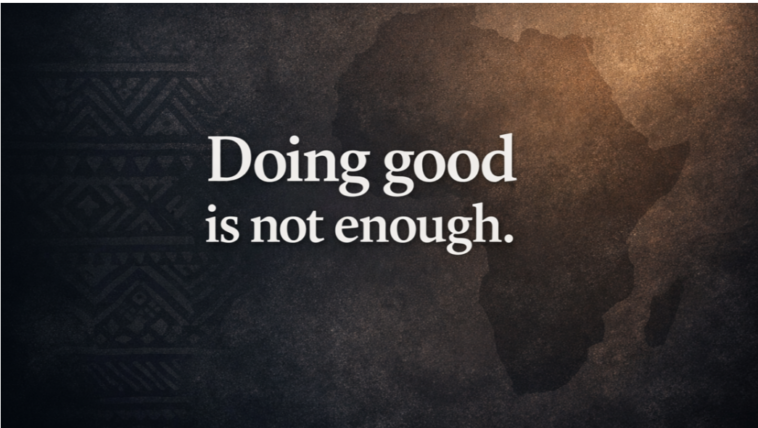
Doing good and doing well are not always the same thing.
Doing good is often defined by intention. Doing well is defined by outcome.
The distance between the two is not effort. It is design, and the ability to execute within the systems we build.
This is not a dismissal of doing good. It is a call to strengthen it. Because desire is not design.
Good intentions without systems thinking do not produce outcomes. They produce activity, reports, and funding cycles. And sometimes, quietly, they produce dependency where there could have been capacity.
Across African ecosystems, decades of well-intentioned intervention have produced a complex reality: food aid that could have been sourced from local farmers, free goods that competed with emerging local enterprises. Much of it was necessary. But necessity alone cannot define how we build systems meant to endure.
And in many cases, the limitation was not capability, but how support was designed and delivered.
The people were never the constraint.
Even in moments of crisis, people do not lose their capability. They bring knowledge, judgment, and networks that no external system can map, let alone replace.
The work is not to solve for people, but to build with them.
Dignity, in this context, is not abstract. It is the ability to participate, to create, and to earn within systems that recognise capability and build on it.
Because what poverty often strips away is not talent, but the conditions to express it.
This is why dignified earning matters, and why jobs, when they are stable, meaningful, and connected to real economic value, become one of its clearest expressions.
That is the difference between an intervention and an investment. Between a program and an institution. Between intention and design.
Liberation follows. It is what happens when systems are designed to enable participation, strengthen local economies, and allow enterprises to emerge, operate, and scale. It is what allows ecosystems to compound.
The goal was never to be needed indefinitely. The goal was always to build systems that can sustain themselves.
The questions have to change: not just what people need, but what they are already building; not just outputs, but ownership when the intervention ends; not just intention, but whether the design can execute.
Because the measure of good work is not what happens while we are present. It is what endures when we are gone.
This post was created with our nice and easy submission form. Create your post!

Written by
Ecosystem Builder I Innovation Strategist I Advancing Africa’s Entrepreneurship, Innovation, and Creative Economies
Did this story move you? Every gift goes directly to Rita Ngenzi — writers on Muwado earn from reader appreciation, not algorithms. Even $1 makes a difference.




Muwado weekly chart
Get Africa’s top 10 stories every Thursday
No account needed — just your email.
Want to follow Rita Ngenzi and get notified every time they publish?
Create a free Muwado account →