

 Oweyegha Afunaduula

Transatlantic slavery was a popular phenomenon in international trade between the 15th and 19th Centuries. That time, Africa was enslaved and its people were a prized commodity to be bought and sold the same way cows are sold and bought today. Therefore if humanity chooses to, it can commoditise humanity any time it wants, the same way it decided recently to commoditise culture and water.
Between the 15 the and 19th Centuries, the slaves were captured in Sub-Saharan Africa and carried across the Atlantic to the Americas (South America and North America). The slaves were mostly from West Africa. The slave trade was often a violent displacement in which men, women and children were brutally treated with chains around their necks, legs and arms. While on the ships, the sick were thrown in the Ocean, along those who tried to helplessly resist. The trade enriched the imperial powers of the time, mainly Spain and Great Britain. Spain transported slaves to South America while Great Britain transported the slaves to North America.
How did Africans participate in the Trans Atlantic Slave Trade? Well, they used the Transatlantic Slave Trade to expel their opponents or to garner profits. This was the case with the Zulu and Nguni, who, after capturing their opponents, sold them into slavery. Otherwise, Chiefs and Kings largely maintained and dictated and controlled the supply of slaves to the Atlantic Slave Trade.
Were any slaves taken from the area called British East Africa? Yes, slaves were traded in British East Africa and it was mainly Arabs that carried out the trade with the area’s Kings and Chiefs. However, it was not until 1873 that the Sultan of Zanzibar, Sseyed Bargash, under pressure from Great Britain, signed a treaty decreeing slavery in his territories illegal. However, the decree was not enforced until 1909. The enforcement marked the end of slavery in East Africa.
The British Colonial government decided to end slave trade and came up with laws to do so. The most prominent of these laws were two: The Slavery Abolition Act, 1883, which abolished slavery in the British Empire, and The Slave Trade Act of 1883, which also applied to the Uganda British Protectorater.
In Uganda Slavery is said to be as old as the traditional-local institutions that used to raid each other and capture opponents and trade them as slaves. These included Ankole, Buganda, Bunyoro and Busoga.
Therefore, if there was any factor that retarded African social, economic, and political development between the 15th and 19th centuries, it was the Atlantic Slave Trade. It depleted Africa of a most important resource in development: people. The people were taken to develop other lands
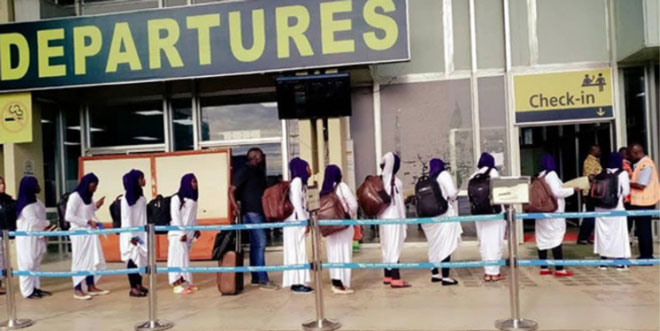
In this article “Uganda From Transatlantic Slave Trade to The New Transcontinental Slave Trade”, I want to write about the revival slave trade in modern times between Uganda and the Arab World in the Middle East. This is like a new interaction between the rulers of Uganda at the centre with the Arabs to sell humans as commodities.
Unlike before, the slaves of today willingly offer themselves and accept to be traded cash commodities. Also, unlike the slaves of long ago, the slaves of today are paid wages. The wages are dehumanizing, but provide social and economic relief to the slaves and their families. They have used the money they get to buy land, build houses, pay fees for their relatives. The thinking in government circles is that the export of labour has helped offset unemployment. The rulers do not see it as modern slavery. Those active in human labour export want labour externalisation to be distinguished from human trafficking, although those exported via human trafficking end up as workers in the Middle East or other countries.
The modern slaves, however, are victims of an unjust economy, which does not generate opportunities and jobs for young Ugandans equally but seems to do so for a small group of young people whose parents and kith and kin are integral to the present-day rulers who are ethnically related and connected to the Tutsi of Rwanda, Mulenge in the Democratic Republic of Congo (DRC) and Burundi.
The Uganda Government has registered many firms that export the slaves to the countries of Middle East, including United Arab Emirates, Qatar, Saudi Arabia, Oman, Kuwait, Yemen and Bahrain. The firms are collectively called Private Labour Recruitment Companies. In May 2024 Qatar alone cleared 20 Ugandan Labour export firms to conduct business. They include Security Link Ltd, Ham Property Services Ltd, BM Forex Limited, Atlas Impex Ltd, ABBA Placement Ltd, Optimal Manpower Placement Ltd, Ebbo Tigers Ltd, Shukran Habib Consultants Ltd, Khim International Consultants Ltd, Jag Security Jag Security Services Ltd, Labour World Connect and Six Stars International Ltd. It is likely thse firm operate across the Middle East.
In 2024, we learnt that the labour export market earned the Uganda government UGX 35 billion in two years. A year-on-year evaluation showed that export earnings increased from US$ 812.69 million (UGX 2.97 trillion) in July 2025 to US$ 1,248.12 trillion (UGX 4.55 trillion) in July 2025.
So, what point am I trying to make? The point is that the export of modern slave labour from Uganda to the Middle East, unlike between the 15th Century and the 18th Century has been institutionalised, with the Central Government rather than traditional-local powers benefiting from the trade. The government is making a lot of money from the firms exporting labour and from the individual slaves via remittances by the modern slaves. Remittances to Uganda last year grew to U$1.21 billion, boosted by receipts from labour exports to the Middle Eastern Arab World, which over the years have grown to eclipse some of the traditional remittance sources such as Europe, the USA and Canada (preliminary data from the Bank of Uganda). In an article in the Daily Monitor of 17 November 2025 by Tom Brian Angutini titled “UGANDA’S remittances projected to hit Shs 7 trillion by 2030”, it is shown that remittances will be a major source of income to Uganda; much higher than money given as aid by the traditional donor countries. According to NTV Uganda, the country received US$ 1.5 billion last year as remittances from the diaspora. Meanwhile, an article by Dorothy Nakaweesi in the Daily Monitor of 16 June 2025 and titled “Worrying Donor Inflows have declined by 84% in Two Years” indicates how the country is relying more on remittances from the Diaspora than on loans and grants from its traditional donors. Nakaweesi’s article, citing Bank of Uganda data reveals that in 2023, donor money fell from US$ 905 million in June 2023 to only US$ 146.4 million.
The cardinal question is: Why is donor money just trickling in? What has gone wrong?
If remittances are now far more significant than loans and grants, why doesn’t the government abandon loans and grants and rely on remittances to finance development? The country is already overburdened by debts. Uganda’s debt burden has significantly increased, reaching UGX 116 trillion (over US$ 30 billion) by mif- June 2025, equating roughly to 51% of the country’s GDP. Government’s assurances that the debt is still sustainable are increasingly convincing fewer and fewer Ugandans. On the ground, there is little to show in terms of development.
In conclusion, I have not deviated from the title of the article. I have just broadened my thinking in light of our current reality. The transcontinental modern slavery route to the Middle is bringing in a lot of money to the government of Uganda through taxation and remittances. The remittances from the Middle East will dominate the the remittaces portfolio of the projected US$ 7 by 2030. It is absolutely important that government learns to use the remittances wisely and step by step distances itself from incessant borrowing and misuse if money on consumptive and unproductive ventures. It is inconsiderate to push the payment of these debts to future generations of Ugandan. Make the economy productive enough to pay off the debts as we withdraw from borrowing any further. Meanwhile government should meaningfully and effectively provide quality public services to the people and make the creation of equitable employment a priority. Slavery is exploitation, which is an abuse of humanity.
For God and My Country.
This post was created with our nice and easy submission form. Create your post!

Written by
I am a retired lecturer of zoological and environmental sciences at Makerere University. I love writing and sharing information.
Did this story move you? Every gift goes directly to Oweyegha Afunaduula — writers on Muwado earn from reader appreciation, not algorithms. Even $1 makes a difference.






Muwado weekly chart
Get Africa’s top 10 stories every Thursday
No account needed — just your email.
Want to follow Oweyegha Afunaduula and get notified every time they publish?
Create a free Muwado account →