

 Ulokcwinyu Ubia

It is a beautiful day. I am tired for sure. My entire body aching from the weekend but guess who has to be the independent woman up to 5pm. It is me.
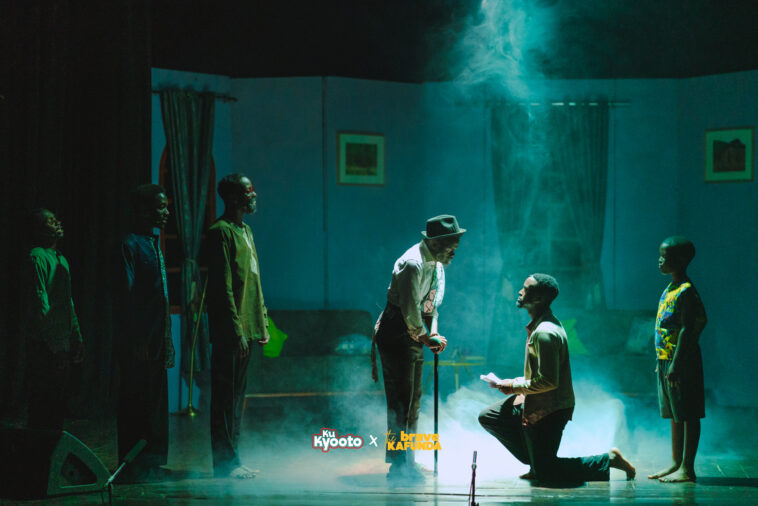
So, over the weekend, I was part of a team of young people who produced a beautiful production: Ku Kyooto at the Uganda National Theatre. For those who missed out, well, stay updated next time. And for those who could not make it, you missed a whole lot. Now, I love this production because the entire production team behind it is young people. Young people said, let us do this thing. Let us jump into the kitchen and cook. A lot went well and a lot did not go as planned, but the whole time, my mind was thinking about one thing – mentorship. This was also reflected in the production itself. Passing knowledge from one generation to another.
The Light That Is Not Being Passed
During the night when the production team was setting up lights, we had a very interesting conversation about mentorship with two brilliant gentlemen – Twinomugisha and The Ace (yes, I am naming names now). The conversation started from frustration. The Uganda National Theatre has just a handful of lights that actually function. And the person who controls these lights, the good sir, Mr. Okware Leonard, has been doing this for as long as many of us can remember. So the question came up: isn’t there anyone else who can actually do this job and let the good sir retire and enjoy the fruits of his youth?
That is probably a conversation we do not want to have.
But let us look at the facts. Micheal Kiwumulo (did lights for She Loves Me), Bob (did lights for Ku Kyooto), Mubiru Albert (did lights for ROPE), Jerry Kyaligonza (Collective UG), Lubwama Duncan (Phantom of the Opera), Ruth Nabushawo (a direct student of the good sir himself). We definitely have people. So why are we pretending we do not? From a pool of people that have proven themselves, we are lying to ourselves if we say none of them is good enough.
The Gatekeeping Backstage
Let us even leave the lights. Let us come backstage. We had two gentlemen – Hassan and Abbey. Resourceful is an understatement. These are the kind of people you want in your corner when things are falling apart. They stayed late, ensuring everything that needed to be set was set. But if you have ever worked backstage at the National Theatre, you know the struggle. The keys. The dressing rooms. The curtains. Convincing some of the older gatekeepers to simply do their job is close to making a chicken wear trousers.
And all this frustration reminded me of something that was once said by the founder of Vine Awards – that “young people just want us to go away.” In my head, I thought, no. We do not want you to wake up one morning and disappear. We want you to teach us. We want you to show us. We want to continue this thing that you call yours, so that one day, it becomes ours too.
Yes, there are a few young people who want the older generation gone. But they are not the majority. What is more dangerous is this culture of holding on to knowledge so tightly that if someone passed on today, their entire organisation would collapse with them.
Mentorship or Teaching?
This question followed me into another space: the ITI conversation about Women in Theatre. I asked a simple question: Would these organisations continue if their founders were no longer there? I got answers. I got reassurance. But there was a catch. The reassurance came from students of the founders. Not mentees. And there is a difference.
Let me break it down.
When I started my first paying job as coordinator of the Kampala International Theatre Festival, I hoped for mentorship. I imagined being under the wings of the Artistic Director, learning everything, maybe even one day stepping into that role. But with time, I realised – I was not being mentored. I was being taught. Important, yes. Valuable, yes. But different.
Then something shifted.
The Mentor I Did Not Expect
I found myself growing under the wings of the Line Producer – Rosette Nteyafas. This was different. This was not just about tasks or instructions. This was life. She invited me into her personal space. I observed how she lived, how she organised her thoughts, her home, her work. I picked up habits without even realising it – like always carrying a pencil bag with pens and sticky notes. I learnt when to speak. When to keep quiet. How to think before responding. How to exist in rooms. I know what she likes. I can order her a meal without asking. Now tell me – is this not mentorship?
According to The 15 Invaluable Laws of Growth by John C. Maxwell, mentorship is modelling. And I have seen it. You look at people like Alex Mukulu and Phillip Luswata.
Dr. Lillian Mbabazi and Mugume Linus. You can tell. Mentorship leaves a trace.
What a Mentor Actually Is
A mentor is available. Not just in theory, but in practice. If the person you call your mentor cannot meet you for coffee once a month, cannot check in, cannot show up, then we need to rethink the title. A mentor has wisdom. Not just spiritual, but emotional, psychological, practical. A mentor offers support and friendship. Not financial dependency, but a safe space for growth. A mentor is a coach.
I did not trust my ability to write. Or speak. Until mine started pushing me, reviewing my work, sending me opportunities, believing in me before I fully believed in myself. That changes you. And most importantly, a mentor lets you go when the time is right. If you are still permanently in their shadow, then you are a student. Not a mentee. Let us have a conversation when your name can stand on its own.
Your mentor is the one who fights for you to get out of their shadow and be your own person. To become even greater and better than them. To leave spaces and not settle for less. Another thing I have learnt, mentors do not tell you what to do. They guide you through what to do.
If there is not even one habit or behavior that identifies you to your mentor, then rethink the title you are giving them. There is no way that you are all over the place being a storyteller, a dj, an editor, a mental health advocate, an actor, a director all at once and yet your mentor is an aligned individual. Then you are not a mentee. You are their student.
The Dangerous Shift: Mentors Becoming “Parents”
As for those that start addressing their mentors as their parents… that is a whole different conversation. I am disturbed by it. Just recently, a presumed “mentor” gave advice to a director to make changes in a production after two of the shows had already been showcased. And I thought to myself – Where has this “mentor” been during the six months of rehearsal? How did they know about the production and not think to pass by even once? It is no surprise that they posted the poster a day before opening night, yet I know for a fact that they have a crowd they could have mobilised to support their “mentee.”
But what do I know? I am just a chaotic Gen Z.
Parentifying mentors places a burden on them. Now suddenly, they have another “son” or “daughter” to look after. And the mentees begin to expect special treatment because they have “Mummy…”, “Papa…”, “Uncle…” Do not even get me started on this culture in the church. People are obeying their “papas” more than the people who actually bore them and yet we wonder why independent thinking is dying in spaces that are supposed to nurture it.
Mentorship Is Not Ownership
Let me say this slowly for the people in the back: Mentorship is not ownership. A mentor is not a god. A mentee is not a disciple. The moment mentorship becomes control, fear, or unquestioned obedience, it stops being mentorship. If you cannot question your mentor, then what are you learning? Because we are not here to raise followers. Followers do not build systems.
The Cost of Not Letting Go
If your system cannot function without you, then you have not built a system. You have built dependency. And dependency is not legacy. Legacy is walking into a space and finding that everything still works even when you are not there.
So What Are We Really Afraid Of?
Are we afraid that young people will fail? Or are we afraid that they might succeed… and even do it better? Because from where I was standing this weekend, I saw young people figuring things out. Failing. Fixing. Adjusting. Delivering. I did not see incompetence. I saw hunger. I saw people who just needed access. Not even permission. Just access.
A Small, Honest Ask
To the ones who have held these spaces for years. We see you. We respect you. But we are here too. Not to replace you overnight. But to learn. To be trusted. To be prepared. Because one day, we will be the ones standing where you stand. And the question is, will we know what to do?
And To Us, The “Chaotic” Ones
Mentorship is not something you demand. It is something you honour. Show up. Do the work. Stay teachable – not blind. And when knowledge is given to you, do not hoard it.
In Closing
Maybe mentorship is not missing. Maybe it has just been misunderstood. Repackaged. Distorted. Gatekept. But real mentorship exists. I have experienced it. And that is why I will keep asking uncomfortable questions. Because I have seen what happens when someone chooses not just to teach you – but to walk with you.
So no, we do not want you to go away. We just want you to let us in and trust us enough to hand over the light switch.
@UlokcwinyuUbia.
This post was created with our nice and easy submission form. Create your post!

Did this story move you? Every gift goes directly to Ulokcwinyu Ubia — writers on Muwado earn from reader appreciation, not algorithms. Even $1 makes a difference.





Muwado weekly chart
Get Africa’s top 10 stories every Thursday
No account needed — just your email.
Want to follow Ulokcwinyu Ubia and get notified every time they publish?
Create a free Muwado account →