

 Rita Ngenzi

We speak often about impact.
We design programs, build initiatives, and convene ecosystems in its name. We measure it, report on it, and increasingly position ourselves around it.
But rarely do we ask the harder question.
At what cost, and to whom?
Beneath the language of impact lies a deeper tension. One that sits at the intersection of intention and structure, of mission and model.
Is impact truly aligned with business?
Or are we, in practice, quietly undermining both?
The assumption is that business thinking betrays impact. I want to suggest the opposite. That the real betrayal is what happens when we refuse to think that way at all.
And I believe how we answer that will define whether the ecosystems we are building on this continent endure, or simply perform.
We have professionalized impact. We have not sustained it.
Impact does not exist in isolation. It is produced, sustained, and scaled through interconnected actors, entrepreneurs, enablers, funders, and institutions. And like any system, its strength is defined not by individual effort, but by the resilience of the whole.
Across the African continent, this tension is not theoretical. Governments articulate bold visions for job creation, industrialisation, and inclusive growth. Continental frameworks like Agenda 2063 set ambitious targets. And the energy is real. Across every region, entrepreneurs are building, innovating, and proving that African enterprises can compete, grow, and endure.
The question is whether the ecosystems around them are keeping pace.
Impact is funded in cycles, delivered through projects, and evaluated on short-term outputs. Organizations are expected to demonstrate results, yet rarely equipped to sustain themselves beyond the lifespan of a grant.
We are building for impact without building for continuity. And I think it is time we named that honestly, not as a failure of intent, but as a failure of design.
Ecosystems are not built on programs. They are built on enterprises.
Programs create activity. Enterprises create continuity. They create jobs, tax revenues, and value that outlasts any intervention, contributing directly to the national agendas we serve.
Which raises the harder question: are we building ecosystems, or are we managing activity?
Supporting entrepreneurs is not the same as building the conditions for enterprises to emerge, survive, and scale. On a continent where the majority of jobs must still be created, where youth unemployment remains one of the defining challenges of our generation, the difference is not semantic. It is structural.
African entrepreneurs are not waiting. They are building anyway, often despite the gaps around them. I have seen this firsthand. The ambition is not the constraint. The ecosystem is.
And that means those of us who operate within it, as enablers, as funders, as institution builders, must ask ourselves honestly whether our designs are truly in service of the enterprises we exist to support.
There is a tension we rarely name directly.
If enterprises are expected to be sustainable, what about the institutions that support them?
Enablers often operate outside the same expectations they place on entrepreneurs. Within many support models, the pursuit of financial sustainability can quietly be perceived as a departure from mission rather than an extension of it.
I believe this framing is one of the most limiting in our sector.
Sustainability is not a compromise of mission. It is the precondition for it. An institution that cannot sustain itself cannot sustain the entrepreneurs it supports.
When support is structured around short-term deliverables rather than long-term institutional resilience, it becomes difficult to build the deep, locally-owned institutions that sustainable development requires.
The question is not who is responsible. It is what we are all willing to redesign.
And there are signs of progress. Blended finance instruments are evolving. Locally-led funds are emerging. Patient capital models are taking root. The architecture is shifting. But shifting is not enough. We need to shift with intention, with urgency, and with a shared commitment to building what lasts.
A system cannot produce what it does not practice. But a system that chooses to change its practice can produce something entirely different.
It is not enough to support entrepreneurs. We must think like them.
An entrepreneurial mindset, one that prioritizes sustainability, adaptability, and value creation, must extend across the entire ecosystem, not sit solely with the entrepreneur.
And that includes how we think about innovation.
In the African context, the most consequential innovations will not be new products. They will be new models. New ways of structuring capital for longevity. New ways of designing support that strengthens institutions rather than substituting for them. New ways of measuring success that reward continuity, not just outputs.
Because innovation is not only about what is built. It is about how systems adapt. And the systems that will define this continent’s next chapter are the ones being redesigned right now.
Sustainability is not a buzzword. It is a design principle.
It is embedded in how systems are structured, how incentives are aligned, and how value is created and retained over time.
Too often, we fund impact as an activity, not as a system. And until we change that, we will keep producing results that impress in the short term and disappoint over time.
Every grant structured around outputs over sustainability, every program designed without an exit strategy, every institution built on the assumption that the next funding cycle will come, these are design choices. And design choices can be changed.
The potential of this continent is not in question. It never has been. What is in question is whether we are building structures worthy of that potential.
So we return to the central question.
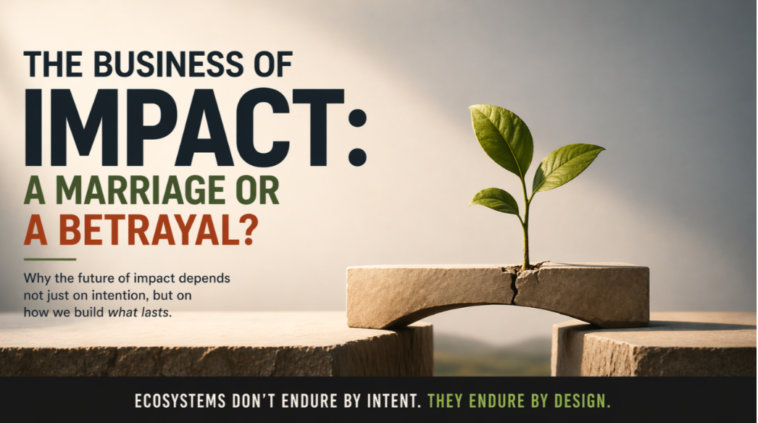
Is the business of impact a marriage, where purpose and sustainability reinforce each other, creating something more durable than either alone?
Or is it a betrayal, where in the relentless pursuit of impact, we neglect the structures that make impact possible?
My honest answer is this: right now, for too many actors in too many ecosystems, it is closer to a betrayal. Not out of bad faith. But out of habit, out of structure, and out of a collective reluctance to redesign systems that are familiar even when they are failing.
But the marriage is already happening. In the entrepreneurs who refuse to wait. In the enablers who are building differently. In the funders who are asking harder questions about what their capital is actually producing.
Impact designed for sustainability compounds over time. Systems built to last create the conditions for transformation. Ecosystems rooted in strong, locally-owned institutions become engines of national development.
The work now is to make that the norm, not the exception.
Not just for the duration of a grant cycle. Not just long enough to report on. But long enough to matter. Long enough to root. Long enough to belong to the continent that made them.
What would it look like if the institutions enabling impact were held to the same standards of sustainability as the enterprises they support?
I think it is time we found out.
This post was created with our nice and easy submission form. Create your post!

Written by
Ecosystem Builder I Innovation Strategist I Advancing Africa’s Entrepreneurship, Innovation, and Creative Economies
Did this story move you? Every gift goes directly to Rita Ngenzi — writers on Muwado earn from reader appreciation, not algorithms. Even $1 makes a difference.






Muwado weekly chart
Get Africa’s top 10 stories every Thursday
No account needed — just your email.
Want to follow Rita Ngenzi and get notified every time they publish?
Create a free Muwado account →