

 Ochieng Umira

On the eve of Rwanda’s Liberation Day, Africa once again finds itself trapped in a familiar conversation. We speak endlessly about what lies beneath our feet, our minerals, our oil, our fertile land, our untapped wealth.
But perhaps we have been asking the wrong question.
Civilizations are not remembered for what they extracted from the earth. They are remembered for what they built upon it.
The true measure of a nation’s liberation is not the abundance of its natural resources, but the quality of the systems it creates. Wealth buried underground may attract investors. Institutions built above ground attract the future.
That is where Rwanda quietly changes the conversation.
While many still look at Africa as a continent of unrealized potential, Rwanda has chosen something far more ambitious. It has transformed itself into a place where imagination no longer needs computer-generated effects.
Consider this for a moment.
Every year, Hollywood spends millions constructing futuristic cities inside studios in London, Atlanta, and other global production hubs. Entire skylines are digitally rendered. Streets are fabricated. Landscapes are enhanced with visual effects to portray a world that does not yet exist.
Yet in the heart of East Africa stands a city that already feels like tomorrow.
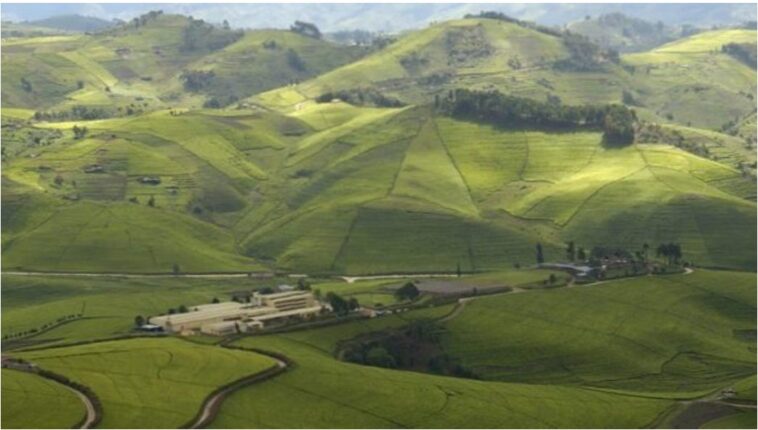
Imagine a camera gliding across Kigali. Clean architectural lines emerging through the morning mist. Green volcanic hills embracing a skyline that appears almost too deliberate to be real. Wide roads. Order. Symmetry. Light. It resembles the opening sequence of a high-budget science fiction film.
Except nothing is computer generated.
It is simply Rwanda.
Infrastructure Is the New Currency
For decades, much of the global film industry viewed Africa through a narrow cinematic lens. The continent became the setting for conflict narratives, humanitarian documentaries, wildlife expeditions, or stories that rarely reflected its complexity.
Rwanda is rewriting that script.
It is positioning itself not merely as another beautiful filming destination, but as Africa’s most reliable cinematic production ecosystem.
And here lies the lesson that many African nations should study carefully.
Rwanda’s greatest competitive advantage is not its breathtaking scenery.
It is its predictability.
Natural beauty captures attention.
Infrastructure secures investment.
When a global production worth tens or hundreds of millions of dollars selects a filming location, executives are not making decisions based solely on landscapes. They are evaluating certainty.
Can expensive equipment arrive on time?
Can international crews move efficiently?
Will permits be issued without bureaucratic uncertainty?
Can production schedules remain uninterrupted?
Can data be transferred instantly across continents?
Through the Rwanda Film Office, Rwanda has steadily built an ecosystem designed to answer these questions with confidence rather than hope.
Its advantages extend well beyond aesthetics.
• A secure environment where international casts, crews, and high-value production equipment can operate with confidence.
• Transparent and efficient permit systems that replace uncertainty with predictability.
• High-speed digital infrastructure that allows footage captured in Musanze to be uploaded to production servers in California or Europe before the day’s shoot has even concluded.
• A national culture of order, reflected in practices such as Umuganda, where collective responsibility becomes visible infrastructure. Clean streets, functional public spaces, and disciplined urban management are not cosmetic achievements. They reduce friction, protect production timelines, and communicate reliability.
This is not simply good governance.
It is economic strategy.
The Lesson Africa Cannot Afford to Ignore
There is a deeper lesson here, particularly as Rwanda commemorates its Liberation Day.
Africa has never lacked beauty.
Africa has never lacked talent.
Africa has never lacked stories.
What has often been missing is institutional predictability.
Possessing magnificent mountains, pristine coastlines, dense forests, or extraordinary wildlife is no longer enough. Geography may inspire filmmakers, but systems determine where they invest.
If customs procedures delay equipment…
If permits become unpredictable…
If security cannot be guaranteed…
The production simply moves elsewhere.
Capital is attracted not only by opportunity, but by confidence.
This is why infrastructure has become the new natural resource.
The global film industry is far more than entertainment. It is a sophisticated economic engine.
One international production activates dozens of sectors simultaneously. Local carpenters construct sets. Caterers feed hundreds of crew members. Hotels accommodate international visitors. Drivers transport equipment. Designers, technicians, editors, electricians, costume makers, digital artists, security personnel, and countless small businesses all become participants in a single creative economy.
Film transforms geography into sustained economic value.
A beautiful landscape is an asset.
An organized nation transforms that asset into an industry.
As Rwanda reflects on its extraordinary journey of resilience, unity, and national renewal since Kwibuka, it offers Africa a broader definition of liberation.
Liberation is not merely freedom from the past.
It is the capacity to build institutions that make the future possible.
A nation truly owns its narrative when it creates an environment where the world comes not to extract, but to create.
So perhaps the question is no longer why Hollywood keeps imagining futuristic worlds.
Perhaps the real question is this:
If the future already has a filming location, why are we still building it somewhere else?
Visit Rwanda. The set is already built.
This post was created with our nice and easy submission form. Create your post!

Written by
I am a film scholar and educator investigating the convergence of digital technology, media policy, and creative economics in Africa
Did this story move you? Every gift goes directly to Ochieng Umira — writers on Muwado earn from reader appreciation, not algorithms. Even $1 makes a difference.






Muwado weekly chart
Get Africa’s top 10 stories every Thursday
No account needed — just your email.
Want to follow Ochieng Umira and get notified every time they publish?
Create a free Muwado account →