

 Oweyegha Afunaduula
Introduction
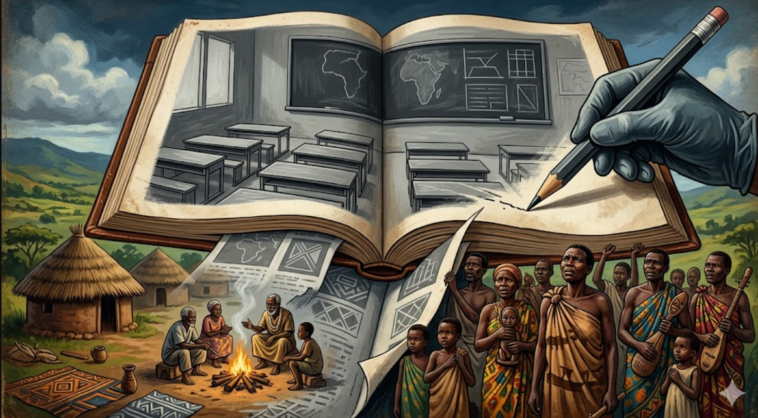
Education is universally championed as a tool for liberation, a pathway out of poverty, and a cornerstone of modern state-building. For the indigenous peoples of Uganda—including the Batwa (Twa), the Karamojong cluster, the Benet (Ndorobo), the Ik, and others—formal education has functioned as a weapon of assimilation, cultural erasure, and structural dispossession. The classroom, from the colonial era to the present, has been a deliberate instrument of state policy to suppress indigenous languages, delegitimise traditional knowledge, and consolidate political control. This weaponisation did not occur in a vacuum. It was forged in the violence of the Ugandan Bush War (1981–1986), which claimed an estimated 50,000 to 300,000 civilian lives, primarily in the Luwero Triangle, an area that was once the food basket of Buganda. This was followed by a brutal counterinsurgency in northern Uganda against the Lord’s Resistance Army, which led to the displacement of over 400,000 people and the deaths of tens of thousands more. It was within this cauldron of state violence—exemplified by events such as the 1989 Mukura massacre, where over 60 people were suffocated in a railway wagon by the National Resistance Army (NRA)—that a compliant, centralised, and punitive education system was forged.
The Architecture of Weaponisation
The weaponisation of education operates through a series of interconnected mechanisms that, together, form a coherent strategy of domination.
Privatisation of Public Education: Who Gains, Who Loses
Since the 2000s, Uganda has seen a significant expansion of private education, often filling the gaps left by an underfunded public system. Secondary schools have been “largely privatised, and are mostly available for wealthier segments of the population”. For indigenous peoples, this privatisation is a double-edged weapon. Private schools, driven by market logic, aggressively promote English at the expense of indigenous languages, viewing them as obstacles to employability. Furthermore, hidden fees and development levies exclude many indigenous families. As the UN Committee on Economic, Social and Cultural Rights has noted, the “uncontrolled development of private education in Uganda is resulting in discrimination, particularly for the most marginalized groups”. The losers are indigenous communities who see their children return from school unable to speak their mother tongue and ashamed of their heritage. The winners are political elites and private contractors who profit from a system that prioritises assimilation over genuine learning.
Massification of Education: UPE and USE as Instruments of Control
The introduction of Universal Primary Education (UPE) in 1997 and Universal Secondary Education (USE) in 2007 was hailed as a pro-poor policy. For indigenous communities, however, massification has deepened the weaponisation of schooling. It has forced enrolment without cultural adaptation, criminalised absenteeism during essential seasonal activities, and standardised an assimilationist curriculum. The state has used UPE/USE as a pretext to close small, community-run indigenous schools, thereby eliminating alternatives. The result, as critics have noted, is an education system that “celebrates enrolment numbers, not retention or learning”. Indigenous children are failed by the system, then blamed for their own failure.
Democratic Backsliding, Authoritarianism, and Academic Freedom
The erosion of democratic governance in Uganda is mirrored within its educational institutions. Democratic backsliding has meant that there is little recourse for indigenous parents who protest against cultural erasure. School management committees, once containing parent representatives, are now often appointed by local officials loyal to the ruling NRM. Within universities, academic freedom—a constitutional right under Article 29(1)(b)—is under sustained attack. At Makerere University, academics have been investigated, and administrators have sought to stifle public lectures and debates on contentious issues, creating a culture of fear and self-censorship. This authoritarian environment ensures that scholars who wish to research or teach indigenous knowledge systems face harassment and professional marginalisation. The state thus ensures that universities produce graduates who view indigenous peoples as problems to be solved, rather than knowledge-holders to be learned from.
De-Philosophising Education and the Denial of Indigenous Epistemologies
A crucial but often overlooked weapon is the deliberate de-philosophising of education. The system has been stripped of foundational questions about purpose, ethics, and the good life, reduced instead to a narrow, technical training for labour markets. This is a political weapon because it removes the very language needed to critique the system. Without an educational philosophy, it is impossible to ask: “Whose knowledge counts? What is a meaningful life for a Batwa child?” This erasure is reinforced by a rigid dichotomy between the arts/humanities, social sciences, and natural sciences. Indigenous knowledge systems are inherently transdisciplinary—a Batwa healer’s practice involves botany (natural science), social organisation (social science), and oral poetry (humanities). The university system forces students to choose one, thereby destroying the holistic nature of indigenous learning and delegitimising it as “unscientific.”
Ideological Consolidation and Education for Politics
The Ugandan education system is explicitly used for ideological consolidation, producing citizens loyal to the ruling NRM. History syllabi glorify the 1986 “liberation war” while omitting the state’s own massacres. Civic education teaches that “development” requires abandoning pastoralism and hunter-gatherer life. Education for politics is a hidden curriculum that teaches indigenous children that politics is something done to them, not something they can do. They are not taught to advocate for their rights under the UN Declaration on the Rights of Indigenous Peoples; they are taught to be passive citizens. A Karamojong child learns that his pastoralist ancestors were “warlike,” while a Batwa child never reads about Batwa cosmology. This is not a failure of design but its success.
State House Control and Party Funding
The most direct weaponisation occurs through State House control over education policy and funding. Since 2016, “policy choices have increasingly come from the State House (read Kaguta and Janet Museveni), not the Ministry of Education. This fusion of political family and technical sector has blurred the line between governance and party control”. Scholarships for indigenous students are distributed through NRM party structures, not through independent merit-based systems. The National Secretariat for Patriotism Corps (NSPC) runs camps where children learn military drills and loyalty to the president, while traditional indigenous leadership is ridiculed. By tying education funding to political loyalty, the state ensures that any indigenous community that resists assimilation is starved of resources.
Case Studies: The Human Cost of Weaponised Education
· The Batwa of the South-West: After their eviction from Bwindi, Mgahinga, and Echuya forests in the 1990s—to create national parks for mountain gorillas—Batwa children entered a school system that taught them to despise their heritage. Teachers called them “backward pygmies.” The curriculum celebrates the same forests as “wilderness without people,” erasing Batwa history as the original inhabitants. The result has been a near-total loss of intergenerational transmission of forest-based knowledge, a classic case of epistemicide.· The Karamojong Cluster: Under military-led disarmament campaigns, formal education has been used to enforce sedentarisation. Schools punish the speaking of Ngakarimojong and teach that livestock herding is “backward.” As a 2022 study in World Development concludes, formal education in Karamoja has “led to multiple forms of violence, aid paradoxes and dead ends”.· The Mukura Massacre: On July 11, 1989, the 106th battalion of the NRA rounded up 300 men from the Teso sub-region, suspected of being rebel collaborators. They were incarcerated in a railway wagon; by the time the doors were opened, 69 had suffocated to death. This event, which the government later described as a “tragic accident”, serves as a brutal metaphor for the suffocation of indigenous and local opposition. The government built a memorial secondary school at the site, a gesture of reparation that many survivors feel was implemented “with little involvement and consultation of the victims”.
Conclusion
The evidence is overwhelming: education in Uganda has been systematically weaponised against the country’s indigenous peoples. It is not a series of unfortunate failures, but an integrated system of domination—from the colonial classroom to the NRM’s State House. UPE and USE were not benign expansions but vehicles for deeper state penetration into indigenous homes. Privatisation did not bring choice but profit-driven assimilation. Democratic backsliding and authoritarianism have silenced dissent, while the de-philosophising of education has removed the very language of critique. Resistance, however, persists. Community-led schools like the Tat Sat Community Academy are “challenging inherent inequities in the nation’s education system by making indigenous knowledge… an integral part of education”. The path forward is not the abolition of formal education, but its radical decolonisation, its re-democratisation, and its re-philosophisation. Until then, the classroom will remain what it has been for over a century—a weapon, not a window.
—
Reference List
- Akena, F. A. (2008). The impact of civil war on education: A case study of Acholiland, northern Uganda (Master’s thesis). University of Toronto.
- Bernard, P. (2016). The politics of the Luweero skulls: The making of memorial heritage and post-revolutionary state legitimacy over the Luweero mass graves in Uganda. Journal of Eastern African Studies, 11(1), 188-209.
- FairPlanet. (2022). Defying colonialism through indigenous knowledge.
- GI-ESCR. (2014, December 22). UN Committee raises issues on the impact of privatization in education on the realization of the right to education in Uganda.
- Global Security. (n.d.). Uganda Civil War.
- Human Rights Watch. (2007). “Get the Gun!”: Human Rights Violations by Uganda’s National Army in Law Enforcement Operations in Karamoja Region.
- Justice and Reconciliation Project. (2011). The Mukura Massacre of 1989, FN XII.
- Kazibwe, D. (2022). Lost in transition? Modernization, formal education and violence in Karamoja. World Development, 158, 106013.
- Minority Rights Group International. (2023). Karamojong and related groups in Uganda.
- Mukasa, N. (2021). The Batwa Indigenous People in Uganda and their Detachment from Forest Livelihood: Land Eviction and Social Plight. PhilPapers.
- Observer. (2025, October 31). The cost of peace in Uganda’s election season.
- Uganda Radio Network. (2026, February 14). Kabumba Protests Threats To Academic Freedom At Makerere.
- Wikipedia. (n.d.). Ugandan Bush War.
This post was created with our nice and easy submission form. Create your post!
Written by
I am a retired lecturer of zoological and environmental sciences at Makerere University. I love writing and sharing information.
Did this story move you? Every gift goes directly to Oweyegha Afunaduula — writers on Muwado earn from reader appreciation, not algorithms. Even $1 makes a difference.




Muwado weekly chart
Get Africa’s top 10 stories every Thursday
No account needed — just your email.
Want to follow Oweyegha Afunaduula and get notified every time they publish?
Create a free Muwado account →