

 Dr. Vijayakumar Parameswaran Unnithan
My Career Architect had given me only a name and an address. “Go and spend an afternoon with him,” he said. “Don’t take notes. Just watch how he looks at things.” I arrived at the studio with the particular anxiety of someone between careers, that hollow, unlit feeling of having stepped out of one story before the next one had begun. The guard was expecting me and directed me down a long corridor toward a meeting room at the far end.
What the walls said first
I walked slowly. The walls on either side held what I can only describe as his evolving life’s work made visible. Many framed shots from films, innumerable national and international awards and citations, including the Pierre Angénieux ExcelLens in Cinematography, and photographs taken on location in places as different as a Kerala backwater and a Himalayan ridge. The faces of actors caught mid-expression. The particular quality of light in each image, warm in one, severe in another, golden in a third, different in every frame, and yet unmistakably the work of the same eye. By the time I reached the door at the end of the corridor, I understood that my Career Architect had sent me somewhere I had not fully prepared for. I knocked, still not entirely sure what the man who had lit some of India’s and the world’s most celebrated films could possibly offer someone whose own story had, for the moment, lost its light.
Shambhu was standing at the far end of the room. He was not looking at me but at the wall beside the window, where the afternoon light was entering at a low angle, casting a long shadow from the window frame across the plaster, here and there filled with spackle. He did not turn immediately. He seemed to be reading something in that shadow that I could not yet see.
“Sit,” he said, without looking away from the wall. “Watch this for a moment.”
The shadow moved almost imperceptibly as the sun shifted. The wall, which had seemed flat and unremarkable when I entered, slowly acquired depth. A ridge of light here, a fold of darkness there, the plaster and the spackle becoming, in that slow minute, a landscape.
“Same wall,” he said finally, turning to face me.
“Different light. The wall has not changed; the context has.
And the context,” he said, settling into his chair, “is not the background. It is a character.”
“It is the darkness and the light, together, that create life. We do not collapse in the face of darkness. We wait — but not passively. We wait with our eyes fully open, reading what the darkness is offering.”
“You are worried about a transition,” he said. It was not a question. “You think the story has ended, and you are standing in the dark between scenes.”
“Yes,” I said. “Good,” he said. “Darkness is not the absence of the story. It is where the story breathes.”
The why that shows you the frame
He told me about a film he had shot early in his career. The central character was named ‘Surya’, the Sanskrit word for the sun, a name that carries within it an entire chromatic world. Gold, amber, the deep orange of late afternoon, the white blaze of noon. He had not planned to let the name influence his palette. But once he noticed the connection, almost by accident, in a production meeting where someone read the name aloud, he felt something shift. He could not unnotice it.
“The colour scheme of the entire film came from a name,” he said, with the mild wonder of someone who has told this story before but still finds it strange.
“Not from the script. Not from the director’s brief. From an unrelated detail that nobody had flagged as significant.”
He looked at me. “Where are you looking for your next direction?”
I mentioned the obvious places. Industry reports. The advice of people in adjacent roles. He listened without expression.
“Those are the script and the director’s brief,” he said.
“Useful. But they will only show you what is already visible. The colour scheme comes from somewhere else. From the detail nobody flagged, from the question you keep asking that nobody has answered yet.”
He paused. “What is the question you keep asking?”
I found, to my surprise, that I knew the answer immediately. Not as a professional agenda or a research interest, but as something quieter and more persistent. A question I had been circling for years in margins and conversations and moments of stillness, without ever treating it as a signal worth following.
I told him.
He listened without interrupting. Then he was quiet for a moment.
“That,” he said, “is your colour scheme.”
Then he said something I had not expected.
“But before I ask what the question is, I ask something else first. Who is this work for? Not the producer, not the audience in the abstract, but someone specific. Someone whose seeing I trust, whose life I want to touch.”
He let that settle. “When you dedicate the act of creation to a person you value, the work changes. It stops being about execution. It becomes an offering.”
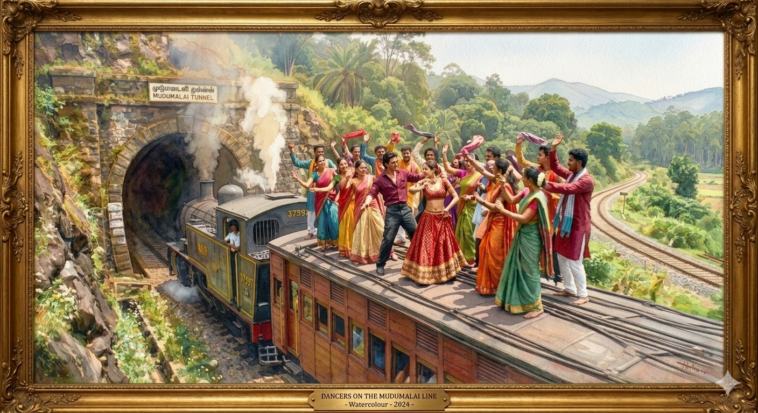
“And then the why,” he continued. “Not what, not how, but why. I once had to shoot a song on a moving train. Dancers on the roof. Open sky. Landscape rushing past. Everyone was asking how, how do we rig the cameras, how do we manage the wind, how do we keep the dancers safe. He smiled.
“I was asking something different. Why are we doing this on a train? Once we found that—because we wanted to capture the nostalgic feeling of a first train ride, the madness—everything else followed. Then I knew the tunnel, the train coming out of the tunnel was important”. In that particular mixture of speed and wonder, the world suddenly became larger than it was.
“Once you answer that, why, the train becomes a stage. The tunnel becomes a held breath between moments of light. The landscape becomes a character. The why does not just motivate you. It shows you the frame before the camera arrives.”
Flexibility is the condition of momentum.
Late in the afternoon, he described a shot that had become something of a legend among people who study his work. A top angle, looking directly down on two men, reduces them to figures in a larger geometry, making visible the forces moving around them that neither could see from where they stood.
“The director wanted eye level,” he said. “Intimate. Two men are talking. But what the scene was actually about power, the way it moves above individuals, indifferent to them. You cannot see that from eye level. You have to be willing to leave the comfortable position.”
He leaned forward slightly.
“Most people in transition are doing exactly this, insisting on eye level. Staying with the perspective that was comfortable in the previous scene. But sometimes the scene has changed, and the old angle no longer shows what is true.”
He stood and walked to the window. The light had changed again. The long shadow was no more, and the wall was now a warm, even amber, the particular colour of late afternoon just before the sun drops behind the buildings.
“I never fight the available light,” he said, looking out. “I read it. I ask what it is offering today, in this place, at this hour. And then I work with what is there.” He turned to look at me.
“Your career is the same. The light you have right now, the particular combination of what you know, where you are, the question you keep asking. That is not a problem to be solved. It is the available light. Read it.”
“And when it changes?” I asked.
“It will always change,” he said. “That is what light does. Challenges do not interrupt the work. They give it momentum. Without the resistance of the shot that will not work, you never find the shot that does. Transitions are not the darkness between scenes. They are the interval in which the next frame is being composed.”
Career Frames
I left the studio as the city outside was moving into its own transition. That brief, irreplaceable interval between afternoon and evening when the sky is neither one thing nor the other, and everything it touches is briefly, extraordinarily beautiful. I left with something I had not known I was looking for. A way of seeing that made the question of next moves suddenly feel like the wrong question entirely. A career, I began to understand, is not a path to be followed. It is more like a film to be made, frame by frame, in the available light, with the courage to ask why before asking how, and the willingness, always, to leave the comfortable angle when the scene demands something truer.
About the Author: Dr. Vijayakumar Parameswaran Unnithan is a scholar- practitioner working at the intersection of career theory, employability, and organisation development. He is the originator of the Post-Skill Professional (PSP) Framework and Career Architect at Careertotus Consultants Pvt Ltd. He is the President of Asia Organisation Development Network (AODN) and publishes in leading management journals. Views are Personal. This piece draws its inspiration from an insightful conversation between world-renowned and legendary cinematographer Santosh Sivan and RJ Shalini. PIc Credits-Nano Banana2.
This post was created with our nice and easy submission form. Create your post!

Written by
Did this story move you? Every gift goes directly to Dr. Vijayakumar Parameswaran Unnithan — writers on Muwado earn from reader appreciation, not algorithms. Even $1 makes a difference.




Muwado weekly chart
Get Africa’s top 10 stories every Thursday
No account needed — just your email.
Want to follow Dr. Vijayakumar Parameswaran Unnithan and get notified every time they publish?
Create a free Muwado account →