

 Dr. Vijayakumar Parameswaran Unnithan

On a quiet man from Kerala, India, who eats his lunch — and moves the world
He does not announce the meal. There is no dramatic reveal, no breathless countdown, no performance of joy manufactured for a waiting audience. Unni simply sits down, pours lentil curry over steaming red rice, mixes it with his fingers in that practiced, unhurried circular motion, and eats. And somehow, across Kerala and the Gulf and a thousand distracted afternoons, tens of thousands of people cannot look away.
What the screen holds still
Kerala is a narrow coastal state at the southern tip of India — a land of coconut palms, backwaters, monsoon rains, and one of the world’s oldest spice trading traditions. Its people speak Malayalam, one of the classical languages of India, lyrical and ancient, with a literature stretching back a thousand years. And among the many things Malayalees carry with them wherever they go in the world, to the cities of the Gulf, to London flats, to rain-drenched hostel rooms in Bengaluru, a city in the South of India, nothing travels as faithfully as the memory of a proper meal eaten at home.
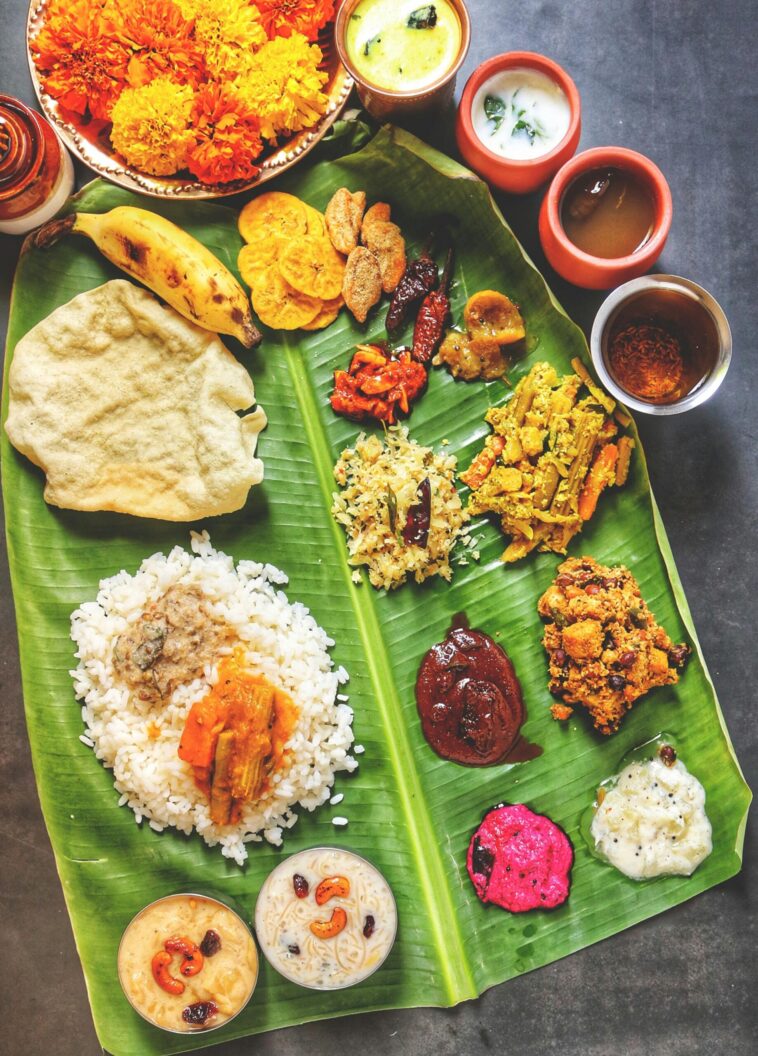
That meal has a name in Malayalam- Oonu. A more elaborate version of Oonu is also known as Sadya. And to understand why Unni has become a phenomenon, you need to understand what an oonu means to those who grew up eating one. It is not merely lunch. It is a sequence or almost a ceremony. There is a specific order in which the dishes arrive on the banana leaf that serves as the plate. First, the golden lentil curry poured over steaming red rice, then the tamarind-spiced vegetable broth, the cool yoghurt curry, the sharp little relish of ginger and jaggery. The hand mixes it all together in a practiced circular motion that every Malayalee learns before they learn to write. There is a moment of stillness before the first morsel. And at the end, if the meal has been right, there settles on the face an expression that Malayalam has a word for- thripthi. It means contentment, but carries something more precise than contentment- the particular satisfaction of a hunger that has been met with exactly the measured combo.
It is another busy day for Unni. He is not, at first glance, anyone remarkable. Simply a Malayalee man sitting down to his lunch, as millions do every afternoon across Kerala. But something in the way he eats caught the world’s attention. He ate mindfully, filmed himself doing it, posted it on Instagram — and within months had drawn 65,000 followers to watch a man eat his lunch. Today, he is a social media celebrity and sought-after brand ambassador for some of Kerala’s most beloved names. The journey from that first quiet meal to this covered a distance no career counsellor could have mapped.
These videos of Unni and his meal contain no background music. None is needed. Only the clink of a steel plate, the soft sound of rice being mixed, the natural acoustics of a home kitchen. For the Malayalee eating a reheated lunch at a London desk, or answering emails through their meal in a glass-walled office in the city, these are the sounds of home. A sentiment repeated endlessly across his comment sections captures what his followers feel better than any metric. “If you see him eating, you will feel hungry even if you have just finished a full meal.”
In a digital landscape built for spectacle like food challenges, amplified theatrics, and content creators performing ecstasy at every bite, Unni has built his following by doing precisely the opposite of what the algorithm supposedly demands. He is quiet. He is present. He looks, above all else, like a man who is genuinely, completely happy with his lunch.
“That happiness, it turns out, is the rarest thing on the internet.”
Witnessed joy
A mother once told him that her daughter had not been eating properly for months. After watching his videos, the child began to eat again. Unni received the compliment with characteristic quietness. Then he said something that stopped the room. He spoke from the heart, “Even I feel like eating again when I see the way I eat my food.”
Sit with that for a moment. A man watches himself eat and feels hungry. Not from vanity, but because what he captures on camera is something genuinely, irreducibly alive. The joy was not produced for the lens. It existed before the lens arrived, and it survived the editing process intact. What that daughter responded to was not a video. It was an invitation to sit down, slow down, and remember that eating is not a task to be completed between notifications. It is, or can be, one of the small daily celebrations of being alive.
The Career Architect would recognise this immediately. The girl was not restored by instruction or nutritional advice or the careful design of a behaviour-change programme. She was restored by witnessing, by watching one person’s unguarded, unhurried pleasure in an ordinary thing, and finding in that witnessing the permission to feel the same.
Joy, when it is real, does not stay on one side of a screen.
What rūci looks like from the outside
Here is where Unni’s story becomes unexpectedly instructive — not just for marketers, but for anyone thinking about work, identity, and what a career can look like.
He eats lunch. He has always eaten lunch. Everyone eats lunch. The activity is the most ordinary thing imaginable. Repeated, unremarkable, taken for granted by every human being on the planet. And yet, through the alchemy of attention, technology, and an audience’s imagination, this daily act has become something else entirely. A craft, a livelihood, a cultural statement, a healing practice.
Unni did not retrain. He did not pivot, rebrand, or identify a market gap and strategically fill it. He paid deep attention to something he already loved, allowed technology to carry it outward, and let the audience complete the story. The gap found him.
Sanskrit, the ancient classical language from which Malayalam draws much of its philosophical vocabulary, has a word that illuminates exactly what happened- rūci. In Sanskrit, rūci has two meanings that, on reflection, are the same. It is taste — the educated palate that knows, after years of exposure, exactly what a meal should feel like in the hand before it reaches the mouth. And it is a deep inclination, the pull toward a form of work that feels, at some fundamental level, like you. Both are developed in the same way. Not by strategy. Not by instruction. But by repeated, attentive encounter with the thing itself. Exposure, over time, can become discernment. Discernment can, over time, become a vocation.
This is why the child who watched Unni eat was learning more than just about appetite. She was watching what rūci looks like when it has been fully inhabited. When the taste for a thing and the devotion to a thing have become indistinguishable. Unni is not illustrating the concept. He is the concept.
“What his audience is responding to is not technique. It is a vocation. And vocation, it turns out, is extraordinarily difficult to fake — and extraordinarily powerful when it is real.”
The brands that have found him understand this intuitively. A dairy cooperative featuring Unni pairing their curd with a traditional Kerala meal drew more engagement than campaigns fronted by film stars. A heritage rice brand, a local electronics retailer, a chicken brand rooted in a four-decade-old recipe — each partnership succeeded for the same reason. Nobody asked Unni to become something he is not. They are not buying his reach. They are buying the trust he has accumulated by never pretending to be anyone other than himself.
Career Unlimited
The most sustainable professional identity, his story quietly argues, is not built by reading the market and positioning yourself within it. It is built by going so deep into what is genuinely yours that the market eventually has no choice but to find you. But this is not passivity. It requires a continuous, attentive sensing of the environment. Not to be swept away by it, but to move with it, to find the precise moment when what is deeply yours and what the world is ready for finally come into contact. Unni did not retreat from the world to eat his lunch. He brought his full self to it and waited, with confidence, for the world to arrive at his table.
Most people spend their careers searching for the work that carries this quality. The work that feels, at the bone, like you. Unni found it at the lunch table. He sat down. He mixed his rice. He was present, completely and without apology, in the most ordinary moment of the day. And in being so, in refusing, meal after meal, to be anywhere other than exactly where he was, he became extraordinary. His rūci for food and his rūci for living were always the same thing. It simply took the rest of us time to see it. The hunger he awakens is not only for food. It is for that quality of presence itself, the reminder that the ordinary, attended to with love, does not stay ordinary for long.
About the Author Dr. Vijayakumar Parameswaran Unnithan is a scholar- practitioner working at the intersection of career theory, employability, and organisation development. He is the originator of the Post-Skill Professional (PSP) Framework and Career Architect at Careertotus Consultants Pvt Ltd. He is the President of Asia Organisation Development Network (AODN) and publishes in leading management journals. Views are Personal. Inspired by the story of https://www.instagram.com/mkbijith/ Picture credit: pexels.com
This post was created with our nice and easy submission form. Create your post!

Written by
Did this story move you? Every gift goes directly to Dr. Vijayakumar Parameswaran Unnithan — writers on Muwado earn from reader appreciation, not algorithms. Even $1 makes a difference.





Muwado weekly chart
Get Africa’s top 10 stories every Thursday
No account needed — just your email.
Want to follow Dr. Vijayakumar Parameswaran Unnithan and get notified every time they publish?
Create a free Muwado account →