

 Ochieng Umira

“If we should take ethnic, racial or linguistic criteria for modifying our boundaries, a good many states in Africa would be wiped off the map.” — President Philibert Tsiranana of Madagascar
A calendar date is a human invention.
Yet on June 30,2026 an arbitrary deadline created a very real humanitarian crisis across South Africa.
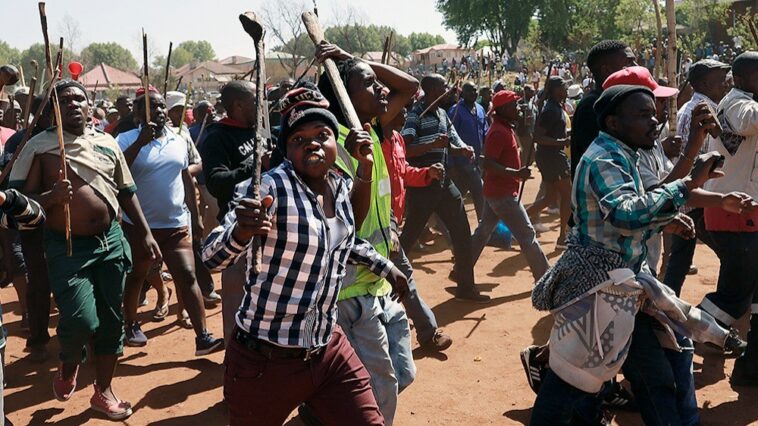
Driven by vigilante pressure groups demanding that undocumented migrants “self-deport,” June 30 became more than a date. It became a psychological border. Although the South African government rejected the deadline, declared it an ordinary working day, and deployed security forces to maintain public order, thousands of Malawian, Mozambican and Zimbabwean nationals fled simply because fear had become more powerful than the law.
But if we are honest, June 30 did not create Africa’s xenophobia.
It merely exposed it.
The deeper question is not why xenophobia exists.
The deeper question is why, sixty years after independence, Africans increasingly fear fellow Africans more than the colonial borders that once divided them.
We Have Been Asking the Wrong Historical Question
For decades, the dominant explanation for Africa’s conflicts has been that European colonial powers drew artificial borders that ignored ethnic, linguistic and cultural realities.
There is truth in that argument.
Colonial borders undoubtedly created long-term structural challenges.
But that explanation is no longer sufficient.
The uncomfortable question we rarely ask is this:
What did African leaders do with those borders after independence?
Immediately after independence, African leaders made a conscious decision through the Organization of African Unity to preserve the inherited colonial boundaries. The decision was pragmatic. Redrawing every border risked plunging the continent into endless territorial wars.
History may ultimately judge that decision as necessary.
But preserving colonial borders was only the first decision.
What African governments built inside those borders became the second.
Too often, post-independence states evolved into systems where political power controlled economic opportunity. Across many countries, vast natural resources coexisted with persistent poverty, weak institutions, corruption and elite enrichment. Colonialism remained a historical burden, but in many cases it also became a permanent political explanation for failures that were increasingly domestic in origin.
When governments fail to fulfil the social contract, societies begin searching for someone to blame.
The easiest target is rarely the most responsible one.
It is simply the most visible.
In South Africa, that visible target has increasingly become fellow Africans.
Xenophobia Is Not the Disease. It Is the Symptom.
South Africa faces genuine structural challenges.
High unemployment.
Extreme inequality.
Slow economic growth.
Crime.
Pressure on housing and public services.
These realities cannot be dismissed.
Every sovereign state has both the right and the responsibility to regulate immigration through lawful institutions.
But there is a profound difference between enforcing immigration law and transforming migrants into the explanation for decades of structural economic problems.
According to available demographic data, immigrants represent only a small percentage of South Africa’s total population. It is therefore difficult to attribute the country’s long-term macroeconomic challenges primarily to migration.
Scapegoats provide emotional satisfaction.
They rarely provide economic recovery.
When governments cannot explain why prosperity has failed to materialise, politics often redirects public anger toward those with the least political protection.
History has repeatedly demonstrated this pattern.
The Forgotten Debt Africa Owes Itself
There is a profound historical irony that should trouble every African.
During Apartheid, neighbouring African states did not ask whether South Africans were foreigners.
Zambia opened its doors.
Tanzania hosted liberation movements.
Mozambique, Angola and Zimbabwe absorbed military and economic retaliation for supporting South Africa’s freedom struggle.
These countries did not measure solidarity through passports.
They measured it through sacrifice.
Today many of those same nationalities are described as outsiders inside democratic South Africa.
History remembers.
Politics often forgets.
The Question Pan-Africanism Never Answered
Supporters of Pan-Africanism often argue that Africans should move freely across the continent.
But another question deserves equal attention.
If migrants are creating businesses, employment and opportunities in South Africa, why were similar opportunities unavailable in many of their countries of origin?
This is not an argument against migration.
It is an argument about governance.
People rarely abandon their homes because they enjoy uncertainty.
They migrate because remaining has become economically, politically or socially more difficult than leaving.
Migration therefore reflects not only differences in opportunity, but differences in governance.
Why I Believe Pan-Africanism Is Dead
Many will disagree with this conclusion.
I understand why.
Pan-Africanism remains one of Africa’s most inspiring political philosophies.
It shaped liberation movements.
It inspired Kwame Nkrumah’s dream of continental unity.
It helped Africans imagine themselves as one people despite colonial boundaries.
But philosophy must ultimately be judged not by its slogans, but by its consequences.
In my view, Pan-Africanism received its fatal wound when the Organization of African Unity elevated state sovereignty above meaningful continental integration. Protecting inherited borders may have prevented immediate territorial conflict, but it also entrenched the nation-state as the supreme political loyalty.
From that moment onward, presidents became guardians of territories rather than custodians of a continental project.
Today we witness the consequences.
A Zimbabwean becomes a foreigner in Johannesburg.
A Congolese is attacked in Durban.
A Malawian flees because fellow Africans tell him he no longer belongs.
Meanwhile African leaders passionately condemn injustice beyond the continent while often remaining divided, hesitant or inconsistent when fellow Africans suffer at the hands of other Africans.
That contradiction is impossible to ignore.
There is no living political animal called Pan-Africanism roaming across Africa today.
What survives is its skeleton.
It appears in summit declarations.
It appears in Africa Day celebrations.
It appears in speeches delivered before international audiences.
But when national interests collide with continental solidarity, national interests almost always prevail.
For me, that is not the survival of Pan-Africanism.
It is its memorial.
South Africa Is Not the Exception
It is tempting to see South Africa as unique.
I do not.
South Africa is simply the most visible mirror reflecting a wider continental reality.
Across Africa, economically stronger states increasingly attract migrants from weaker neighbours. At the same time, citizens facing economic frustration begin questioning why outsiders appear able to build businesses while locals struggle.
These frustrations are real.
But unless African governments address the governance failures that push citizens to migrate in the first place, xenophobia will continue to reappear under different names, in different countries and against different communities.
You cannot build African unity while economic opportunity remains so uneven across the continent.
Borders Have Changed Their Meaning
Colonial governments drew physical borders.
Post-colonial governments strengthened economic borders.
Now ordinary citizens are constructing psychological borders.
The passport has become more than a travel document.
It has become a measure of who deserves opportunity.
That may be the greatest post-colonial tragedy of all.
Because the liberation of Africa was never supposed to end with replacing European administrators with African presidents.
It was supposed to restore the dignity of Africans themselves.
If an African can become a stranger simply by crossing an African border, then perhaps our greatest post-independence achievement was not continental liberation, but the successful preservation of colonial geography.
A Final Reflection
History will remember June 30, 2026 not because of the date itself, but because it forced Africa to confront an uncomfortable truth.
Perhaps xenophobia is not evidence that Pan-Africanism is under attack.
Perhaps it is evidence that Pan-Africanism, as a lived political project, has already died.
And if colonial borders are defended more fiercely than African brotherhood, if fellow Africans are more easily blamed than failed governance, and if national interest consistently triumphs over continental solidarity, then we are left with one unavoidable philosophical question:
Did Pan-Africanism ever truly exist beyond the speeches of our founding fathers, or have we spent six decades celebrating an idea that died the moment Africa chose to preserve colonial borders without transforming the politics that lived inside them?
This post was created with our nice and easy submission form. Create your post!

Written by
I am a film scholar and educator investigating the convergence of digital technology, media policy, and creative economics in Africa
Did this story move you? Every gift goes directly to Ochieng Umira — writers on Muwado earn from reader appreciation, not algorithms. Even $1 makes a difference.






Muwado weekly chart
Get Africa’s top 10 stories every Thursday
No account needed — just your email.
Want to follow Ochieng Umira and get notified every time they publish?
Create a free Muwado account →