

 Ochieng Umira

There is a question African cinema must confront.
For decades, many filmmakers across the continent have pursued what seemed like the safest path to international recognition. The assumption was simple. The more familiar a film felt to global audiences, the greater its chances of crossing borders.
The digital era is proving the opposite.
The world’s most successful cultural exports are no longer those that dilute their identity for international consumption. They are the ones that lean so deeply into their local realities that they become universally compelling.
Consider South Africa’s Amapiano.
Since 2019, streams of Amapiano outside Sub Saharan Africa have grown by more than 563% on Spotify. The genre has inspired artists, dancers, and producers from France to Morocco to Japan and has accumulated hundreds of millions of streams globally.
What makes this remarkable is not that Amapiano became global.
It is how it became global.
Amapiano did not ask for permission from Western radio. It did not remove its log drums. It did not dilute itself to fit foreign expectations. It became a global phenomenon precisely because it remained unapologetically local.
The lesson for African cinema is profound.
The path to the world is not through imitation.
It is through authenticity.
Before the Algorithm, There Was the Palava Tree
Long before recommendation engines and streaming platforms, our ancestors already understood something fundamental about human attention.
Stories become powerful when they emerge from a specific place.
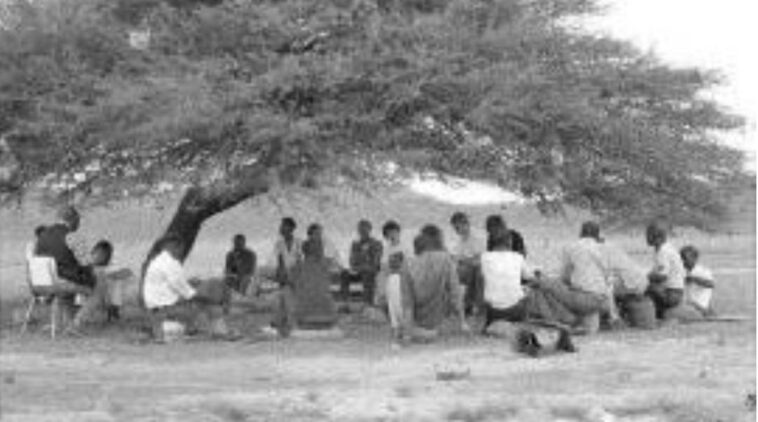
Across many African societies, the Palava Tree served as a space where communities gathered to process grief, celebrate triumphs, resolve disputes, and pass wisdom across generations. The stories told there were not designed for distant audiences. They reflected the realities, values, languages, humor, and contradictions of the people who lived beneath its shade.
Yet many contemporary filmmakers continue to operate under a different assumption.
They believe global success requires cultural translation before cultural expression.
The result is often a paradox.
We spend enormous energy competing in genres perfected elsewhere while overlooking the one advantage nobody can replicate.
Our own stories.
When you imitate Hollywood, you enter a crowded marketplace.
When you step under the Palava Tree, you have no competition.
No one else on earth can tell your story.
The Digital Algorithm Is Hungry for Authenticity
The algorithm is often criticized for dividing us.
What receives less attention is its most interesting characteristic.
It rewards distinction.
In a world drowning in content, average content disappears.
The internet does not need another generic crime drama. It does not need another low budget imitation of someone else’s success.
What captures attention is cultural texture.
The slang.
The rhythm.
The worldview.
The details that make a place feel alive.
This helps explain why audiences embraced Squid Game. It helps explain the success of Parasite. It helps explain why a Spanish series like Money Heist became a global phenomenon.
Think about one of its most beloved characters.
Nairobi.
Millions of viewers across the world developed an emotional connection to a character named after an African city.
That specificity did not limit the story.
It strengthened it.
Audiences did not reject what was unfamiliar.
They embraced it.
This is the lesson many African filmmakers still underestimate.
People are not searching for a sanitized version of themselves.
They are searching for authentic access into the lives of others.
Africa’s Strategic Opportunity
Africa is the youngest continent on earth, with more than sixty percent of its population under the age of twenty five.
This generation is connected to the world through digital networks, yet many are searching for identity, belonging, and cultural grounding.
That creates an extraordinary opportunity.
African cinema can become more than entertainment.
It can become a vehicle for cultural diplomacy.
A source of soft power.
A driver of economic development.
A bridge across a continent still navigating the legacy of borders it did not create.
For policymakers, investment in authentic storytelling is not merely cultural spending. It is an investment in national identity, economic growth, and global influence.
For academics, African cinema offers a living archive of how memory, identity, language, and globalization interact in the digital age.
For filmmakers, authenticity is no longer simply an artistic choice.
It is becoming a competitive advantage.
The evidence increasingly suggests that local stories are not barriers to global audiences.
They are gateways.
The Mandate for African Cinema
If African cinema seeks its own Amapiano moment, three principles deserve serious consideration.
First, write local before writing global.
Stories should emerge from communities rather than imagined international expectations.
Second, trust the subtitles.
The success of international cinema has demonstrated that audiences are willing to cross linguistic boundaries when the story is compelling.
Third, preserve cultural texture.
Keep the local slang.
Keep the customs.
Keep the music.
Keep the humor.
Keep the contradictions.
The riches are in the niches.
The more specific a story becomes, the more universal it often feels.
Returning to the Palava Tree
The great misconception of globalization is that it requires sameness.
It does not.
What makes global exchange meaningful is difference.
The digital era has connected humanity through platforms and networks, but connection alone does not create understanding.
Stories do.
Perhaps the task before African cinema is not to become more global.
Perhaps it is to become more deeply African.
The Palava Tree reminds us that the stories most capable of traveling across oceans are often the ones rooted most firmly in the ground beneath our feet.
The algorithm may be one of the defining technologies of our age.
But the deeper truth remains ancient.
Human beings are searching for meaning.
They are searching for identity.
They are searching for belonging.
And they often find it in stories from places they have never been, told by people they have never met, speaking languages they do not understand.
The future of African cinema may not lie in escaping the Palava Tree.
It may lie in bringing the world back beneath its shade.
What local African story, community, or cultural tradition do you believe global audiences are ready to discover next?
This post was created with our nice and easy submission form. Create your post!

Written by
I am a film scholar and educator investigating the convergence of digital technology, media policy, and creative economics in Africa
Did this story move you? Every gift goes directly to Ochieng Umira — writers on Muwado earn from reader appreciation, not algorithms. Even $1 makes a difference.






Muwado weekly chart
Get Africa’s top 10 stories every Thursday
No account needed — just your email.
Want to follow Ochieng Umira and get notified every time they publish?
Create a free Muwado account →