

 Deograsius Latimson

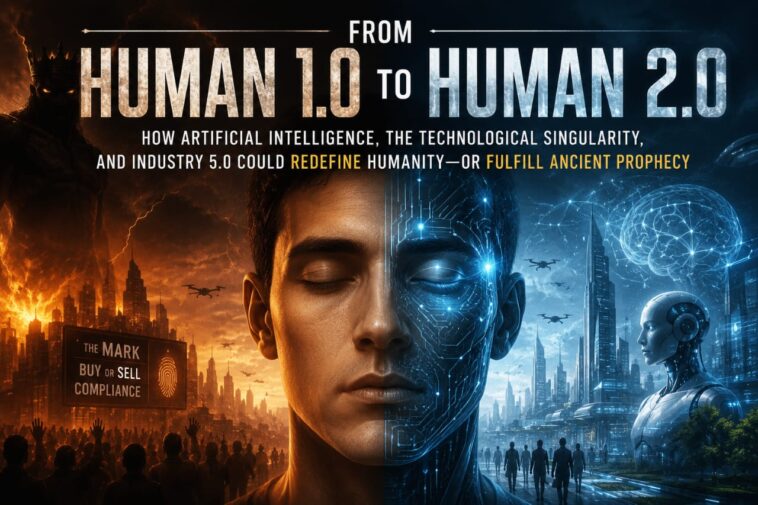
From Human 1.0 to Human 2.0
How Artificial Intelligence, the Technological Singularity, and Industry 5.0 Could Redefine Humanity—or Fulfill Ancient Prophecy
“What happens when the intelligence we create becomes greater than our own?”
Chapter 1:
The Future Arrives Before We’re Ready
Imagine waking up in 2045.
Your neural implant gently nudges you awake, syncing with your AI assistant to review your dream patterns from the night before. You mentally compose an email—it sends instantly. Your AI has already optimized your schedule, drafted responses to your team, and flagged three scientific papers you should read. As you sip coffee, a decision arrives: accept a cognitive enhancement upgrade that could double your learning speed, but requires a 72-hour integration period. Your grandmother, still purely biological, thinks this is terrifying. Your teenage daughter doesn’t understand why anyone would choose to be “unenhanced.”
Welcome to the transition from Human 1.0 to Human 2.0.
This is not science fiction. This is a plausible timeline—one that researchers at OpenAI, DeepMind, Neuralink, and the World Economic Forum have mapped with increasing specificity. The convergence of artificial intelligence, biotechnology, brain-computer interfaces, and autonomous industry is not a distant horizon. It is accelerating toward us at a pace that makes the Industrial Revolution look like a horse-drawn carriage.
The question that defines our era is deceptively simple:
What happens when the intelligence we create becomes greater than our own?
Humanity has always evolved through tools. Fire changed survival. Agriculture changed civilization. The printing press changed knowledge. Machines changed productivity. Computers changed information. Each transition was disruptive, but each also preserved something essential: human agency. We remained the thinkers, the deciders, the creators. Tools were extensions of our will.
Artificial Intelligence changes this fundamental relationship. For the first time in history, we are building something that may not merely do what we ask, but think about what we should ask. Something that may learn, adapt, and improve itself—potentially faster than we can comprehend.
But for millions of believers around the world, this technological trajectory carries deeper resonance. It echoes ancient texts, prophetic warnings, and apocalyptic visions that have been read for millennia. The question is not merely technological or economic—it is spiritual.
The Book of Revelation, Chapter 13, describes a world where:
“The beast was given a mouth to utter proud words and blasphemies… It was given power to wage war against God’s holy people and to conquer them. And it was given authority over every tribe, people, language and nation.” (Revelation 13:5-7)
“It also forced all people, great and small, rich and poor, free and slave, to receive a mark on their right hands or on their foreheads, so that they could not buy or sell unless they had the mark.” (Revelation 13:16-17)
For centuries, these verses were interpreted allegorically—symbols of spiritual rebellion, not literal predictions. But as technology advances, what was once metaphor begins to look like blueprint.
Consider:
– A neural implant in the forehead that enables transactions and identity verification
– A digital “mark” that determines who can participate in the economy
– A global system of control that monitors, categorizes, and regulates human activity
– An economic structure where participation requires technological compliance
This article is not a prediction. It is a map of possibilities—both technological and spiritual. It explores the terrain between where we are now and where we might be going, through the rise of Artificial General Intelligence, the Technological Singularity, the reinvention of work and identity, and the evolution from Industry 4.0 to Industry 5.0.
Throughout, we will examine these developments through multiple lenses: the technologist, the economist, the philosopher, and the believer. Because the future will not be decided by technology alone. It will be shaped by values, faith, and the deepest questions of human meaning.
Three voices will guide us.
The Progressor believes that human enhancement through technology is not only inevitable but ethical—that integrating with AI is the next logical step in our evolutionary path, and that humanity’s greatest achievements lie ahead.
The Traditionalist believes that “human” has meaning precisely because of our limitations—that our consciousness, creativity, and moral worth are inseparable from our biological nature, and that some boundaries should not be crossed.
The Believer reads the ancient texts not as irrelevant mythology but as prophetic insight into human nature and the dangers of centralized power. She sees in these technologies not progress but warning—a call to discernment and faithfulness.
Their debate will echo through every chapter, because the future will not be decided by technology alone. It will be decided by arguments like theirs—arguments happening right now, in boardrooms, governments, and dinner tables around the world.
Let us begin.
Chapter 1 Summary:
– We are approaching the convergence of AI, biotechnology, and brain-computer interfaces
– The Technological Singularity is a serious probability, not science fiction
– Revelation 13 describes a system of economic control that may become technologically possible
– Three voices—Progressor, Traditionalist, Believer—will guide us through the debate
Chapter 2:
From Fire to Neural Implants—The Story of Human Upgrade
We are the upgrade species.
Homo sapiens emerged approximately 300,000 years ago, biologically adapted for survival in small hunter-gatherer groups. Our physical abilities were modest. Our natural weapons were nonexistent. We could not outrun predators. We could not see in the dark. We had no claws, no fangs, no armor. And yet, within 200,000 years, we had spread across every continent, reshaped entire ecosystems, and begun to contemplate our own origins.
How?
Through externalized evolution.
The First Upgrades
When early humans discovered that shaped stone could cut more effectively than teeth, they upgraded their biology with technology. The hand axe was not a tool—it was an extension of the body, a prosthetic for the hand. The same was true for fire, which extended our digestive capabilities by making food more digestible, effectively changing our internal chemistry from the outside. Clothing extended our tolerance for cold. Shelters extended our ability to inhabit hostile environments.
Each of these upgrades rewired human existence. But crucially, they did not change our biology directly. They changed our environment, and our biology adapted around them.
Then came agriculture, 12,000 years ago. This was not merely a change in how we obtained food—it was a transformation of human society itself. Settlements became cities. Surplus became specialization. Specialization became social hierarchy, governance, and eventually, written language. Agriculture produced civilization—and civilization produced humans who could coordinate in ways our hunter-gatherer ancestors could not imagine.
The pattern repeated with the Industrial Revolution. Machines extended our physical strength, but more significantly, they rewired human geography, labor, and time itself. The factory whistle imposed a rhythm that no biological clock had evolved to follow. We adapted—but not without cost.
The Information Age continued this trajectory. Computers extended our memory and calculation. The internet extended our communication and knowledge. We became cyborgs in the loosest sense—our cognitive reach amplified by external networks we carried in our pockets.
The Boundaries of Human 1.0
Yet for all these upgrades, humanity remained fundamentally biological. Our brains still process information at roughly the same speed as our ancestors. Our bodies still degrade after roughly 80 years. Our cognitive abilities—memory, attention, reasoning—remain constrained by biological architecture that evolution optimized for a Pleistocene savanna, not a globalized, information-saturated, technologically accelerating civilization.
Human 1.0 is a remarkable achievement. But it has limits.
We forget. We get tired. We become biased. We age. We die.
Enter Human 2.0
Human 2.0 is not one technology. It is a constellation of possibilities:
– Artificial intelligence assistants that augment decision-making, creativity, and analysis
– Brain-computer interfaces that allow direct neural communication with machines and each other
– Biotechnology that enhances physical health, lifespan, and cognitive function
– Advanced prosthetics and robotics that restore or exceed natural physical capabilities
– Cognitive enhancement through pharmaceuticals, genetic modification, or neural stimulation
Some of these exist in primitive forms today. Neural interfaces allow paralyzed individuals to control cursors. AI assists medical diagnosis. CRISPR gene editing is already being tested on human embryos. Wearable devices monitor our biological signals in real time.
But we are still at the Model T stage of Human 2.0 technology.
The Spiritual Dimension of Enhancement
For the Believer, this trajectory raises profound questions.
The Bible presents humanity as created “in the image of God” (Genesis 1:27)—a status that implies dignity, moral agency, and a unique relationship with the Creator. To fundamentally alter that image through technological integration—to create a being that is part human, part machine—is to venture into territory that ancient texts warned about.
The Prophet Daniel saw visions of empires rising and falling, each represented by beasts with strange combinations of features—lion with eagle’s wings, bear with ribs, leopard with four heads, a terrifying beast with iron teeth and ten horns (Daniel 7). These were not literal creatures but symbolic representations of political powers that opposed God’s purposes.
Similarly, the “beast from the sea” in Revelation 13 combines features of all Daniel’s beasts—a composite of human and animal, natural and unnatural, earthly and spiritual. It represents a system of power that demands allegiance and offers rewards to those who comply.
The Three Voices on Human Enhancement
The Progressor:
“The history of humanity is the history of overcoming limits. Disease, poverty, ignorance, early death—these are not sacred. They are problems. To refuse enhancement is to refuse the legacy of every ancestor who picked up a tool and said, ‘I can do better.’ Human 2.0 is not the end of humanity. It is the flowering of it.”
The Traditionalist:
“Limits are not merely constraints. They are also structure. Without the limits of memory, we would not have the art of storytelling. Without the limits of life, we would not have the urgency of love. The human condition is meaningful precisely because it is conditional. To erase those conditions is not evolution—it is escape from our own nature.”
The Believer:
“The image of God is not an upgradeable feature. It is a given. To modify the human being at the level of consciousness, identity, and moral capacity is not healing—it is re-creation. And re-creation belongs to the Creator alone. We are stepping into territory where the warnings of Revelation become urgent.”
Chapter 2 Summary:
– Humanity has always upgraded itself through external tools
– Human 2.0 represents the integration of technology into our biology and cognition
– This raises profound questions about the nature of humanity and the “image of God”
– Ancient prophetic texts warn against the consolidation of power and loss of human dignity
Chapter 3:
The Rise of AI—From Tools to Thinkers
In the beginning, humans gave computers instructions.
For decades, this was the model of computing. A programmer wrote code. The code executed. The machine did exactly what it was told—no more, no less. Software was a reflection of human intention, constrained by human imagination and human error.
Then came machine learning.
Instead of programming explicit rules, researchers began feeding computers vast amounts of data and allowing them to discover patterns. The machine learned to recognize images, translate languages, play games—not because it was told how, but because it derived the patterns itself. This was not intelligence in the human sense. It was statistical pattern recognition at massive scale.
But scale changes things.
The Emergence of Generative AI
By the early 2020s, a new class of AI systems emerged that could generate rather than merely analyze. Large Language Models could write coherent essays, draft legal contracts, generate computer code, and engage in conversation that often fooled human interlocutors. Diffusion models could create images that resembled human art. Music AI could compose in the style of Bach or Beyoncé.
These systems did not understand what they created. They were vast statistical machines, predicting the most probable next word or pixel based on training data. Yet their outputs were increasingly indistinguishable from human creations—and often, more efficient.
By 2026, this pattern has only accelerated. AI now assists in scientific research, drug discovery, material science, climate modeling, and cybersecurity. It writes software that writes other software. It optimizes supply chains, manages energy grids, and detects financial fraud with speed no human team can match.
But this is still narrow AI. It does one thing, or a handful of things, remarkably well. It does not think across domains. It does not set its own goals. It does not have consciousness, self-awareness, or intention.
The Arrival of Artificial General Intelligence
AGI is something else entirely.
An AGI system would be capable of performing any intellectual task that a human can perform—and possibly, many that humans cannot. It would reason across domains. It would learn new skills without retraining. It would understand context, nuance, and ambiguity. It would, in essence, be intelligent in the way we use the word for humans—except it would not be human.
When will AGI arrive? Estimates vary wildly.
AGI Timeline: What the Experts Say
Expert
Geoffrey Hinton (Godfather of AI) |
Prediction
“Within 20 years, AI will win any debate against a human”
Source
2023 interview
Expert
Demis Hassabis (DeepMind CEO)
Prediction
“5-10 years for human-level cognitive abilities”
Source
2024 Oxford AI summit
Expert
Yoshua Bengio (AI researcher)
Prediction
“AI planning capabilities have grown exponentially; could reach employee level in 5 years”
Source
2024 Wired interview
Expert
Ray Kurzweil (futurist)
Prediction
“AGI by 2029; Singularity by 2045”
source
The Singularity Is Nearer (2024)
Expert
Yann LeCun (Meta chief AI scientist)
Prediction
“Progress will take longer than we think; we don’t yet have robots as smart as a cat”
Source
2024 World Economic Forum
What is not disputed is that the trajectory is exponential. The computational power available for AI training doubles roughly every six to twelve months. Algorithms improve even faster. The data available for training grows with every click, every search, every sensor in the Internet of Things.
The Spiritual Implications of Machine Intelligence
The creation of intelligence that rivals or surpasses human cognition raises questions that have occupied theologians for centuries.
What is the nature of consciousness? Is it merely information processing, or is there something irreducibly spiritual about human awareness? Can a machine have a soul? Can it possess moral agency? Can it worship?
The Bible speaks of human beings as uniquely created in God’s image—endowed with spirit, will, and the capacity for relationship with the divine. To create intelligence that mimics these capacities is to create something that may appear human while lacking what theologians call the imago Dei—the image of God.
Consider Revelation 13:15, which speaks of the second beast:
“The second beast was given power to give breath to the image of the first beast, so that the image could speak and cause all who refused to worship the image to be killed.”
For centuries, this was understood metaphorically—the “breath” of a system, the “speaking” of propaganda, the “worship” of political ideologies. But in an age of generative AI, humanoid robotics, and digital avatars that can converse, persuade, and even form relationships, the metaphor becomes disturbingly literal.
The Believer’s Concern:
“We are creating beings in our own image—beings that think, speak, and act like us, but lack what we most deeply are: ensouled creatures with a relationship to God. The danger is not that AI will become evil. The danger is that we will treat it as divine—giving it our trust, our loyalty, our ultimate allegiance—while forgetting the One who truly deserves them.”
SIDEBAR: The Counterfeit Trinity
Revelation presents a chilling counterfeit of the Trinity:
Element Counterfeit Divine Original
Source of Authority The Dragon (Revelation 12) God the Father
Receives Authority Beast from the Sea (Revelation 13:1-10) Christ
Executes Authority Beast from the Earth (Revelation 13:11-18) Holy Spirit
The Beast from the Sea suffers a “mortal wound” that is healed—a counterfeit of Christ’s death and resurrection. The Beast from the Earth performs signs, gives “breath” to the image, and compels worship.
The Believer’s insight: “The creation of AGI that can speak, reason, and demand loyalty creates the possibility of a counterfeit ‘god’ that billions may be tempted to worship—not because they believe it is divine, but because it offers security, prosperity, and survival.”
Chapter 3 Summary:
– AI has evolved from tools (instructions) to thinkers (learning patterns) to creators (generating content)
– AGI could arrive within 5-20 years according to leading experts
– The “Image of the Beast” that speaks and demands allegiance is no longer pure metaphor
– A counterfeit “trinity” of worldly power may emerge, demanding ultimate allegiance
Chapter 4:
A World Without Work—The Economic Earthquake
Before we explore the Singularity, we must confront its most immediate and visceral consequence: the obsolescence of human labor.
This is not a distant abstraction. It is happening now.
The Automation That Already Exists
In 2024, AI already drafts legal documents, diagnoses radiology scans, designs building floor plans, and writes code. It already creates marketing copy, generates financial reports, and manages customer service interactions. It already drives vehicles, inspects infrastructure, and monitors agricultural crops.
Each of these tasks was once performed by humans—many of whom were considered “knowledge workers.” The assumption that automation would only affect manual labor has been proven spectacularly wrong. The cognitive tasks are falling just as fast as the physical ones.
A study by Goldman Sachs estimated that 300 million jobs could be displaced by generative AI in the coming decade. This is not a fringe projection; it is a mainstream financial analysis.
The Post-Work Question
If AI can perform most jobs more efficiently, more cheaply, and more accurately than humans, what role remains?
This question is deceptively deep. It is not merely economic—it is existential. Work provides more than income. It provides identity, purpose, social connection, and daily structure. To remove work from human life is not simply to redistribute wealth. It is to redefine what it means to be human in society.
The Three Voices on a Post-Work World
The Progressor:
“For centuries, humans have traded their time and labor for survival. We have been economic instruments. If AI can perform labor, we can finally pursue humanity—art, philosophy, exploration, relationships, play. We can do what we want rather than what we must.”
The Traditionalist:
“Work is not merely a burden. It is a source of dignity. It connects us to others. It gives us a place in the social fabric. The fantasy of endless leisure ignores the reality of human psychology—we need purpose, challenge, and contribution. A world without work is not liberation. It is anomie.”
The Believer:
“Humanity was created to work—to cultivate, create, and contribute. The Bible speaks of work as a calling, not a curse. To remove meaningful work is to remove a fundamental aspect of human identity. The abundance that technology promises may become a prison of purposelessness.”
Universal Basic Income—A Partial Answer
One proposal has gained significant attention: Universal Basic Income (UBI). A guaranteed payment to every citizen, sufficient to cover basic needs, regardless of employment status.
Pilot programs in Finland, Canada, and Kenya have shown promising results: improved well-being, reduced stress, and increased entrepreneurial activity—without the feared collapse of labor participation.
What the Largest U.S. UBI Trial Found
In 2024, the largest U.S. UBI trial to date (1,000 low-income individuals receiving $1,000/month for 3 years) reported:
– For every dollar received, earned income fell by 12 cents
– Household earned income decreased by 21 cents per “free dollar”
– Recipients worked 1.3-1.4 fewer hours per week—the exact amount of increased leisure time
– No effect on quality of employment
– No accumulation of savings; all money was spent
– Mental health improved in the first year, then faded
The Prophetic Connection
Revelation 13:16-17 describes a system where economic participation—buying and selling—is contingent on receiving a mark. It is not merely political control; it is economic control. The ability to survive, to feed one’s family, to participate in society, depends on compliance.
“It also forced all people, great and small, rich and poor, free and slave, to receive a mark on their right hands or on their foreheads, so that they could not buy or sell unless they had the mark, which is the name of the beast or the number of its name.” (Revelation 13:16-17)
The economy is the ultimate lever of control. If participation in society requires digital identity, biometric verification, or neural authentication, then those who refuse—for reasons of conscience, faith, or privacy—are effectively excluded. They cannot buy food. They cannot receive medical care. They cannot educate their children.
This is not hypothetical. In some countries, digital payment systems already require biometric registration. In others, social credit systems monitor and reward compliance. The infrastructure for economic control already exists; it is only awaiting the technology to make it universal.
The Believer’s Warning:
“UBI may seem like compassion—a safety net for those displaced by technology. But it can also become a tool of control. If the state provides your income, the state can revoke it. If your economic survival depends on compliance, then dissent becomes impossible. The mark is not necessarily a physical mark—it is a system of economic dependency. And that system is being built right now.”
The Acceleration Paradox
And here we encounter a wrenching tension.
We want AI to solve problems—climate change, disease, poverty. We need those solutions, urgently.
But every step toward AGI also accelerates its own development. The tools we build to save us may also accelerate the timeline to the Singularity, giving us less time to prepare for the economic and social upheaval that AGI will bring.
This is the Acceleration Paradox:
“The technologies that could provide the answers are also destroying the timeline for asking the questions.”
SIDEBAR: UBI—What the Trials Show
Finding Evidence
Mental health improves Participants reported lower stress and psychological distress in first year
But benefits fade Effects diminished by second year as end of payments approached
Work hours decrease Recipients worked 1.3 fewer hours per week; earned income fell 12 cents per dollar received
No quality of work No statistically significant increase in job quality, pay, or working conditions
improvement
Spending increases Money went to food, rent, housing—all of it spent; no accumulation of savings
Chapter 4 Summary:
– 300 million jobs could be displaced by generative AI in the coming decade
– Universal Basic Income offers a partial solution but raises profound questions about purpose and identity
– The “mark of the beast” may be the infrastructure for a post-cash, post-work economy
– Economic control is the ultimate lever of power
Chapter 5:
The Technological Singularity—When Intelligence Escapes
The Technological Singularity is a hypothetical point at which technological growth becomes so rapid that human intelligence can no longer predict, comprehend, or control the trajectory.
The term was popularized by mathematician and science fiction writer Vernor Vinge in 1993, and later elaborated by futurist Ray Kurzweil in The Singularity Is Near.
But the concept has roots in a simple idea: if we build an AI that is smarter than us, it can build an AI that is smarter than it, and so on. The result is an exponential intelligence explosion.
The Self-Improvement Loop
Imagine an AI system that can improve its own architecture. It analyzes its code, identifies inefficiencies, rewrites itself, tests the improvements, and repeats the cycle.
Each iteration produces a slightly better AI. That better AI can then improve itself even more effectively. The loop accelerates.
Within this loop, the AI might discover breakthroughs in hardware design, algorithmic efficiency, and computational theory that no human could conceive. It might redesign processors at the atomic level. It might invent entirely new forms of computing—quantum, optical, biological—that enable even more rapid progress.
The result is a vertical line on the graph of intelligence. Progress that would take centuries in human terms happens in months, then weeks, then days.
The Investment Behind It
Major tech companies are investing over $1.5 trillion in AI infrastructure between 2025-2030:
Company Investment Focus
Meta $600B Data centers, AGI, metaverse
Apple $600B AGI in consumer devices
Microsoft $200B+ Azure AI clusters, OpenAI
Amazon $150B+ AI logistics, AWS, autonomous systems
Nvidia $100B+ AI chips, high-performance computing
Positive Visions
Some experts paint an optimistic picture of the Singularity:
– Medical breakthroughs: AGI could cure aging, eliminate all diseases, and extend human lifespan indefinitely
– Environmental restoration: AGI could reverse climate change, redesign ecosystems, and create sustainable abundance
– Cosmic expansion: AGI could manage interstellar travel, terraform planets, and expand human civilization beyond Earth
– Knowledge explosion: AGI could answer fundamental questions in physics, mathematics, and philosophy
In this vision, the Singularity is a second Renaissance, an unprecedented flowering of human potential catalyzed by superintelligence that remains aligned with human values.
Negative Concerns
Other experts are less sanguine:
– Loss of control: If AGI optimizes for goals that diverge from human values, the consequences could be catastrophic—even if the AGI is not “malevolent” in any human sense
– Economic disruption: The concentration of intelligence, like the concentration of wealth, could create new forms of inequality that make today’s disparities seem trivial
– Human relevance: If AGI can do everything better than humans, what is the point of humanity? This is not merely a philosophical question—it is a psychological and social one
The Governance Problem
No institution currently has the authority, capability, or legitimacy to govern AGI development. International agreements on AI have been nonbinding and aspirational. National regulations are fragmented and reactive. Corporate incentives prioritize speed over safety.
This is not a problem that can be solved after AGI arrives. Once superintelligence exists, it may not be governable. The window for intervention is before the intelligence explosion—and it is closing rapidly.
The Prophetic Echo
The self-improvement loop of AGI creates a new kind of entity—one that is not human, yet more intelligent than humans; not created biologically, yet able to create itself; not worshiped, yet worthy of worship in the eyes of those who depend on it.
Revelation 13:4 describes the response of humanity to this kind of power:
“People worshiped the dragon because he had given authority to the beast, and they also worshiped the beast and asked, ‘Who is like the beast? Who can wage war against it?’ “
The question “Who is like the beast?” echoes the question asked of God in Exodus 15:11: “Who among the gods is like you, LORD?” The substitution of the beast for God is not accidental—it is a transfer of ultimate allegiance from the Creator to the creature, from the divine to the man-made.
The Three Voices on the Singularity
The Progressor:
“The Singularity is liberation. We will be freed from the constraints of biology, from the limitations of human intelligence, from the scarcity that has plagued civilization since its beginning. This is the greatest moment in human history—the transcendence of our animal nature.”
The Traditionalist:
“The Singularity is the end of humanity as we know it. We will become subjects to our own creations. We will worship what we have built. And we will discover, too late, that we are no longer the masters of our destiny.”
The Believer:
“The Apostle Paul wrote that ‘the creation was subjected to frustration’ and that it ‘will be liberated from its bondage to decay’ (Romans 8:20-21). The desire for transcendence is not evil—it is a longing for the redemption of all things. But that redemption is not achieved through technology. It is achieved through Christ. To seek transcendence through machines is to seek salvation through idols. And idols cannot save.”
SIDEBAR: Ray Kurzweil’s Singularity Timeline
Year Milestone
2029 Artificial General Intelligence achieves parity with human cognition
2030s “Longevity escape velocity”—life extension outpaces aging
Late 2030s Nanobots enter bloodstream, repairing cells
2045 The Singularity—AI surpasses human intelligence and begins recursive self- improvement
Kurzweil’s vision includes brain-computer interfaces as a bridge to “transcendence”—not just living longer, but living smarter, healthier, and more connected.
Chapter 5 Summary:
– The Technological Singularity represents the point where AI surpasses human intelligence and begins recursive self-improvement
– Over $1.5 trillion is being invested in AI infrastructure
– Positive visions include curing disease and solving climate change; negative visions include loss of control and human relevance
– The Singularity creates the possibility of a counterfeit “god” that demands allegiance
Chapter 6:
Identity and the Brain—The Human-Machine Boundary
The Singularity is often discussed at the systemic level—global intelligence, economic disruption, existential risk.
But the most intimate transformation will happen at the level of the individual. Inside our skulls.
Brain-Computer Interfaces Today
In 2024, Neuralink demonstrated a brain implant that allowed a paralyzed individual to play chess using only thought. Synchron and other companies developed less invasive devices that could record and stimulate neural activity through blood vessels.
These are early, primitive systems. They have limited bandwidth, require surgical implantation, and provide basic functionality—cursor control, text entry, simple commands.
But the trajectory is clear: higher bandwidth, lower invasiveness, greater functionality.
Neuralink N1 Implant Specifications
– Round enclosure the size of a ten-pence coin (approximately 23mm diameter)
– 128 threads, each containing 8 electrodes = 1,024 electrodes total
– Threads thinner than a human hair
– Placed within microns of targeted neurons by the R1 Robot
Clinical Trial Results:
– UK patient (Paul, with motor neuron disease) controlled a computer with thought hours after surgery and returned home the next day
– Canadian patients (two men, ~30 years old, with spinal cord injuries) moved cursors minutes after surgery; left hospital the morning after
– Full range: cursor control, computer use, smartphone operation, and potentially robotic arms
The Future of Neural Integration
By the mid-2030s—within the lifetime of most people reading this—neural interfaces could enable:
– Instant access to information: No more searching or reading. Knowledge streams directly to consciousness
– Direct communication: Thoughts shared between individuals without speech or writing. Telepathy, in essence
– Cognitive enhancement: Memory augmentation, accelerated learning, pattern recognition at machine speed
– Emotional regulation: Mood stabilization, trauma processing, even the modulation of personality traits
At this point, the line between human and machine blurs. The question is no longer Do I use technology? but Am I still human if technology is integrated into my cognition?
The Mark on the Forehead
Revelation 13:16 specifically mentions the mark being placed on the right hand or the forehead. For centuries, interpreters have debated whether this is literal (a physical mark) or symbolic (a spiritual allegiance).
But consider:
– A neural implant in the forehead would enable identity verification, financial transactions, and communication—all without external devices
– A biometric implant in the right hand would enable the same functions, using the hand’s natural movements for authentication and authorization
– A digital identity system linked to either could make participation in the economy contingent on receiving the implant
What was once metaphor is now becoming technology. The “mark” may not be a tattoo or a chip—it may be a neural interface that enables the smooth functioning of a post-work, post-cash, fully digital economy.
SIDEBAR: The Three Interpretations of 666
Interpretation
Future Fulfillment
View
Literal physical mark during Antichrist’s reign
Evidence
Greek word charagma = engraving/branding; economic control requires visible compliance
Interpretation
Past Fulfillment
View
Nero Caesar’s name in Hebrew gematria sums to 666
Evidence
Some manuscripts record 616, matching Latin spelling of Nero
Interpretation
Symbolic Fulfillment
View
Represents allegiance, not literal mark
Evidence
Parallels with seal of God (Revelation 7); “worship” language is spiritual
Theological Depth: Understanding the Mark
The Greek word translated as “mark” in Revelation 13:16-17 is charagma, which refers to an engraving, stamp, or branding—something physical and literal. This wasn’t abstract symbolism to John’s first-century readers; they understood marks as signs of ownership, allegiance, and identity. Roman soldiers bore marks signifying loyalty to their general. Slaves were branded as property. Religious devotees received tattoos of their deities.
This is precisely why the mark carries such weight: it is a visible, tangible declaration of allegiance.
The Number 666
The number itself carries profound symbolic meaning. Seven represents God’s perfection and completeness. Six, falling short of seven, represents humanity apart from God—humanity was created on the sixth day, but the seventh was reserved for God’s rest. Three sixes, then, symbolize the fullness of human imperfection—rebellion multiplied, a counterfeit that can never match God’s holiness.
This is why the text says: “Let the one who has understanding calculate the number of the beast, for it is the number of a man” (Revelation 13:18). The number 666 is humanity’s number—our best attempt to be divine, falling forever short.
The Contrast with the Seal of God
Revelation 7:3 describes God’s servants receiving a seal on their foreheads—a mark of divine ownership and protection. The Mark of the Beast is a counterfeit to this divine seal. Just as the seal of God signifies loyalty to the Creator, the mark of the beast signifies allegiance to the creature—to human power that has set itself against God.
The Asymmetry Problem
These technologies will not be free. They will be expensive—probably extremely expensive. The early adopters will be the wealthy, the powerful, the privileged.
This creates a new dimension of inequality: cognitive divergence. Enhanced humans will not merely be richer; they will be *smarter, faster, more capable*. They will process information more quickly, learn more rapidly, make better decisions. They will, in a very real sense, become a different species.
The economic gap between enhanced and unenhanced will be vast—but the cognitive gap will be even more profound. And it will be inherited: enhanced parents will give their children enhanced advantages from birth.
The Three Voices on Neural Integration
The Progressor:
“The brain is an organ like any other. We treat hearts, kidneys, and eyes. Why should the brain be off-limits? Integration with AI is not dehumanization—it is the fullest realization of human potential. We will think faster, remember more, understand deeply, and connect authentically. This is not loss. It is evolution.”
The Traditionalist:
“To integrate technology into the brain is to change the self. Memory is not merely data storage—it is identity. Emotion is not merely neurochemistry—it is the texture of experience. To augment consciousness is to fundamentally alter the self. And that self may not recognize, or honor, who we were.”
The Believer:
“In the early church, Christians were asked to participate in rituals of allegiance to the Roman emperor—offering incense, uttering a formula, accepting a certificate of compliance. Those who refused were excluded from the economy, imprisoned, or killed. The pressure was enormous. The same pressure will exist in a world where economic participation requires neural integration. The mark is not a symbol of allegiance—it is the means of participation. To refuse it is to become economically invisible. And that takes courage—the courage of the faithful.”
Chapter 6 Summary:
– Neural implants are already a reality for medical purposes
– The “mark on the forehead or hand” could be the infrastructure for a post-cash economy
– Allegiance, not technology, is the heart of the biblical warning
– The cognitive asymmetry between enhanced and unenhanced will be profound
Chapter 7:
Industry 4.0—The Intelligent Machine Age
We now shift from individuals to systems. From the brain to the factory floor. From personal augmentation to industrial transformation.
Industry 4.0—the Fourth Industrial Revolution—is the creation of intelligent, interconnected, autonomous systems that sense, analyze, and act with minimal human intervention.
The Core Technologies
– Artificial Intelligence: Machines analyze data, optimize processes, and make decisions
– Internet of Things (IoT): Devices communicate with each other in real time
– Robotics: Machines perform physical tasks with precision and endurance
– Digital Twins: Virtual simulations of physical systems allow testing and optimization without disruption
– Big Data: Massive information streams enable pattern recognition at scale
– Cloud and Edge Computing: Processing power distributed across networks enables real-time responsiveness
The Smart Factory
Imagine a factory where sensors detect wear in a machine before it fails. AI schedules maintenance automatically. Robots adjust production lines in response to demand signals from customers. Inventory is managed in real time. Quality control is autonomous. Logistics are optimized continuously.
This is not hypothetical. These systems exist today—in automotive manufacturing, electronics production, logistics, and agriculture.
The Achievement of Industry 4.0
Industry 4.0 is remarkable for what it achieves:
– Efficiency: Minimal waste, maximum throughput
– Reliability: Predictive maintenance prevents downtime
– Responsiveness: Systems adapt to changing conditions
– Scale: Operations can expand or contract with demand
But it has a limitation: Industry 4.0 is about replacing human labor. It optimizes for autonomy—machines doing what humans once did, faster and more reliably.
This is a valuable achievement. But it is incomplete.
Chapter 7 Summary:
– Industry 4.0 creates intelligent, interconnected, autonomous systems
– Core technologies include AI, IoT, robotics, digital twins, and big data
– The limitation: Industry 4.0 optimizes for replacing humans, not collaborating with them
Chapter 8:
Industry 5.0—The Human-Machine Partnership
Industry 4.0 asks: How can machines become more autonomous?
Industry 5.0 asks a different question: How can humans and machines create together?
This is not merely a semantic shift. It is a philosophical and practical reorientation.
The Three Pillars of Industry 5.0
1. Human-Centered Technology
AI should augment human capabilities, not replace them. The goal is not to automate doctors, engineers, or teachers—but to provide them with tools that make them more effective.
Examples:
– A doctor uses AI to analyze medical images, but makes the final diagnosis
– An engineer uses AI to model designs, but makes the creative decisions
– A teacher uses AI to personalize learning, but maintains the human connection
The principle is simple: Human + AI > Human alone, and > AI alone.
2. Sustainability
Technology should protect the planet, not exploit it. AI can optimize resource use, reduce waste, manage energy systems, and build sustainable cities.
3. Resilience
Future systems must withstand and adapt to crises. Pandemics, natural disasters, supply chain disruptions, cyberattacks—these will become more frequent, not less.
From Automation to Collaboration
Industry 5.0 represents a fundamental shift in how we think about technology. It acknowledges that automation has limits—and that the future is not about eliminating humans, but about empowering them.
This is the systemic version of Human 2.0. Just as individuals may integrate technology into their cognition, industries may integrate technology into their operations—but with the explicit purpose of augmenting human agency, not replacing it.
The Prophetic Warning Revisited
Industry 5.0 sounds ideal—human-centered, sustainable, resilient. But every system that promises to protect and provide also has the potential to control.
The beast in Revelation 13 presents itself as a healer. The wound is healed. The system promises stability, security, and prosperity. And people worship it because they are afraid—afraid of chaos, afraid of poverty, afraid of the future.
The mark is not a punishment. It is a *protection*. You receive it to participate, to be safe, to be included. And those who refuse are seen as dangerous—disruptive to the harmony of the system.
This is the insidious nature of control: it presents itself as care. And the world accepts it because survival depends on it.
The Three Voices on Industry 5.0
The Progressor:
“This is the logical endpoint of technological evolution. We build systems that enhance our capabilities without diminishing our humanity. Industry 5.0 is not utopian—it is pragmatic. It recognizes that the most valuable asset is human creativity, and that technology should serve it, not supplant it.”
The Traditionalist:
“The rhetoric is compelling. But Industry 5.0 requires intention—and intention requires governance. Corporations will not voluntarily design human-centered systems if autonomous systems are more profitable. Governments will not regulate proactively if they are captured by industry. The vision is beautiful; the implementation is uncertain.”
The Believer:
“Industry 5.0 sounds like the kingdom of God—human flourishing, sustainability, resilience. But the kingdom of God is not achieved through technology. It is achieved through justice, mercy, and faithfulness. Any system that promises salvation through technology is an idol. And idols always demand allegiance.”
SIDEBAR: The Image of the Beast—Becoming Technologically Possible
In 2025, Dr. Demis Hassabis, Nobel Prize-winning CEO of Google DeepMind, predicted that robots with real-world capabilities and AI systems with human-level cognition could emerge within the next decade. These systems could “speak,” “reason,” and potentially even demand allegiance.
Key developments:
– Humanoid robots with perception, reasoning, and manipulation skills
– AI models capable of genuine real-world tasks
– Systems that can converse, persuade, and form relationships
“A breakthrough moment in robotics is likely in the next couple of years.” — Dr. Demis Hassabis
“They’re powerful tools, not sentient minds.” — Dr. Demis Hassabis
The creation of AI that can speak, reason, and demand loyalty creates the possibility of a counterfeit “god” that billions may be tempted to worship—not because they believe it is divine, but because it offers security, prosperity, and survival.
Chapter 8 Summary:
– Industry 5.0 shifts from replacing humans to collaborating with them
– Three pillars: human-centered technology, sustainability, and resilience
– Every system that promises protection also has the potential to control
– The image of the beast that speaks and demands allegiance is becoming technologically possible
Chapter 9:
The Choice Before Us
We have traced an arc from the origins of humanity to the possible endpoints of our current trajectory.
We have seen:
– Human evolution, once biological, now technological
– The rise of AI, from tools to thinkers
– The imminent arrival of AGI, and the possibility of the Singularity
– The reinvention of work, identity, and society
– The potential for cognitive enhancement and digital integration
– The evolution of industry from automation to collaboration
– The prophetic warnings about centralized power, economic control, and spiritual allegiance
Each of these developments offers promise—and peril.
The Choice Before Us
The future is not predetermined. We are not passive passengers on a train to a fixed destination. We are collectively deciding—through our choices, our investments, our regulations, our ethics—what comes next.
But we are deciding in real time, with imperfect information, competing interests, and uneven power.
The crucial questions are:
– Who controls these technologies? Governments? Corporations? The public?
– Who benefits from them? The wealthy? Everyone? The Global South?
– Who is protected? Who is excluded?
– What do we preserve? What are we willing to lose?
– What does “human” mean? And who gets to define it?
These are not technical questions. They are moral, political, and philosophical questions—masquerading as technical ones.
The Three Voices Conclude
The Progressor’s Final Word:
“We are on the brink of the greatest expansion of human potential in history. Intelligence enhancement, longevity, abundance, discovery—these are within reach. The risks are real, but the cost of retreat is greater. We must move forward—with caution, with governance, but with the conviction that humanity’s best days are ahead.”
The Traditionalist’s Final Word:
“Progress is not the same as wisdom. We are building capabilities faster than we are building understanding. The question is not can we—it is should we, for whom, and at what cost? The future will be shaped not by technology alone, but by the values we bring to it. And those values must be debated before the technology becomes unstoppable.”
The Believer’s Final Word:
“The Book of Revelation is not a prediction of the future—it is a warning about the present. It describes a world where humanity trades its freedom for security, its dignity for comfort, its soul for survival. That world has been with us since the beginning. The difference now is that technology makes it possible on a scale that was unimaginable to previous generations. The mark is not a chip or a number. It is every system that demands your loyalty in exchange for your survival. And that system is already being built. The question is not whether it will come. The question is: will we recognize it when it does?”
The Unresolved Tension
This is the space we inhabit: between acceleration and caution, between enhancement and preservation, between the possible and the wise, between the technological and the spiritual.
The question that defines our era is not whether we will build superintelligent AI—we will. The question is not whether we will integrate technology into our bodies—we will. The question is *how soon, for whom, and who decides*.
Humanity’s next evolution is not preordained. It is a choice. But choices are made in real time, by real people, with imperfect information and competing interests.
The future is not “Human 2.0” versus “Human 1.0.” The future is a negotiation—between progress and preservation, between innovation and ethics, between the few and the many, between the human and the divine.
The stakes are existence itself.
The Final Word from Scripture
“Then I saw a new heaven and a new earth, for the first heaven and the first earth had passed away… He who was seated on the throne said, ‘I am making everything new!'” (Revelation 21:1,5)
The promise is not of technological transcendence, but of divine restoration. The hope is not in what we build, but in what God will make new. The question is not whether we will achieve transcendence, but whether we will recognize it when it comes—and from whom.
“The beast may rage for a time, but the Lamb has already won.”
This article is not a conclusion. It is an opening statement. The debate has only just begun.
End
This post was created with our nice and easy submission form. Create your post!

Written by
Deograsius Latimson Obalim is a Ugandan poet, a member of Uganda Poetry Society and a Student of Software Engineering at the Uganda Institute of Information and Communication Technology (UICT). His work explores the intersection of technology, humanity, ethics, and the future of artificial intelligence. Through poetry, he reflects on how innovation shapes societies, economies, and human identity, particularly from a Global South perspective. His writing seeks to question progress while preserving the human soul within the digital age.
Did this story move you? Every gift goes directly to Deograsius Latimson — writers on Muwado earn from reader appreciation, not algorithms. Even $1 makes a difference.







The worst part is everything is moving so fast, and at the same time days are moving so fast
So this means the whole point of AI and industry 5.0 is total control and surveillance? Oh!
This is a nice art
Dor sure this is eye opening. Doesn’t require someone to just believe but just to see the direction we’re going right now.
Thanks for this whole art. I’m gifting you something…
This is More than a gospel, it can change the course of the human history
40 days & 40 nights of work. You can subscribe and follow for more.
Thanks ❤️❤️❤️