

 Anesu Chikumba
Reflections from Africa Media Festival
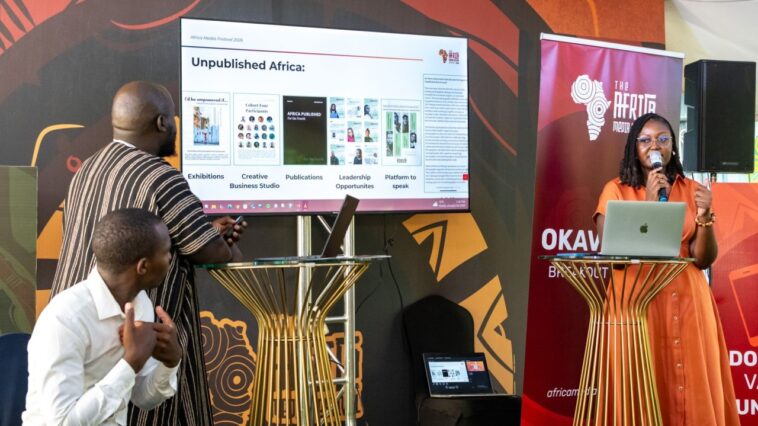
When I first heard about the Africa Media Festival, I remember thinking that it was the kind of space I hoped to one day attend. So I was truly honored that the first time I attended, I did so as a speaker facilitating a workshop.
Being paired with a Kenyan photographer Ramadhan Said, who had recently exhibited with us through Unpublished Africa Photo Week as part of the Representation exhibition made the experience even more interesting. He already had some understanding of our work through Unpublished Africa, but I needed to learn more about his work with the Nubian community in Kenya, as well as the creative community he was working within in Kibera.
Collaborating on the workshop created an interesting balance between the perspective of a curator and that of a photographer. Our session, From Observation to Responsibility, focused on publishing, visibility, consent, and the responsibility that comes with documenting people and communities.
Visibility Is Not Neutral
The issue of consent within photography and publishing comes up often through the work I do as our publishing guidelines are quite stringent. We generally avoid publishing images with identifiable features, especially in situations where consent is unclear or where circulation could create an unintended consequence for the people being photographed.
In many African countries, once someone is in a public space, photographers are legally allowed to capture and publish their image but we try to emphasize that legality and ethics are not always the same thing, as an image can travel far beyond the control of the photographer.
Once an image is published, it can be shared, reframed, commercialized, or completely recontextualized. This is what we framed our discussion around: responsibility begins before publication, not only after publication.
Africans Telling African Stories
One of the broader conversations currently happening across African media spaces is around Africans telling their own stories. While this is important, one of the areas we covered is that context matters deeply and needs to be considered even within African storytelling itself.
Being from the same country, city, or region as someone does not automatically mean that we fully understand the realities of a particular community. Context often requires time, relationship-building, listening, and sometimes collaboration with people who are closer to that lived experience. Without that, storytelling can still flatten or misrepresent communities, even when done with good intentions.
What Happens When Images Travel Beyond Their Original Context
Recontextualization after publication is something that happens often: a photograph is taken in one context and later circulates in another, resulting in it carrying a completely different meaning from what was originally intended. We tend to underestimate this, particularly in fast-moving digital environments where an image can be shared with ease once it’s published online.
This conversation has become increasingly relevant within event photography as well, as photographers seem to be pressured to capture faces and expressions to prove attendance, excitement, or energy within a room. But there are also ways to document atmosphere, participation, and movement without necessarily centering identifiable faces or compromising people’s privacy.
That tension between visibility and privacy is becoming more apparent as more images circulate online, and as more people raise concerns about how their likeness is being used by brands, organisations, and media platforms without clear consent or compensation.
From Observation to Responsibility
I am beyond grateful for the engagement we received during the workshop as it became interactive with photographers and journalists sharing their own lived experiences and challenges around documentation, publishing, and responsibility. Senior photographers reflected on situations they had encountered in the field, while others spoke about the pressures of visibility, speed, exposure, and competition within today’s media environment.
Here are a few of the points we shared during the workshop:
- Visibility is not neutral. Visibility can create opportunity, but it can also create harm.
- Documentary photography should not only be considered as creative expression as once published, it also becomes public record.
- Responsibility begins before publication and continues after circulation.
- Consent should be viewed as relational and ongoing, not simply transactional.
- Sustainable visibility matters more than rapid exposure.
- Community can act as ethical infrastructure within storytelling.
- Context should not be treated as optional within African storytelling.
Photographers are not only documenting society; they are also helping shape how communities, cities, and realities are understood by others. That responsibility deserves more discussion within African creative and media spaces.
Thank you again to the photographers whose work we shared about during the workshop: Paballo Makatla, Joyce Kipunga, Adebote Mayowa, Hawo Kane, Abadjaye, and Justin SODOGANDJI—all alumni of Unpublished Africa.
And thank you to Martie Mtange, the Baraza Media Lab, and Africa Media Festival teams for the opportunity to contribute to the conversation!
Hi, Have We Met?
My name is Anesu Chikumba, Founder of Unpublished Africa, a pan-African platform supporting photographers and visual storytellers across the continent. Through our work, we have supported creatives in 29 African countries to date, held events across 9 countries, and run programmes in English, French, and Portuguese.
We are always looking to collaborate with partners, organisations, and communities interested in expanding opportunities for African creatives and amplifying African stories.
If that sounds like you, I’d love to connect.
This post was created with our nice and easy submission form. Create your post!
Written by
Creative Economy Practitioner | Building pathways for African visual storytellers | Founder, Unpublished Africa
Did this story move you? Every gift goes directly to Anesu Chikumba — writers on Muwado earn from reader appreciation, not algorithms. Even $1 makes a difference.




Muwado weekly chart
Get Africa’s top 10 stories every Thursday
No account needed — just your email.
Want to follow Anesu Chikumba and get notified every time they publish?
Create a free Muwado account →