

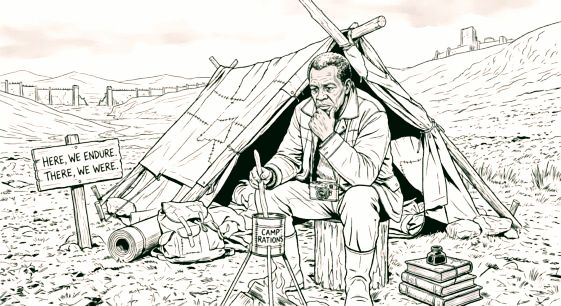
 Caesar Obong Ng'bong ocen

Chapter Twenty-Five: The Music Therapist
Two weeks after the night we discovered that the mind could be used as a weapon, we stopped running.
Not because we were safe.
Because we had finally understood that there was nowhere left to run to.
The men who had come for us had disappeared. The accident on the road to Kampala had changed whatever plan they had been following, but it had not ended the danger. If anything, it had confirmed what we had begun to suspect.
We were no longer being hunted by individuals.
We were being moved around by something larger.
So we stayed at Samuel’s house.
We talked less.
We watched more.
Samuel spent his days studying the maps on his wall. Peter filled his notebook with names, dates, routes and questions he could not answer. I spent most of my time listening.
That was how I first noticed the stranger.
He did not knock.
He stood outside the doorway as though the house belonged to him and waited.
Samuel saw him first.
He looked like a man built for distance rather than display—short, broad-shouldered and muscular, with the compact strength of someone accustomed to walking farther than roads allowed. His face was weathered. His eyes were small and watchful.
A faded jacket hung loosely over a plain shirt.
Across his back was a small black bag.
A talking drum rested against his left shoulder.
He looked at the three of us.
Then he walked inside.
No greeting.
No apology.
No hesitation.
He stopped in the middle of the room.
“Which one amongst the three of you is Obong?”
Peter and I looked at each other.
I was the first to speak.
“Do you know how annoying it is to enter someone’s house without greeting and start asking questions?”
The man looked at me.
For a moment I thought he might apologize.
Instead, he smiled.
“Good.”
Samuel stepped between us.
“Who are you?”
The stranger studied him from head to toe, then back again.
“I am who I am.”
He shifted the drum on his shoulder.
“A therapist. A sound pathologist. A student of vibration. A rhythmist.”
He paused.
“And a man who has spent most of his life listening.”
Peter gave a short, involuntary laugh.
The man’s expression did not change.
“I cure people using sound.”
The statement was so absurdly confident that, for a moment, none of us knew how to answer it.
It reminded me of being young and going to church for reasons that had little to do with God.
You would sit beside the girl you wanted to speak to, spend the entire service rehearsing what you were going to tell her, then somehow spend twenty minutes discussing vegetables, gardening or fishing.
Anything except the truth.
By the time courage arrived, somebody with a sharper tongue had already taken her attention.
Peter and I spoke at almost the same time.
“We’re not looking for a therapist.”
The words collided between us like two badly timed notes.
“I know.”
The stranger’s eyes settled on me.
“That is why I am here.”
Something changed in Samuel’s face.
“You should leave.”
The man did not move.
“Someone is sick.”
Peter stood.
“Who?”
The stranger looked at him.
“You already know.”
Peter’s face tightened.
“The businessman?”
A slight nod.
“He is getting worse.”
Samuel folded his arms.
“And what does that have to do with you?”
The stranger lifted the black bag from his shoulder.
“Everything.”
He placed it on the floor and opened it.
Inside were instruments.
A small wooden flute.
A tuning fork.
An harmonica.
Several pieces of percussion equipment.
An old portable recorder.
Nothing looked particularly dangerous.
That made it worse.
Peter stared at the contents.
“What exactly do you do?”
The man picked up the flute.
“I listen.”
“To music?”
“To people.”
He looked directly at me.
“Sometimes the body speaks before the mouth does.”
Something moved through my chest.
Not pain.
Recognition.
The stranger noticed.
His eyes narrowed.
“You felt that.”
I swallowed.
“Felt what?”
He smiled.
“You don’t know what you’re carrying.”
Peter stepped toward him.
“Who sent you?”
The man returned the flute to the bag.
“Does it matter?”
“Yes.”
“Then ask a better question.”
Peter’s jaw tightened.
“Who sent you?”
The stranger looked at Samuel.
Then at Peter.
Then back at me.
“The same people who have been looking for you.”
The room became still.
Samuel’s hand moved toward the door.
The stranger spoke before he reached it.
“If they wanted you dead, I would not be standing here.”
Samuel stopped.
“They want the businessman alive.”
“Who are they?” Peter asked.
The stranger said nothing.
“And why do they want him alive?”
Still nothing.
I stepped forward.
“Who are they?”
This time the stranger looked at me.
“They believe you are the only one who can make him walk again.”
A pressure formed behind my eyes.
It began as a dull sensation.
Then it sharpened.
The hair along my arms rose.
I knew that feeling.
Two weeks earlier, it had preceded the visions.
I closed my eyes.
The room disappeared.
Darkness.
Then a low sound.
Not quite a drum.
Not quite a heartbeat.
Something deeper.
Something that seemed to come from beneath the earth itself.
Toom.
Dung.
Dung.
Toom.
Dung.
Dung.
Three beats.
Again.
Toom.
Dung.
Dung.
My eyes opened.
The stranger was watching me.
“What did you hear?”
I breathed slowly.
“Resonance.”
He waited.
“Like a heartbeat.”
“From where?”
I looked at the floor.
“I don’t know.”
He nodded.
“That is what I thought.”
Peter stared at him.
“You knew this would happen?”
“No.”
“But you weren’t surprised.”
“I have seen it before.”
“Seen what?”
“People hearing things they cannot explain.”
Samuel’s voice hardened.
“With the businessman?”
The stranger nodded.
“He hears things too.”
Peter’s expression changed.
“What?”
“Voices.”
The room seemed to shrink.
“What voices?” I asked.
The stranger’s answer came quietly.
“People he has hurt.”
Nobody spoke.
“He says they speak to him at night.”
Peter shook his head.
“That’s impossible.”
The stranger shrugged.
“Most things become possible after people have exhausted every ordinary explanation.”
Samuel watched him carefully.
“What is your name?”
“Mugenziranahawe.”
Peter frowned.
“That’s a long name.”
“You can call me Mugenzi.”
“And what exactly are you doing here, Mugenzi?”
“I was sent to help you.”
“By whom?”
Mugenzi looked toward the maps on Samuel’s wall.
“That question will become useful later.”
Peter’s patience was thinning.
“You said you came to help us reach the businessman.”
“I came to provide the means.”
“What means?”
“Transport.”
Samuel laughed bitterly.
“You think we can simply walk into Kampala?”
“No.”
“Then what?”
Mugenzi looked at Peter.
“You don’t have to go to him.”
A pause.
“He will come to you.”
Peter stared at him.
“How?”
Mugenzi’s eyes moved toward me.
“Acoustic resonance.”
The words hung in the room.
Peter shook his head.
“He’s in Kinshasa.”
“I know.”
“He can barely walk.”
“I know.”
“Then how exactly is he supposed to come here?”
Mugenzi looked at me.
“That is what we are going to learn.”
Samuel stepped closer.
“You came all this way to tell us that?”
“No.”
Mugenzi picked up the black bag.
“I came because you are about to make a mistake.”
Peter stiffened.
“What mistake?”
“Trying to fight something you don’t understand.”
He looked at the maps.
“You think your enemies are the men who came to take you.”
His finger touched one of Samuel’s red routes.
“They are not.”
He followed the line across the map.
“The men are only movement.”
He tapped the wall.
“The system is the enemy.”
Samuel said nothing.
Mugenzi turned toward me.
“And whatever is happening inside you is not a weapon.”
“Then what is it?”
He considered the question.
“An instrument.”
Peter frowned.
“An instrument for what?”
Mugenzi smiled faintly.
“That is what you have to learn.”
He walked toward the door.
Samuel did not move.
Neither did Peter.
Mugenzi opened it.
Then stopped.
“One more thing.”
He looked back at me.
“Do not confuse power with understanding.”
Then he walked away.
For several seconds, none of us moved.
Samuel finally closed the door.
Peter looked at me.
“What did he mean?”
“I don’t know.”
Samuel returned to the table.
“He knew too much.”
Peter noticed something on the floor.
The flute.
Mugenzi had left it behind.
He picked it up.
A symbol had been carved into the wood.
A circle crossed by three lines.
Peter turned it over.
“What is this?”
Samuel shook his head.
“I’ve never seen it.”
I reached for the flute.
The moment my fingers touched the wood, everything vanished.
The room.
The walls.
Peter.
Samuel.
Darkness.
Then sound.
A melody so faint I almost missed it.
I saw a hospital.
Crowded.
White walls.
Harsh lights.
A child sat alone on the floor of a hospital room.
A woman was crying beside him.
The child did not move.
But his fingers did.
Tap.
Tap.
Tap.
Tap.
Four slow beats.
The woman covered her face.
The child continued tapping.
I pulled my hand away.
The room returned.
Peter caught my arm.
“What did you see?”
“A child.”
“Where?”
“I don’t know.”
Samuel took the flute from me.
Nothing happened.
Peter touched it.
Nothing.
Samuel looked at me.
“It responds to you.”
I shook my head.
“No.”
But I knew he was right.
The flute had carried something.
Or perhaps it had not carried anything at all.
Perhaps it had simply awakened something already inside me.
That possibility frightened me more.
Mugenzi returned that afternoon.
He did not knock.
He never did.
This time he carried a large kettle drum.
He walked into the house, placed it on the floor and looked at me.
“Obong.”
I waited.
“Play.”
“I don’t play drums.”
“You don’t need to.”
He pointed at the drum.
“Play the rhythm you felt.”
“That isn’t the same thing.”
“It is to the body.”
Peter stood in the corner with his arms folded.
Mugenzi sat beside the drum.
He struck it once.
Tooom.
The sound spread through the room.
It seemed to linger after the drum had stopped.
He waited.
Then struck it again.
This time I felt the vibration beneath my feet.
Not through the air.
Through the ground.
He played three slow beats.
Toom.
Dung.
Dung.
Without thinking, I answered.
Three beats.
Mugenzi nodded.
“Again.”
I repeated them.
He changed the rhythm.
I followed.
He changed it again.
I tried to stop.
My hands moved anyway.
Peter stepped forward.
“Enough.”
Mugenzi stopped.
Peter pointed at him.
“You said you were bringing transport.”
“I am.”
“Where is it?”
“Not here.”
Peter’s eyes narrowed.
“And who are they?”
Mugenzi said nothing.
“The people you keep talking about.”
Silence.
Peter continued.
“Are they the ones killing people?”
Mugenzi looked at him.
“The ones causing political turmoil?”
No answer.
“The ones behind the arms embargo?”
Mugenzi’s expression did not change.
Peter stepped closer.
“Are they the ones who have been hunting us?”
Mugenzi finally nodded.
“Yes.”
Peter’s fist tightened.
“And you work for them?”
“No.”
“Then why are you helping us?”
Mugenzi looked at me.
“Because resonance does not belong to them.”
He struck the drum.
Once.
The sound entered my chest.
Again.
My breathing changed.
Then three times.
Toom.
Dung.
Dung.
The room disappeared.
I was somewhere else.
Far away.
Very far away.
There was no house.
No refugee settlement.
No Peter.
No Samuel.
Only darkness.
Then—
a heartbeat.
Weak.
Irregular.
Alive.
I listened.
Another heartbeat answered.
The first became clearer.
My eyes closed.
The hospital returned.
The businessman lay on a bed.
His body looked smaller than I remembered.
His face was pale.
His eyes were open.
He was afraid.
Someone stood beside him.
A man in a dark suit.
The man held a telephone.
He spoke.
I could not hear the words.
The image shifted.
A doctor.
A security guard.
A corridor.
Another door.
Another corridor.
Then darkness.
I opened my eyes.
Mugenzi had stopped playing.
Peter was standing beside me.
“What happened?”
I struggled to breathe.
“The hospital.”
“What did you see?”
“The businessman.”
“Where?”
“Kinshasa.”
Mugenzi nodded.
Peter looked at him.
“You knew.”
“I suspected.”
“Who was the man with the telephone?”
Mugenzi shook his head.
“You saw what you were ready to see.”
“That’s not an answer.”
“It is the only one I have.”
Peter moved closer.
“You know something.”
“Yes.”
“Then tell me.”
Mugenzi’s expression remained calm.
“Knowing is not the same as understanding.”
Peter almost laughed.
“Don’t speak to me in riddles.”
Mugenzi pointed toward the drum.
“You think your ability is power because people become well when you touch them.”
He touched the drum.
“But music has always understood something you have not.”
“What?”
“Nothing disappears.”
He struck the drum once.
“Sound moves.”
Another strike.
“Pain moves.”
His hand touched his chest.
“Memory moves.”
He pointed toward Samuel’s maps.
“Information moves.”
Samuel slowly raised his head.
Mugenzi continued.
“Your enemies understand movement. That is why they have always been able to find you.”
Peter looked at me.
“And what do we understand?”
Mugenzi answered without hesitation.
“Resonance.”
The word remained in the room.
I did not fully understand it.
But somewhere inside me, something did.
That night I could not sleep.
Rain whispered against the roof.
Peter slept on the other side of the room.
Samuel was in the next room.
I sat beside the window.
I listened.
Water.
Wind.
Breathing.
A distant cough.
A baby crying.
A cooking pot scraping against the ground.
Then—
three beats.
Pause.
Three beats.
Pause.
I opened my eyes.
Nobody was outside.
The rhythm came again.
Three beats.
Pause.
Three beats.
I closed my eyes.
The businessman appeared.
He was no longer lying in the hospital bed.
He was sitting upright.
Someone stood beside him.
A man in a dark suit.
The businessman looked terrified.
The man leaned toward him.
This time I heard the words.
“You should never have started those cave men of God.”
The businessman looked toward the door.
The vision broke.
I opened my eyes.
Peter was standing behind me.
“You heard it too.”
I turned.
“Heard what?”
“The rhythm.”
He looked toward the window.
“Three beats.”
I stared at him.
“You heard it?”
He nodded.
Then he smiled.
Not happily.
Something darker.
“They regret everything they did to us.”
He sat beside me.
“And now they think you can heal them without me.”
He laughed softly.
“This world.”
He shook his head.
“It’s payback time.”
For the first time since leaving the cave, I understood that whatever had happened to us was no longer confined to either of us.
It was connecting us.
Not metaphorically.
Not emotionally.
Something else.
Something deeper.
Peter looked at me.
“What did you see?”
I told him.
He listened without interrupting.
When I finished, he picked up his notebook.
“The businessman isn’t controlling this.”
“No.”
“Someone else is.”
“Yes.”
Peter looked toward Samuel’s maps.
“Then the system is bigger than we thought.”
I nodded.
He wrote a sentence.
The businessman is not the target.
He is the message.
Peter underlined it.
Then he looked at me.
“And Mugenzi?”
I thought about the flute.
The drum.
The three beats.
The strange recognition I had felt when I first saw him.
“I think he’s the messenger.”
Peter closed the notebook.
Outside, the rhythm came again.
Three beats.
Pause.
Three beats.
Then silence.
I looked into the darkness.
For the first time, I understood why a music therapist had been sent to find us.
He had not come to teach us music.
He had come because there were things moving through the world that could not be seen.
Things carried by sound.
By memory.
By pain.
By information.
By people.
And somewhere in that invisible movement, something had begun to answer when we listened.
Mugenzi had given it a name.
Resonance.
I did not yet know what it meant.
But I knew one thing.
The moment we learned how to listen, the world had begun listening back.
This post was created with our nice and easy submission form. Create your post!

Written by
Caesar Obong Ng'bong Ocen is a Ugandan writer whose work traverses narrative fiction, cultural memory, and moral inquiry. Drawing on African cosmologies, and reflective storytelling, his writing engages with issues of power, identity, faith, and the human condition within post‑conflict societies. His series blends political realism with interior psychological struggle, articulating the tensions between duty and conscience, tradition and modernity, exile, redemption. Obong Ng'bong's work bridges literary and social worlds: it interrogates African historical and political realities while exploring philosophical and ethical questions that resonate across disciplines. His narratives are grounded in cultural authenticity and moral depth, making them relevant to both literary and humanistic inquiry. He also mentors emerging writers and contributes to dialogue on African storytelling traditions and their place in contemporary literature.
Did this story move you? Every gift goes directly to Caesar Obong Ng'bong ocen — writers on Muwado earn from reader appreciation, not algorithms. Even $1 makes a difference.





Muwado weekly chart
Get Africa’s top 10 stories every Thursday
No account needed — just your email.
Want to follow Caesar Obong Ng'bong ocen and get notified every time they publish?
Create a free Muwado account →