

 Caesar Obong Ng'bong ocen

Chapter Twenty-Three: The Family Cares
Their heavy footsteps came closer until they stopped outside Samuel’s little home.
For several seconds, nobody spoke.
Then one of the men called my name.
“Obong. Obong—Obong.”
His voice carried through the thin walls with an unsettling softness. It sounded almost like the voice of someone who had come to offer a peace token, or a father finally prepared to admit his faults to rebellious children.
“We do not want to hurt you or Kaburu.”
He paused.
“The two of you could have helped our state grow. You have the power to save a life from thousands of kilometres away, yet you chose to run around the country, spending countless nights in forgotten neighbourhoods, chasing air.”
His tone remained calm.
Almost affectionate.
“Just like your friend Kaburu—the forgotten hero.”
Rain drummed against the roof.
“You think the state cares about your power? We gave you a clean job. Preach the word of God to the people of the world and allow business to continue as usual.”
Another pause.
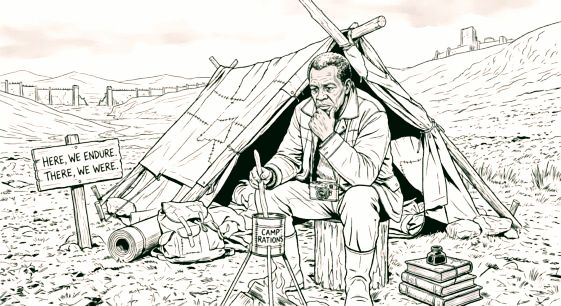
“You chose to hide in a refugee settlement and depend on camp rations.”
His voice softened.
“Why?”
The question entered the room more quietly than the rain.
Why?
Until that moment, I had believed I knew the answer.
I had run because I was afraid.
I had travelled because staying in one place had become dangerous.
I had preached because perhaps healing was the only thing left in me that still felt useful.
I had crossed borders because the country behind me had begun to feel like a room without doors.
But standing in Samuel’s darkness, listening to a stranger speak about choices I had believed were mine, another possibility began to take shape.
What if they had never been entirely mine?
The thought came suddenly.
Then memory began doing what memory sometimes does when fear gives it a new language.
The book deal.
The tour.
Maggie…
Even the housemaid I had come to love and father her a child could have been some sort of arrangement, not so?
Not necessarily by one person. Not necessarily as part of one plan.
But arranged enough to make me believe I was choosing freely while other people quietly determined where I would go next?
I remembered Okello calling me his son-in-law almost immediately, before any proper introduction had taken place. At the time, I had taken it as one of his strange jokes.
Now I wondered whether he had known something about me before I knew anything about him.
Then there was Mary Mwaibako relationship to Peter Kaburu.
Had she really entered Peter Kaburu’s life by coincidence or was it a setup by those who knows how the system works.
Why was Maggie Okello so interested in investigating the DNA of Peter Kaburu’s son
And then there was Dokolo.
How had they found us when we were stranded there?
How had they transported us directly to Soroti?
And why did Maggie received us with such warmth, as though Peter and I were children returning home after a long journey?
At the time, every event had seemed separate.
Now they began to resemble points on a map.
Samuel’s maps.
Red lines crossing ports, towns and borders routes…
Routes were never accidental.
They existed because someone needed something moved from one place to another.
A shipment.
A person.
Information.
Money.
I felt the darkness press closer.
Then came another knock.
Three slow blows against the door.
Samuel moved immediately.
He reached for the Tadoba and extinguished its flame.
Darkness swallowed the room and neither of us knew wether the door was either open or bolted closed.
Nobody spoke.
For a moment, I could hear only the rain and the sound of our breathing.
Then the door opened.
The four men did not wait for an invitation.
They entered.
Their boots struck the floor one after another.
Four silhouettes crossed the narrow doorway.
They moved with the calm confidence of men who already knew what was inside.
They did not hesitate.
They did not search.
They did not ask permission.
They simply walked in.
Peter’s hand disappeared beneath his jacket.
Even though darkness had swallowed us inside Samuel’s little home, I could hear Peter grinding his teeth. Years spent beside him had taught me one thing: when Peter was afraid, he went silent; when he was angry, he ground his teeth, as though the pressure of his jaw could keep his temper from breaking loose.
Samuel remained still.
That frightened me.
He had spent seventeen years around warehouses, border crossings, manifests and receiving points. He knew what men looked like when they came to inspect something and what they looked like when they already knew where everything was.
These men did not look like inspectors.
They looked like men following a route.
One of them shut the door behind him.
The latch fell into place.
Quietly.
But to me, it sounded like the closing of a cell.
Nobody moved.
Then the man who had spoken outside spoke again.
“Obong.”
His voice was closer now.
“We know you are afraid.”
Peter shifted beside me.
“But fear is not necessary.”
The man almost laughed.
“You have misunderstood us.”
I wanted to ask who they were.
I wanted to ask how they had found us.
I wanted to ask what they wanted from Samuel.
But the questions remained trapped in my throat.
Because somewhere inside me, I already knew.
They had not come because of Samuel.
They had come because of us.
And suddenly I understood something more frightening.
We were not simply being hunted.
We were being recovered.
The distinction mattered.
Samuel had spent seventeen years learning how humanitarian supplies disappeared between warehouses, ports and refugee camps. He had followed numbers that refused to make sense. He had compared manifests with receiving documents, signatures with quantities, departure records with arrival records.
Eight hundred sacks of maize left one place.
Five hundred arrived.
The missing three hundred had not evaporated.
They had gone somewhere.
Samuel had taught me that a discrepancy was not always an error.
Sometimes it was evidence of a route.
Standing in his house now, with four strangers occupying the only door, I began to understand the possibility that Peter and I had been moving through a different kind of logistics.
We were not sacks of maize.
We were not medicine.
We were not blankets.
We were people.
But people could be moved too.
Our movements had been monitored.
Our opportunities might have been arranged.
Our relationships might have been influenced.
Our usefulness might have been measured.
And when we stopped moving according to whatever route had been expected of us, someone had come to find us.
Samuel shifted.
I heard the faint scrape of his chair.
He was looking at the men, though I could barely see him.
“Who sent you?”
Silence.
One of the men gave a quiet laugh.
“Samuel,” he said, “after seventeen years in logistics, you still think every shipment has a sender you can name.”
Samuel did not answer.
The man continued.
“Sometimes the important question is not who sent the shipment.”
He paused.
“It is who owns the route.”
A cold sensation moved through me.
The room seemed to shrink.
Samuel’s maps returned to my mind.
The red lines.
The ports.
The towns.
The borders.
Routes connecting places that should never have belonged to the same story.
I suddenly understood why Samuel had been so disturbed by the missing supplies.
The numbers had not merely been telling him what was missing.
They had been telling him where power travelled.
And perhaps Peter and I had travelled along some of those same routes without knowing it.
But why us?
Why had so many people invested so much effort in finding two fugitives?
The answer came from Peter.
The forgotten hero.
The man who had spent his life asking questions.
Peter was an August-child, born and bred in the noble circles of power. He knew their corridors, their people and their language. He had grown up close enough to power to understand how it breathed.
But there was something the system had failed to remove from him.
His adventurous mind.
Peter could never leave a mystery alone.
Where others saw a closed door, he saw a question.
Where others accepted an official explanation, he searched for the missing sentence.
That mind had made him a journalist.
It had also made him dangerous.
Perhaps I had become valuable because of what I could do.
Peter had become dangerous because of what he could discover.
And together, perhaps, we had become something the system had not calculated properly.
Then another memory surfaced.
People had not merely been looking for us.
Some people had seemed to be waiting for us to appear.
Waiting.
The word stayed with me.
Why would anyone wait?
I remembered the way certain people had spoken about our disappearance.
Not always with grief.
Not always with fear.
Sometimes with anticipation.
As if our suffering were an event whose outcome mattered.
I thought of Peter’s family.
Then his uncle.
The thought arrived without warning.
His uncle had always seemed strangely distant from the chaos surrounding Peter.
Too distant, perhaps.
But distance could mean many things.
Protection.
Ignorance.
Or knowledge.
I remembered the stories Peter had told me about his family—the money, the connections, the quiet influence, the people who could make a phone call and cause a problem to disappear.
I did not know whether his uncle had anything to do with the men standing in Samuel’s house.
But for the first time, I wondered whether he might know more about Peter’s disappearance than Peter had ever been told.
Then a darker thought followed.
What if the suffering itself had become profitable?
What if somewhere, behind closed doors, men who would never step into a refugee settlement had been watching our movements as though they were numbers on a board?
One expected us to surface in Uganda.
Another expected us to cross a border.
Someone else expected us to be captured.
Another expected us to emerge wounded.
Perhaps some people had made calculations around our disappearance.
Perhaps some had even made wagers.
The idea was grotesque.
I almost rejected it.
But Samuel’s maps had taught me something.
Systems rarely waste what can be measured.
And anything that can be measured can eventually be valued.
Our disappearance had value.
Our survival had value.
Our capture had value.
The question was not whether someone was making money from our suffering.
The question was who stood to benefit.
And then I understood why the refugee settlement might matter.
We had fallen outside the route.
We had become refugees instead of fugitives moving through predictable places.
We had stopped appearing where someone expected us to appear.
We had disappeared from the manifest.
For people accustomed to moving human beings, money or information along controlled routes, that would have been a problem.
We had become unaccounted for.
Unaccounted for.
The phrase stayed with me.
That was what Samuel had found in the humanitarian records.
Missing quantities.
Missing signatures.
Missing deliveries.
And perhaps that was what we had become.
Missing people.
Peter shifted beside me.
His teeth had stopped grinding.
That frightened me more than the sound had.
He was thinking.
Then he spoke.
“Who is my uncle working for?”
Silence.
The four men did not move.
No denial came.
No confirmation.
Only silence.
Peter inhaled slowly.
“You know him.”
Still nothing.
Peter gave a soft laugh.
It was not a happy laugh.
“My uncle sent you.”
One of the men moved.
I could hear the faint scrape of his boot against the floor.
But he did not answer.
Instead, another voice came from the darkness.
“You should not ask questions about family matters.”
Family.
The word struck me harder than any threat.
The family cares.
I understood the title now.
Or thought I did.
They cared enough to know where we were.
They cared enough to follow us across borders.
They cared enough to decide what should happen to us when we were no longer available to decide for ourselves.
But perhaps I was making the same mistake again.
Perhaps I was trying to give one name to a system that had many hands.
Samuel spoke before I could think further.
“Where is the route leading?”
This time there was no laughter.
The man closest to him answered.
“You have spent seventeen years watching things disappear, Samuel.”
He took a step.
“Now you should learn where they go.”
Samuel was silent.
The man continued.
“And you should both understand something.”
His voice became almost gentle again.
“You were never supposed to be free.”
The words settled over us.
For a moment, nobody moved.
Then I understood.
We had thought we were running from a government.
What if the government was only the visible face of something larger?
We had thought our families were protecting us.
What if protection and ownership had become difficult to distinguish?
We had thought exile had saved us.
What if exile had simply taken us off the expected route?
Peter’s hand remained beneath his jacket.
His notebook was still there.
The four men had not asked for it.
Not yet.
That frightened me more than if they had.
Because if they already knew about it, they had no reason to ask.
And if they did not know, Peter was carrying something whose value we had not yet understood.
Samuel’s little house no longer felt like a hiding place.
It felt like a receiving point.
A place where something that had gone missing had finally arrived.
Only now I wondered what the shipment was.
Peter.
Me.
The notebook.
The information inside our memories.
Or something none of us had yet recognized.
Outside, the rain continued to fall.
The four men waited.
They did not need to threaten us.
They did not need to raise their voices.
They already knew the route.
And perhaps that was the most frightening thing of all.
They knew where we had come from.
They knew where we were.
What they wanted to know was where we would go next.
For the first time, I wondered whether exile had truly been an escape.
Perhaps we had not escaped the system.
Perhaps we had only travelled farther into it.
This post was created with our nice and easy submission form. Create your post!
Written by
Caesar Obong Ng'bong Ocen is a Ugandan writer whose work traverses narrative fiction, cultural memory, and moral inquiry. Drawing on African cosmologies, and reflective storytelling, his writing engages with issues of power, identity, faith, and the human condition within post‑conflict societies. His series blends political realism with interior psychological struggle, articulating the tensions between duty and conscience, tradition and modernity, exile, redemption. Obong Ng'bong's work bridges literary and social worlds: it interrogates African historical and political realities while exploring philosophical and ethical questions that resonate across disciplines. His narratives are grounded in cultural authenticity and moral depth, making them relevant to both literary and humanistic inquiry. He also mentors emerging writers and contributes to dialogue on African storytelling traditions and their place in contemporary literature.
Did this story move you? Every gift goes directly to Caesar Obong Ng'bong ocen — writers on Muwado earn from reader appreciation, not algorithms. Even $1 makes a difference.





Muwado weekly chart
Get Africa’s top 10 stories every Thursday
No account needed — just your email.
Want to follow Caesar Obong Ng'bong ocen and get notified every time they publish?
Create a free Muwado account →