

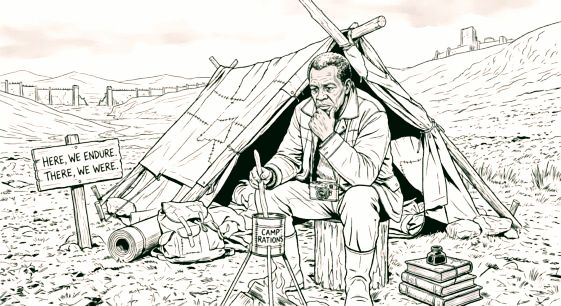
 Caesar Obong Ng'bong ocen
Chapter Thirty: Privilege-guilt
The three of us sat side by side on the balcony.
Below us, Lake Victoria stretched toward the horizon, wide and silent beneath the afternoon sky. From where we sat, high above the city in the presidential suite, the lake appeared almost peaceful. Its surface caught the light and scattered it into a thousand trembling fragments.
The two men beside me were accustomed to places like this.
I was not.
Or perhaps that was no longer entirely true.
Over the years, I had learned something about powerful men. They had a way of making luxury appear ordinary. A presidential suite was simply a room. A lake view was simply a view. A bottle placed on the table was simply something to drink.
And a brand-new vehicle parked outside could be called a small toy.
That morning, I had been told that an SUV was waiting for me.
The latest of its kind.
Brand-new.
Not a vehicle I had ordered.
Not one I had saved for.
Not one I had even imagined owning.
Yet there it was.
A gift.
Or so I had been told.
I had spent enough time around wealth to understand that gifts were not always gifts. Sometimes they were messages. Sometimes they were rewards. Sometimes they were warnings. And sometimes, the more expensive the gift, the more difficult it became to understand what the giver truly wanted in return.
But to the men beside me, money seemed to have lost its meaning.
They spoke of things I could not afford as though they were ordinary household objects.
One of them turned toward me.
“Mr. Obong,” he said.
His voice was calm.
“You have been a friend to our family for a long time.”
I looked at him.
“I have read your coverage of the autobiography of my brother,” he continued. “It was fascinating.”
The other man remained silent.
Then the first man looked away from the lake and directly at me.
“But what I told you earlier is the truth.”
For a moment, I said nothing.
“That boy,” he continued, “is my biological son.”
His voice did not rise.
There was no drama in it.
Perhaps that was why the words felt heavier.
“My blood runs in him,” he said. “And now in his son.”
The wind moved across the balcony.
Somewhere below us, the city continued its business. Vehicles moved through traffic. People walked. Phones rang. Doors opened and closed.
But for a moment, none of that seemed to exist.
Only the lake.
The three of us.
And the truth.
I had heard parts of the story before.
Not from an autobiography.
Not from newspapers.
Not from public speeches or carefully written accounts of family history.
I had received fragments of it long before the pieces began to arrange themselves in the right order.
Peter Kaburu.
The man I had travelled with.
The man who had been arrested.
The man who had lived in fear, exile and uncertainty.
The man who had spent so much of his life searching for explanations.
And now here I was, sitting on a balcony overlooking Lake Victoria, listening to a man speak of him not as a journalist, not as a friend, not as a political inconvenience—
but as a son.
“My blood runs in him.”
The words remained with me.
Then the man beside me spoke again.
“You have to carry my message to him.”
I looked at him.
“What message?”
For the first time, his expression changed.
It was only slightly.
A weakening of the face.
A small crack in the confidence of a man who had spent much of his life surrounded by wealth, influence and people willing to carry messages on his behalf.
“Tell him,” he said quietly, “that I did not forget.”
I waited.
“Tell him that a man can make many mistakes in his life. Some mistakes can be corrected.”
He stopped.
The lake moved below us.
“Others,” he continued, “remain alive even after the man who made them believes they are dead.”
I understood then why the conversation was taking place on that balcony.
It was not a business meeting.
It was not a celebration.
And the vehicle waiting outside was not merely a vehicle.
Nothing was ever merely anything in the world of powerful men.
The SUV was a message too.
Perhaps they wanted to make me happy.
Perhaps they wanted to reward me for friendship.
Perhaps they wanted me comfortable.
Or perhaps they wanted to ensure that I would remember who had given it to me.
I looked toward the parking area.
Far below, somewhere beyond the polished corridors and guarded entrances of the hotel, my new vehicle waited.
A small toy.
That was what he called it.
I almost smiled.
There are people in this world for whom money has lost its meaning.
They do not measure wealth by what something costs.
They measure it by what it can do.
A vehicle can buy loyalty.
A house can buy silence.
A favour can purchase a memory.
And sometimes a gift is simply a chain made from a material too expensive for the receiver to recognize.
The man beside me leaned closer.
“Use it,” he said.
I turned toward him.
“The vehicle?”
He nodded.
“It is outside.”
I looked back at Lake Victoria.
“Why me?”
Neither of the men answered immediately.
That silence troubled me more than anything they had said.
Finally, he smiled.
“Mr. Obong, you have been a friend to our family for a long time.”
The same words again.
Friend.
Family.
Truth.
Gift.
I repeated them silently in my mind.
Something about the conversation did not sit comfortably with me.
Perhaps it was because I already knew that Peter would not easily believe me.
I had tried before.
I remembered looking at him and saying:
“I want to tell you something about your biological father.”
Peter had dismissed me.
He had waved the conversation away as though I were beginning another one of my strange stories.
“John Owino is in great shape,” he had said. “Perhaps next week we could go and visit him.”
Then he had looked at me with that familiar mixture of amusement and impatience.
“Haven’t you benefited from his autobiography?”
At the time, I had said nothing.
How could I explain that an autobiography could contain a lifetime and still leave out the most important truth?
How could I tell him that the story I knew was not written in any book?
Now, sitting beside these men in the presidential suite, I understood that the truth was becoming impossible to ignore.
Peter Kaburu had been walking through his own history without knowing it.
He had been looking for enemies.
He had been looking for explanations.
He had been looking for justice.
And somewhere behind all those searches stood a truth about his own blood.
The man beside me reached for his drink.
“The rich also cry, Mr. Obong.”
I looked at him.
For a moment, I thought I had misunderstood.
He was a man surrounded by everything most people spent their lives trying to obtain.
Money.
Influence.
Connections.
Security.
A presidential suite.
A lake beneath his balcony.
People ready to answer when he called.
And yet his face carried something that money had failed to remove.
Regret.
“The rich also cry,” he repeated.
Then he looked toward the lake.
“Sometimes we cry because of the things money gave us.”
I did not answer.
“Sometimes,” he continued, “we cry because of the things money took away.”
The wind passed over the balcony again.
And suddenly I understood that the wealth surrounding us was not the story.
The presidential suite was not the story.
The expensive vehicle was not the story.
Even the lake, shining peacefully beneath us, was not the story.
The story was a man who had discovered that he could buy almost anything except the years he had lost with his son.
“My blood runs in him,” he had said.
And now in his son.
Three generations.
A truth travelling silently through blood while the people carrying it remained strangers to one another.
I looked once more toward the parking area.
The SUV waited outside.
A gift.
A message.
A small toy.
I did not know which description frightened me most.
But I knew one thing.
Sooner or later, I would have to speak to Peter again.
And this time, when I told him that I knew something about his biological father, the truth would no longer sound like a revelation.
It would sound like a fact.
Whether he was ready to hear it or not.
Because sometimes a man spends his entire life searching for his father.
And when the truth finally arrives, he discovers that the father had been searching for him too.
This post was created with our nice and easy submission form. Create your post!
Written by
Caesar Obong Ng'bong Ocen is a Ugandan writer whose work traverses narrative fiction, cultural memory, and moral inquiry. Drawing on African cosmologies, and reflective storytelling, his writing engages with issues of power, identity, faith, and the human condition within post‑conflict societies. His series blends political realism with interior psychological struggle, articulating the tensions between duty and conscience, tradition and modernity, exile, redemption. Obong Ng'bong's work bridges literary and social worlds: it interrogates African historical and political realities while exploring philosophical and ethical questions that resonate across disciplines. His narratives are grounded in cultural authenticity and moral depth, making them relevant to both literary and humanistic inquiry. He also mentors emerging writers and contributes to dialogue on African storytelling traditions and their place in contemporary literature.
Did this story move you? Every gift goes directly to Caesar Obong Ng'bong ocen — writers on Muwado earn from reader appreciation, not algorithms. Even $1 makes a difference.





Muwado weekly chart
Get Africa’s top 10 stories every Thursday
No account needed — just your email.
Want to follow Caesar Obong Ng'bong ocen and get notified every time they publish?
Create a free Muwado account →