

 Caesar Obong Ng'bong ocen
Chapter Twenty-Six: Perilous Ignorance
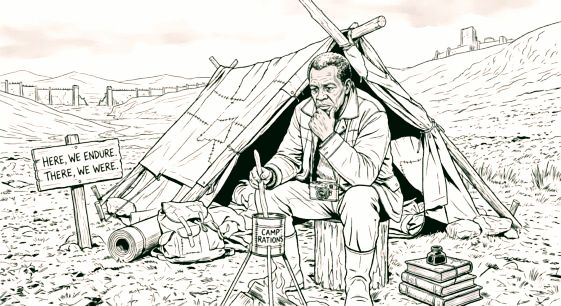
Morning came quietly to the refugee settlement.
For once, there was no shouting.
No hurried footsteps.
No arguments at the shelters.
No rumours moving faster than the people who carried them.
Under the enormous muvule tree at the edge of the camp, several unmarked buses stood in a single file, their engines idling softly in the cool morning air.
They had arrived before sunrise.
Nobody seemed to know exactly when.
The vehicles bore no flags, no organisation names and no obvious markings beyond small identification numbers on their windscreens. Their presence alone was enough to change the mood of the settlement.
People were leaving.
Not fleeing.
Leaving.
There was a difference.
Families stood in orderly lines as names were called during the post-takeover roll call. Children clung to their parents. Women carried bundles wrapped in blankets. Men held plastic bags, jerrycans and the few possessions they had managed to preserve through displacement.
Some looked frightened.
Others looked exhausted.
But most looked hopeful.
For people who had spent months measuring their lives in terms of temporary shelters, food distributions and the next night, a bus represented something almost sacred.
Movement.
A beginning.
A possibility.
I stood beneath the muvule tree beside Peter.
Neither of us had a bag.
Neither of us had a name on the list.
We were not refugees.
We had never been refugees.
We had come here for another reason.
We had come to bring hope to people who had almost forgotten what the word meant.
At least, that was what everyone believed.
Perhaps it was also what we had believed.
Peter watched the buses.
“They’re going.”
“Yes.”
“Everyone.”
“Almost.”
He looked at the lines.
Then at me.
“And we’re staying.”
I did not answer.
A woman passed in front of us carrying a sleeping child. She smiled when she saw us.
“Pastor.”
I smiled back.
She continued toward the buses.
For a moment, I felt something heavy inside my chest.
We had entered this settlement believing that we were the ones bringing something to these people.
Yet somewhere along the way, they had given us something too.
They had shown us what survival looked like without power.
What hope looked like without certainty.
What faith looked like when there was no evidence that tomorrow would be better.
Peter touched my shoulder.
“Look.”
I followed his gaze.
Mugenzi was walking toward us.
He carried the same black bag.
The talking drum was strapped across his back.
For once, he was not walking like a man who had arrived somewhere without permission.
He looked tired.
He stopped in front of us.
“You are leaving.”
Peter smiled faintly.
“We don’t seem to have much choice.”
Mugenzi looked at the buses.
“None of you have much choice.”
He turned toward me.
Then reached into his bag.
He removed the small wooden flute.
The same flute I had touched two days earlier.
He placed it in my hand.
“This is yours.”
I looked at it.
“I don’t play.”
“You don’t need to play.”
He took out a small tuning fork and placed it beside the flute.
“And this.”
I looked at the two objects.
“What am I supposed to do with them?”
“Listen.”
I almost smiled.
“That’s all you ever tell me.”
“It is enough.”
He looked toward the camp.
People were still boarding the buses.
Children were waving through the windows.
Some of the older men stood silently, watching the settlement they had inhabited for so long disappear behind them.
Mugenzi’s eyes followed them.
“When you reach people, don’t always try to heal them.”
I looked at him.
“Then what should I do?”
“Connect.”
He paused.
“Use sound.”
His voice was softer now.
“Sometimes people cannot hear words.”
He touched his chest.
“But they can feel rhythm.”
I looked at the flute.
“And the drum?”
Mugenzi nodded.
“Use it.”
“How?”
“Not to command.”
He looked directly into my eyes.
“To connect.”
Something changed in his face.
His eyes became wet.
For the first time since I had met him, the man who never seemed surprised by anything looked like an ordinary human being.
A tear rolled down his cheek.
He wiped it away quickly.
Then he smiled.
“You have been trying to understand what happened to you.”
He looked at Peter.
“Both of you.”
Peter said nothing.
Mugenzi turned back to me.
“Maybe understanding will come later.”
He touched the flute.
“Until then, listen.”
A bus horn sounded.
Mugenzi stepped back.
“Where are you going?” I asked.
“Entebbe.”
Peter looked at him.
“Why?”
“Because someone is waiting.”
“Who?”
Mugenzi smiled.
“You ask too many questions.”
Peter laughed.
“You answer too few.”
Mugenzi turned toward the bus.
Then stopped.
He looked back at us.
“Do not be afraid of what you don’t understand.”
He hesitated.
“Be afraid of what you think you understand.”
Then he climbed aboard.
The door closed.
The bus pulled away.
We watched until it disappeared beyond the trees.
Peter turned toward me.
“Do you understand anything he just said?”
“No.”
Peter smiled.
“Good.”
Before I could answer, a man appeared from behind the muvule tree.
He was dressed differently from everyone else.
Dark trousers.
A crisp white shirt.
A tailored jacket.
Polished shoes.
He carried no visible weapon.
He did not need one.
There was something about the way he walked that suggested he was accustomed to entering places where other people waited for permission.
He approached us.
“Mr Kaburu.”
Peter turned.
The man extended a card.
“Peter Kaburu?”
Peter took it.
The man looked at me.
“Obong.”
I nodded.
He reached into a leather folder and handed Peter several documents.
Then a fuel card.
Then another small card.
Finally, he placed a set of keys in Peter’s palm.
Peter stared at them.
“What is this?”
“Your transport.”
“Where?”
The man pointed beyond the settlement.
An SUV stood beneath another tree.
New, dark. and sparkling clean.
It looked completely out of place among the battered vehicles, humanitarian trucks and ageing motorcycles surrounding it.
Peter looked at the vehicle.
“Who does it belong to?”
“Now?”
The man smiled.
“You.”
Peter looked at me.
I looked at him.
The man handed him a satellite phone.
“This may be useful.”
Peter examined it.
“Who sent you?”
The man’s smile disappeared.
“I was asked to make sure you received these.”
“By whom?”
“People who know where you are going.”
Peter stared at him.
“Where are we going?”
The man looked at me.
“That depends on what you decide to do.”
He handed me one final document.
I looked at it.
My name was written on the first page.
Underneath it was a designation I did not recognise.
I looked up.
“What is this?”
The man ignored the question.
Instead, he looked at me for several seconds.
“Thank you.”
“For what?”
“For working with the world.”
I frowned.
“I don’t understand.”
“You don’t have to.”
He nodded toward Peter.
“Neither does he.”
Then he walked away.
I watched him disappear behind the buses.
Peter was still holding the keys.
“Working with the world?”
I shook my head.
“I’ve done nothing.”
“Neither have I.”
We looked at each other.
Then at the SUV.
Then back at the documents.
The strange thing was that the man had spoken as though we had completed some mission we had never known we were part of.
Perhaps that was the most frightening part.
We had spent weeks trying to discover who was moving us.
Now we were beginning to realise that some people did not need to move us themselves.
They only had to arrange the road.
Peter opened the driver’s door of the SUV.
I walked around to the passenger side.
Before I could enter, a humanitarian officer approached us.
“Where are you going?”
Peter pointed toward the SUV.
“Kampala.”
The officer looked at us.
“You’re not on the transport list.”
“We were told we could use the vehicle.”
“I don’t care who told you.”
He looked at our clothing.
Then at the documents.
“You cannot travel with the refugee convoy.”
Peter’s face hardened.
“We’re not asking to travel with them.”
The officer shook his head.
“The convoy is restricted.”
“We’re clergy.”
The officer paused.
“Clergy?”
I nodded.
“We were working in the camp.”
“Yes.”
He looked at the documents.
Then back at us.
“Which church?”
Peter answered.
“Our mother church is in Kampala.”
The officer handed the documents back.
“Then report to your church.”
Peter stared at him.
“That’s it?”
“That’s it.”
He pointed toward the buses.
“These vehicles are for registered refugees and authorised personnel.”
“We were authorised personnel.”
“Were.”
The word hung between us.
Peter looked at the settlement.
The camp was already changing.
Shelters were being dismantled.
Families were being counted.
Names were being crossed off lists.
The place that had once seemed permanent was becoming temporary again.
The officer softened slightly.
“You brought hope here.”
He looked at me.
“Now go home.”
Home.
The word sounded strange.
I had not thought about home in a long time.
Peter closed the SUV door.
“Come on.”
We walked back toward the vehicle.
Before getting inside, I looked once more toward the buses.
One of the children from the camp pressed her face against a window.
She saw me.
She raised her hand.
I raised mine.
The bus moved.
Then another.
Then another.
One after the other, they disappeared down the road.
The settlement became quieter.
Peter started the engine.
The SUV came alive beneath us.
For the first time in weeks, we were sitting inside a vehicle that belonged to us.
Or at least appeared to.
Peter placed the satellite phone on the dashboard.
The documents lay between us.
“Where do we go?”
I looked at the paper Mugenzi had left with me.
Then at the road.
“Kampala.”
Peter nodded.
We started driving.
We had gone less than a kilometre when the satellite phone rang.
Peter stopped the vehicle.
Neither of us spoke.
It rang again.
He picked it up.
“Hello?”
Silence.
Then a voice.
A man’s voice.
Calm.
Measured.
“Are you Peter Kaburu?”
Peter looked at me.
“Who is this?”
The voice ignored the question.
“Are you with Obong?”
Peter’s eyes narrowed.
“Yes.”
A pause.
“Good.”
“Who are you?”
Another pause.
Then:
“Tell Obong that the man from Kinshasa has arrived.”
The line went dead.
Peter slowly lowered the phone.
I stared at him.
“What did he say?”
Peter looked toward the road ahead.
“The man from Kinshasa.”
Neither of us moved.
Mugenzi had told us the businessman would come to us.
Now someone was telling us that a man had already come.
Peter started the engine again.
We drove toward Kampala.
Neither of us spoke for several minutes.
Then Peter broke the silence.
“Do you realise what just happened?”
“No.”
“We’ve been trying to understand why all these people keep appearing.”
I looked at him.
“And?”
He held the steering wheel tighter.
“They’re not appearing.”
He glanced at the satellite phone.
“They’re waiting.”
The road stretched ahead.
Kampala was somewhere beyond the horizon.
And somewhere in that city, a man had travelled all the way from Kinshasa to meet two men who had spent weeks believing they were hiding from the world.
We had not been hiding.
We had been gathering.
We simply had not known it.
And that, I was beginning to understand, was the most dangerous thing of all.
Not knowing who was watching.
Not knowing who was helping.
Not knowing who was moving whom.
And worst of all—
not knowing what role we had already been given in a game whose rules nobody had bothered to explain.
This post was created with our nice and easy submission form. Create your post!

Written by
Caesar Obong Ng'bong Ocen is a Ugandan writer whose work traverses narrative fiction, cultural memory, and moral inquiry. Drawing on African cosmologies, and reflective storytelling, his writing engages with issues of power, identity, faith, and the human condition within post‑conflict societies. His series blends political realism with interior psychological struggle, articulating the tensions between duty and conscience, tradition and modernity, exile, redemption. Obong Ng'bong's work bridges literary and social worlds: it interrogates African historical and political realities while exploring philosophical and ethical questions that resonate across disciplines. His narratives are grounded in cultural authenticity and moral depth, making them relevant to both literary and humanistic inquiry. He also mentors emerging writers and contributes to dialogue on African storytelling traditions and their place in contemporary literature.
Did this story move you? Every gift goes directly to Caesar Obong Ng'bong ocen — writers on Muwado earn from reader appreciation, not algorithms. Even $1 makes a difference.





Muwado weekly chart
Get Africa’s top 10 stories every Thursday
No account needed — just your email.
Want to follow Caesar Obong Ng'bong ocen and get notified every time they publish?
Create a free Muwado account →