

 Caesar Obong Ng'bong ocen

Chapter Twenty-Seven: Oblivion
By the time we reached Kampala, the refugee settlement already felt like a distant dream, a bad memory, and a pain suffered in silence. The city welcomed us without ceremony. As we zoomed past the Northern Bypass, connecting to the Entebbe-Kampala Expressway, and moved from Ndeeba into Queensway, a swarm of boda-boda riders and taxis pushed through traffic like they owned the city. At Balikuddembe Market, traders shouted from every corner; there were no roadside stalls this time around, as their goods were spread along the pedestrian lanes. Music leaked from shops. People crossed the streets carrying bags, children, phones, and the ordinary burdens of everyday life. Elsewhere, city enforcement officers were chasing women who sold groundnuts and fruits balanced on their heads.
Nothing had changed except the chaotic order of a developing nation, where the corrupt kept manipulating the entire country at the expense of the taxpayers’ burden. And yet, everything else had changed—including how the street was run and who owned it. Peter drove the new SUV through the traffic without saying much. The vehicle still felt borrowed. The fuel card was in the compartment beneath the dashboard, and the satellite phone rested between us. The documents we had been given remained inside a leather folder on Peter’s lap. None of these documents explained why we had received any of what we had received. The only instruction was for us to report to our mother church, where someone had already arranged everything. Can you imagine? People who wanted to capture you just yesterday are now showering you with gifts and thanking you for things you haven’t even done. Do you know how frightening that can be to a person like me?
Come to think of it, at one point, someone who wants to use you disappears behind a curtain of arrangements. Just as you are about to ask why or who he is, another dangerous foe breaks loose and loses his head over nothing—it’s always the way it is.As my thoughts drifted here and there like a creative writer, Peter finally broke the silence.”Do you know what bothers me most?””Yes, I think… e-very-thing?” I answered boldly, to which Peter forced a dry smile.”For once, you’re right,” he answered, tapping the steering wheel and dodging a boda-boda rider who had just zoomed past us from the wrong side—the nightmare of most drivers on Kampala streets.”We were given a vehicle, fuel, documents, and a satellite phone by a man who wouldn’t tell us who he is or who sent him,” Peter continued in bemused frustration.”Yes,” I answered. It seemed the same thoughts running through my head were also awakening in Peter’s.”And then we were told to report to our mother church. Do you remember back in Soroti when you landed a heavy blow on someone just because of this nonsense? Yet today, we are in the same shoes as that man.””Yes. I call it a sweet prison.””Ha ha ha ha! ‘Sweet prison’ my foot! The past has been recalibrated to its future. Back then, we could feel and see the Mbugumbugu trap, but now we’re doing exactly what they want us to do.”
That was when i looked through the window noticing how fast the city was changing.
“Where else would we go cave man?”
Peter didn’t answer.
That was the problem.
We had reached a point where obedience and survival were beginning to look like the same thing.
The church stood on a quiet Kampala hill over looking Lake victoria on one side and behind a high stone wall.
It was old enough to have survived several generations of paint.
The cross above the entrance was faded.
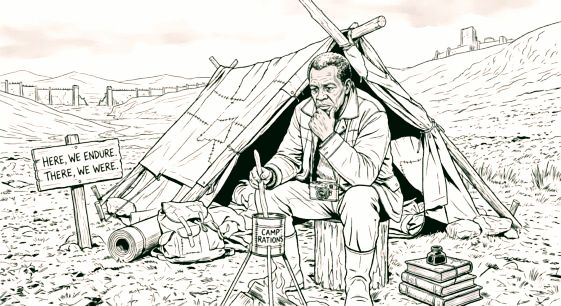
The compound was almost empty and beside the church there was a large tent peached beside the brickwork of the main church.
Peter parked beneath a palm tree many distance away from the church pick a dry ratio and began munching, an act that made neither of us to immediately got out of the car.
Then the satellite phone rang and Peter looked at it.
The number was unknown but he answered anyway.
“Hello.”
Nothing.
Then a man’s voice cracked from the other end of the cellphone.
“Are you there?”
Peter looked at me.
“Who is this?”
“You were instructed to come.”
“By whom?”
Silence.
Then:
“Go inside…”
The line went dead.
Peter placed the phone down.
“I hate this.”
“So do I.”
We entered the church.
The interior was dark and cool.
There were rows of wooden benches, an old pulpit and a large wooden cross above the altar.
No congregation.
No priest.
No music.
Only silence.
At the front of the church, someone sat alone.
His back was turned toward us.
He was wearing a dark suit.
A walking stick rested against his chair.
He appeared exhausted and his structure was bonny from head to toe, it was as if something had taken all the meat from his body leaving a walking corpse.
Peter stopped.
I did too.
The man slowly turned.
I knew him.
Not because I had met him before but because I had seen him in the visions.
The hospital bed.
The corridor.
The man with the telephone.
The businessman.
He looked older than he had in my visions.
Much older.
His face had lost its authority.
His body had become thin.
His eyes were sunken.
He looked like a man who had discovered that wealth could buy almost everything except time and death.
He looked at me.
“Oboooong.”
Peter moved forward.
“You came all the way from Kinshasa.”
The businessman nodded.
“I had toooo.”
“Why?”
He looked at his hands.
“Because Kinshasa became unsafe for my condition.”
Peter laughed without humour.
“Unsafe for your condition?”
The businessman looked up.
“Unsafe because of what I know.”
The church seemed colder.
Peter stepped closer.
“What do you know?”
The businessman looked at me.
“Everything they don’t want remembered.”
My stomach tightened.
“What is happening to you?” I asked.
He smiled weakly.
“Oblivion.”
Peter frowned.
“What?”
The businessman tapped his temple.
“That is where they want to send me.”
He pointed toward his chest.
“Not death.”
Then toward his head.
“Oblivion.”
He explained no further.
I felt the familiar pressure behind my eyes.
The businessman noticed.
“Do you hear that too.”
I closed my eyes.
Three beats.
Toom.
Dung.
Dung.
I opened them.
The businessman was frightened.
“You hear them too.”
“Who?”
“The people who were supposed to be forgotten are returning pastor, they are here for revenge, for the pain I caused them but am innocent it’s the economy of scale to blame, the system that runs the financial wheel for everything to keep flowing.”
Peter looked between us.
“Stop speaking in riddles.”
The businessman shook his head.
“I am not speaking in riddles.”
He pointed toward the empty church.
“I am speaking about how businesses and money is made.”
Peter’s expression hardened.
“Then tell us the truth.”
The businessman laughed softly.
“The truth is what I have said already?”
He looked at me.
“Do you know what happens when powerful men realise they have created too many witnesses?”
Nobody spoke.
“They don’t kill everyone.”
He leaned forward.
“They make people forget.”
A silence followed.
Peter stared at him.
“How?”
The businessman looked toward the cross.
“Money… Money is everything.”
Then:
“Fear.”
Then:
“Drugs.”
He paused.
“Religion.”
Finally:
“Stories.”
The word disturbed me.
“Stories?”
He nodded.
“People can be taught how to think, how to entertain themselves, how to dress, what to believe in and what to remember.”
Peter opened his notebook.
“What are you talking about?”
The businessman looked at him.
“History.”
Peter stopped writing.
The businessman continued.
“Erase the evidence.”
“Destroy the witnesses.”
“Replace the story.”
“And eventually…”
His voice became almost a whisper.
“…nobody remembers there was ever anything to avenge.”
I felt something move through me.
Not pain.
Recognition.
Mugenzi’s words returned.
Nothing disappears.
Sound moves.
Pain moves.
Memory moves.
Information moves.
The businessman looked at me.
“They thought they could erase everything.”
Peter leaned forward.
“Who?”
The businessman closed his eyes.
For several seconds, he seemed unable to speak.
Then he whispered:
“The Council.”
Peter went still.
I felt the pressure behind my eyes intensify.
“The Council for Economic Affairs?”
The businessman opened his eyes.
“You know them.”
“We have heard the name.”
He smiled sadly.
“You have heard the name.”
He looked toward the church doors.
“You haven’t met the people.”
Peter’s hand tightened around his notebook.
“Who are they?”
The businessman reached inside his jacket.
Peter immediately moved toward him.
But the businessman withdrew only an envelope.
He placed it on the table.
“This contains names.”
Peter took it.
“Names of what?”
“People who disappeared.”
He looked at me.
“People who were made to disappear.”
Peter opened the envelope.
Inside were lists.
Names.
Dates.
Locations.
Payments.
Medical records.
Transport routes.
Humanitarian shipments.
Political meetings.
Hospital admissions.
The pages continued.
Peter’s breathing changed.
“This is enormous.”
The businessman nodded.
“It is bigger than me.”
“How big?”
The businessman looked at him.
“Big enough to survive me.”
Peter turned another page.
Then stopped.
I saw his face change.
“What?”
He pointed.
A familiar organisation appeared on the page.
Then another.
Then another.
Names connected to humanitarian agencies.
Businesses.
Churches.
Political offices.
Security companies.
The same world that had surrounded us from the beginning.
Different names.
Different uniforms.
The same machinery.
The businessman leaned back.
“They don’t own everything.”
Peter looked at him.
“Then what do they own?”
The businessman smiled.
“Connections.”
The word echoed through me.
Connections.
Sound.
Resonance.
Movement.
Memory.
Everything was beginning to form a pattern.
Peter looked at me.
“You understand?”
“No.”
The businessman answered for me.
“He understands more than he thinks.”
I looked at him.
“What do you want from me?”
His expression changed.
For the first time, he looked genuinely afraid.
“Nothing but if you can remove the pain away from my body I will be forever greatful.”
He paused.
“I want you healing and rememberance.”
The words struck harder than anything else he had said.
Peter stared at him.
“Why?”
The businessman looked toward the cross.
“Because soon, I may not remember myself.”
The church became silent.
Then I heard it.
Three beats.
Toom.
Dung.
Dung.
The businessman began shaking.
Peter stood.
“What’s happening?”
The businessman covered his ears.
“Not again.”
The sound came again.
Three beats.
This time I felt it in my bones.
The church lights flickered.
The businessman gasped.
Then he looked directly at me.
“They are coming.”
“Who?”
He whispered:
“The people who erase.”
The doors at the back of the church opened.
A man entered.
Then another.
Both wore dark suits.
Neither carried visible weapons.
The businessman looked at them.
His face emptied.
For a moment, I saw something terrifying.
Recognition.
Then confusion.
Then nothing.
He looked at Peter.
“Who are you?”
Peter froze.
“What?”
The businessman stared at him.
“I don’t know you.”
Peter stepped closer.
“It’s me.”
The businessman shook his head.
“I don’t know you.”
I moved toward him.
“Do you know me?”
He looked at me.
His eyes were vacant.
Then he smiled politely.
“I’m sorry.”
His voice was calm.
“I don’t believe we’ve met.”
Something inside me broke.
Peter turned toward the two men.
“What did you do?”
Neither answered.
One of them reached into his pocket.
The other remained by the door.
I felt the pressure behind my eyes rise.
Then the rhythm began again.
Three beats.
Pause.
Three beats.
I closed my eyes.
The church disappeared.
I saw the cave.
The stone.
The darkness.
Peter.
The light beneath the earth.
Then the hospital.
The child.
The flute.
Mugenzi.
The businessman.
The Council.
The refugees.
The buses.
The SUV.
Every image seemed to move through me at once.
Not like memories.
Like sounds.
Everything connected.
Nothing had disappeared.
Nothing had been erased.
It had only been buried.
Waiting for the right frequency.
I opened my eyes.
Peter was staring at me.
“Obong?”
I looked at the businessman.
He no longer remembered us.
But somewhere beneath that emptiness, I could still hear his heartbeat.
Three beats.
Pause.
Three beats.
I reached for his hand.
Peter grabbed my shoulder.
“Don’t.”
I looked at him.
“He asked me to remember him.”
Peter released my shoulder.
I touched the businessman.
The room vanished.
This time there was no hospital.
No corridor.
No darkness.
There was only a voice.
Mugenzi’s voice.
Far away.
Almost buried.
Nothing disappears.
Then another voice.
A child’s voice.
Remember.
I opened my eyes.
The businessman was crying.
He didn’t know why.
Neither did I.
Peter stood beside me.
The two men at the door had disappeared.
The church was empty.
Only the three of us remained.
The businessman looked at me.
For a brief moment, recognition returned to his eyes.
“Obong.”
I leaned closer.
“What?”
He whispered:
“They will try to make you forget.”
Then his eyes closed.
The rhythm stopped.
Outside, Kampala continued as though nothing had happened.
Traffic moved.
People shouted.
Music played.
Life continued.
But inside that old church, I finally understood the true danger of oblivion.
Death could end a life.
Oblivion could erase the reason that life had ever mattered.
And if the vendetta was to mean anything at all, we would have to remember.
Not only what had been done to us.
But what had been done to everyone who had disappeared before us.
Because revenge without memory was merely violence.
Memory turned it into reckoning.
This post was created with our nice and easy submission form. Create your post!
Written by
Caesar Obong Ng'bong Ocen is a Ugandan writer whose work traverses narrative fiction, cultural memory, and moral inquiry. Drawing on African cosmologies, and reflective storytelling, his writing engages with issues of power, identity, faith, and the human condition within post‑conflict societies. His series blends political realism with interior psychological struggle, articulating the tensions between duty and conscience, tradition and modernity, exile, redemption. Obong Ng'bong's work bridges literary and social worlds: it interrogates African historical and political realities while exploring philosophical and ethical questions that resonate across disciplines. His narratives are grounded in cultural authenticity and moral depth, making them relevant to both literary and humanistic inquiry. He also mentors emerging writers and contributes to dialogue on African storytelling traditions and their place in contemporary literature.
Did this story move you? Every gift goes directly to Caesar Obong Ng'bong ocen — writers on Muwado earn from reader appreciation, not algorithms. Even $1 makes a difference.



Muwado weekly chart
Get Africa’s top 10 stories every Thursday
No account needed — just your email.
Want to follow Caesar Obong Ng'bong ocen and get notified every time they publish?
Create a free Muwado account →