

 Musanjufu Benjamin Kavubu

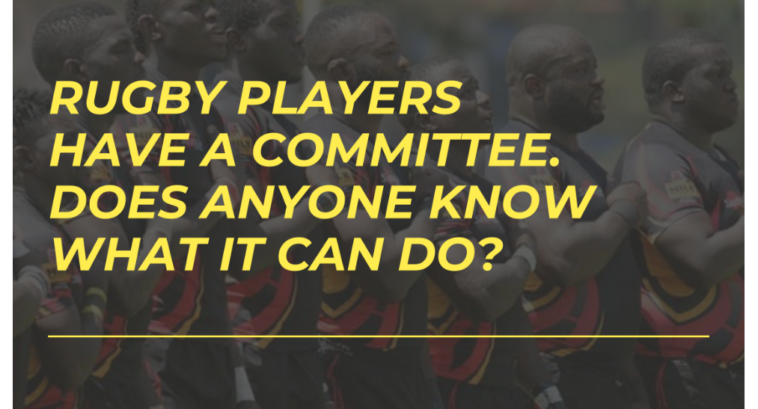
Uganda Rugby’s Athletes’ Committee is constitutionally supposed to be the most democratic structure in the federation. It is going to be the most misunderstood, the most underpowered, and potentially the most consequential but only if the players bothers to use it properly.
When Uganda Rugby adopted its 2025 Constitution, it embedded within it a structure that most club administrators, most coaches, and frankly most players themselves have never heard discussed until recently, there was no pre-season briefing, or any stakeholder meeting about the Athletes’/Players’ Committee. I don’t think this is an oversight by the drafters, it’s by design if you understand the fabric of Uganda Rugby administrators. It’s not rocket science, a properly activated Athletes’ Committee, read carefully against what the constitution actually says, is one of the few bodies in Uganda Rugby’s governance architecture that has a guaranteed seat at the table, with a vote on the highest executive body in the sport.
That is not a small thing. That is everything.
The Athletes’/Players’ Committee under Article 12.6 is composed of three categories of members. Eight are directly elected by registered active athletes in good standing, the most democratically pure provision in the entire constitution, because no ExCom appointment, no club delegate, no regional chairman stands between the players and those eight seats. The athletes according to the constitution vote, the athletes decide. Two additional members are appointed by the President of Uganda Rugby with the approval of the Executive Committee. And then there is a third category, any member of the World Rugby or Rugby Africa Athletes’ Committee who is a Ugandan citizen automatically sits on the committee by virtue of that international position.
Each category carries its own political logic. The eight elected seats are the committee’s democratic legitimacy. The two presidential appointments are where the executive’s hand reaches in, and I will return to that. The World Rugby/Rugby Africa pathway is the international thread that connects Uganda’s player voice to the global governance conversation, and it is chronically underutilised because Ugandan rugby has rarely invested in getting players onto those international bodies in the first place.
Here is where the constitution becomes genuinely interesting, and where most people’s understanding stops at the surface.
Once the Athletes’ Committee is constituted, it elects from among its own members a Chairperson and a Secretary, and the constitution explicitly requires that these two officers be of opposite genders (Art. 12.6.8). That gender balance requirement is not a decoration, it means that every Athletes’ Committee in Uganda Rugby’s history going forward must have cross-gender leadership at its top, which is more than can be said for the ExCom itself.
The Chairperson of the Athletes’ Committee then becomes, under Article 12.6.9, an ex officio Member of the Executive Committee with a right to vote. Not an observer. Not an invited guest, but a full voting member.
And under Article 16.5, which governs who is an eligible voter at an elective General Assembly, two representatives of both genders elected by the Players’/Athletes’ Committee, one female, one male each have a vote at the General Assembly itself.
So the pathway runs: athletes elect the committee, the committee elects its Chairperson, the Chairperson sits on the ExCom with a vote, and two committee representatives vote at the General Assembly. That is three democratic entry points for player voice into the highest levels of Uganda Rugby governance. The question is whether players know this, and whether anyone will ever use all three simultaneously with strategic intent.
The two presidential appointments under Article 12.6.2(b) will deserve more scrutiny, because they can easily be spies.
On paper they are a safeguard, a mechanism to fill gaps in representation, to ensure skills or constituencies the elections did not produce are still present on the committee. In practice, in a governance environment where the ExCom has historically operated with minimal accountability, they are an executive insertion point into the one body that is supposed to represent the players independently, that’s why they can easily be bu KGBs for the Kasasas.
Think about what this means in concrete terms. The eight elected members could be predominantly from upcountry clubs, from women’s rugby, from age-grade backgrounds, genuinely representative of the breadth of Ugandan rugby. The President then appoints two members. If those two are chosen to dilute a reform minded committee or to ensure a loyalist presence, the 8-2 majority still holds mathematically, but the committee’s culture and its relationship with the ExCom shifts. Presidential appointees owe their seats to the President, because they are tokens. Elected members owe their seats to athletes. Those are different mandates, and they will eventually pull in different directions.
The constitution provides no criteria for those two appointments beyond gender balance across the full committee. There is no requirement that they be active athletes. There is no prohibition on appointing someone who is simultaneously an ExCom member or club official. That gap is exploitable, and in Uganda’s rugby context, where institutional inertia has long favoured central control, it is worth naming before it is exploited.
Article 12.6.4 states that the Executive will arrange elections for Athletes’ Committee members “at a date after finalisation of the World Rugby elective General Assembly.” I pointed this out when Dr Katumba Adruf (PhD) shared rhe constitution on X in my own mundane analytical way. That bit of the constitution doesn’t make sense given what is going on.
Let us be honest about the amateur reality first, because any discussion of the Athletes’ Committee that does not start from Uganda’s actual rugby context is fantasy governance.
Most players in Uganda Rugby play without contracts, without stipends, and without any formal documentation of their relationship to their clubs. They travel to matches using personal funds or allowances that arrive inconsistently. Their medical cover during competition is either non-existent or provided through informal arrangements that evaporate the moment a serious injury occurs, Ruben keeps on reminding us about this on almost every fatcats X space and it’s from his personal lived experience. They retire from the national team and discover that four years of wearing the Cranes jersey has left them with no career pathway, no pension provision, and no formal recognition that would open doors in administration or coaching especially if they didn’t take rugby education seriously as Edwin admonishes players to during that space.
The Athletes’ Committee, properly resourced and properly mandated, should be the institutional voice that names these conditions publicly, tracks them systematically, and holds the ExCom accountable for improving them. That is not a radical demand. It is the minimum that Article 12.6.1 of the constitution actually describes when it says the committee shall “address issues related to athlete welfare, rights, and development.”
But the real frontier is the one that will define whether this committee becomes consequential in the next decade, and is not welfare in the traditional sense. It is image rights in the age of streaming.
Uganda Rugby has begun attracting broadcast interest, so many want to be part of the sport even if it’s sort of ring fenced at the moment. Matches appear on local television. Very few clips circulate on social media, which is a wanting area but step in the right direction. The Enterprise Cup is going to generate highlight packages in the future. The national team’s fixtures now draw streaming audiences beyond Uganda’s borders. This is nascent, but it is real, and its trajectory points in one direction only.
Every time a player appears in that broadcast footage, their face, their performance, their name on a graphic, something of commercial value is being created. The question of who owns that value, and whether any part of it will flow back to the player, is a question that Uganda Rugby’s constitution does not answer. It does not answer it because no one has yet forced it to be asked, Captain Ivan tried to but was overtaken by very many events.
In more mature rugby economies this question has been fought over extensively. World Rugby’s own Image Rights Policy establishes that players have individual image rights that are separate from the federation’s commercial rights in a broadcast. When a federation sells broadcasting rights to a competition, it is selling the right to show the competition, but the individual player’s image, name, and likeness carry separate rights that in professional contexts are negotiated through player associations and unions.
Uganda Rugby is not a professional environment. But the gap between amateur and professional is closing faster than the governance structures are moving. Play It Loud, Uganda’s homegrown streaming platform, is already broadcasting local content. NBS TV covers rugby but as the East African broadcasting market deepens, and it will the moment will arrive when Uganda Rugby signs a broadcast deal of genuine commercial value, and the players whose performances made that deal possible will receive nothing, because there is no mechanism in place to ensure otherwise.
The Athletes’ Committee is the constitutionally designated body to change this. Article 12.6.1 mandates it to “address issues related to athlete welfare, rights, and development” and to “act as a liaison between the Athletes and the Executive in advocating for Players’ concerns.” Image rights in a broadcasting context are a player’s concern. Streaming residuals are a player’s concern. The commercial use of a player’s likeness on a federation’s social media channels is a player’s concern.
A properly activated Athletes’ Committee should be drafting an Image Rights Policy and presenting it to the ExCom for adoption before Uganda Rugby signs its next broadcast deal, not after but before. Because once the commercial framework is established without player protections, retrofitting them is exponentially harder.
The generation of rugby players currently coming through Uganda’s schools and possibly university competitions has grown up watching themselves on phones. They understand, at an instinctive level, that their performances are content. They know that content has value. What they do not yet have is the institutional architecture to translate that understanding into negotiating power.
The Athletes’ Committee is that architecture, if it is built properly. A committee that meets at least twice a year as Article 12.6.10 mandates, but in practice meets far more frequently, will build a policy agenda, and uses its ExCom seat strategically to become the body that ensures Uganda’s rugby players enter the streaming economy as rights holders rather than as unpaid performers.
This requires the committee to think beyond match fees and medical cover, important as those are. It requires thinking about data, who has access to player performance data generated by GPS systems and the many AI camera trakers, and whether clubs can sell that data to analytics platforms without player consent. It requires thinking about social media, whether the federation can use a player’s image in a commercial sponsorship post without a licensing arrangement. It requires thinking about name and likeness, whether a jersey with a player’s name when we get there can be sold without any return to the player.
None of these questions have clean answers in Uganda’s legal framework yet. That is precisely why the Athletes’ Committee needs to be asking them now, while the commercial framework is still being built, rather than ten years from now when the precedents are set and the leverage is gone.
One final observation worth making. The Athletes’ Committee eligibility criteria under Article 12.6.3 set a minimum age of 18 with no upper limit correctly recognizing that a recently retired national team player of 32 may have more to contribute to athlete governance than someone who has never played at the top level. The ExCom eligibility criteria under Article 16.3, by contrast, set a floor of 35.
This creates a constitutional gap at the intersection of the two bodies. The Athletes’ Committee Chairperson, who under Article 12.6.9 becomes an ex officio ExCom member could theoretically be 25 years old. They would hold a voting seat on the ExCom despite being ineligible to stand for any other ExCom position. That is not a problem. It is actually the constitution accidentally doing something right, creating a pathway for young, active players to hold executive power that the general eligibility criteria would otherwise deny them.
The question is whether anyone running for Athletes’ Committee Chairperson in Uganda knows this. Whether any player in their mid-twenties with genuine governance ambition understands that the fastest route to the ExCom table with a vote runs not through the 35-year minimum age gate but through the Athletes’ Committee door that has no upper age bar and an 18-year floor.
If they do not know it, someone should tell them. That is what this article is for.
The 2025 Constitution of Uganda Rugby has given athletes a more direct pathway to executive power than most amateur sports federations on this continent provide. Eight directly elected seats. A guaranteed ExCom chair. Two General Assembly votes. Twice-yearly meetings. A mandate covering welfare, rights, development, and fair play.
What it has not done is guarantee that any of this will be used. The World Rugby dependency in Article 12.6.4 means elections can be delayed. The presidential appointments in Article 12.6.2(b) mean the executive’s hand is inside the tent. The absence of any image rights, data rights, or streaming policy framework means the commercial future is being built without the players at the table.
The committee is a tool. Tools require people who know how to use them, and who care enough to pick them up.
Uganda rugby’s players from the Eagles to the schools competitions, from the Enterprise Cup clubs to the regional associations are the ones who fill the stadiums, generate the footage, carry the jerseys, and produce the content that sponsors and broadcasters are beginning to pay for. The Athletes’ Committee is, on paper, their institutional voice in the room where decisions about all of that are made.
The 2027 season will test whether the players’ voice will finally speak clearly. The constitution has already given it a seat. The question is whether anyone will sit in it.
This post was created with our nice and easy submission form. Create your post!

Written by
<a href="https://benjaminwatchblog.wordpress.com/">Benjamin WATCH blog</a>, Community Manager <a href="http://afrobloggers.org.zw/">Afrobloggers</a>, Social Media and Africa Lead Coordinator Africaniwa, Real Estate enthusiast, Team Manager <a href="https://kyambogorugby.com/">Kyambogo Rugby </a>
Did this story move you? Every gift goes directly to Musanjufu Benjamin Kavubu — writers on Muwado earn from reader appreciation, not algorithms. Even $1 makes a difference.


Muwado weekly chart
Get Africa’s top 10 stories every Thursday
No account needed — just your email.
Want to follow Musanjufu Benjamin Kavubu and get notified every time they publish?
Create a free Muwado account →