

 Ochieng Umira

What happens to African cinema when the gates suddenly close?
For years, filmmakers across the continent were told that salvation would arrive through streaming platforms. We were encouraged to believe that if African stories were “good enough,” global algorithms would eventually reward us with visibility, sustainability, and legitimacy. But today, the illusion is collapsing in real time.
As global streaming corporations become increasingly risk-averse, selective, and profit-driven, African creators are once again confronting an uncomfortable truth: we do not own the infrastructure that circulates our stories.
The retrenchment of platforms, shrinking commissioning budgets, and algorithmic invisibility of African content reveal a deeper crisis—not simply of distribution, but of sovereignty.
And perhaps the most important question now is this:
Why are we still designing African film distribution systems that depend almost entirely on foreign digital gatekeepers?
For decades, academic discourse and policy frameworks treated Africa’s so-called “informal” distribution networks as a problem to be corrected. Street vendors, WhatsApp circulation, community screenings, pirate DVD economies, influencer networks, and social media creators were framed as evidence of institutional failure rather than adaptive innovation.
But what if we have misunderstood the ecosystem entirely?
What if the future of African cinema will not emerge from imitating Hollywood’s collapsing models, but from engineering new decentralized systems rooted in African digital realities?
The post-streaming era demands a radical rethinking of how African moving images travel.
It requires us to stop seeing influencers, YouTubers, comedians, meme creators, and digital communities as cultural distractions. They are not peripheral to cinema anymore. They are rapidly becoming the continent’s most powerful distribution infrastructure.
The future African distributor may not own a cinema chain.
They may own a smartphone, a YouTube network, and an audience of 10 million loyal followers.
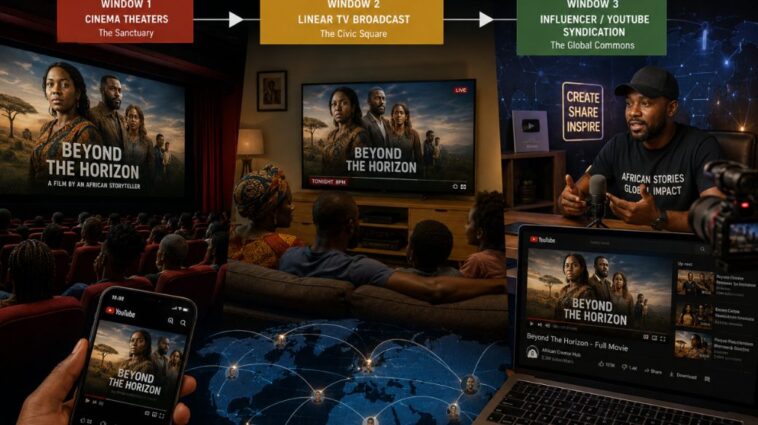
The Three-Tier Architecture of African Film Distribution
If African cinema is to survive and scale sustainably, independent filmmakers must reject the fantasy of instant streaming releases as the primary pathway to visibility. Instead, we need a strategic release ecosystem that preserves cinematic value while maximizing audience reach.
Window 1 — The Cinematic Sanctuary
Physical Exhibition
Cinema theaters still matter.
Not because Africa has enough screens—it does not—but because theatrical exhibition gives film cultural weight, prestige, ritual, and economic positioning. The theater transforms film into an event rather than disposable content.
Even limited theatrical runs across major African cities can:
- Build critical legitimacy
- Generate concentrated revenue
- Create media conversation
- Strengthen audience attachment
- Delay uncontrolled digital circulation
The theater remains cinema’s sacred space.
Window 2 — The Civic Square
Linear Television
While policymakers and film schools obsess over streaming, millions of African households still consume stories primarily through television.
Linear broadcasting remains one of the continent’s most powerful public spheres.
Television offers:
- Mass domestic reach
- Immediate licensing income
- Household normalization of local narratives
- Cross-generational accessibility
- National cultural penetration
In many African countries, television still reaches audiences that streaming infrastructure cannot.
Ignoring this reality is not innovation. It is elitism disguised as technological progress.
Window 3 — The Global Commons
Influencer-Led Digital Syndication
This is where the paradigm fundamentally changes.
Instead of begging global SVOD platforms for visibility, filmmakers should collaborate directly with Africa’s largest digital creators and influencer ecosystems.
Why build an audience from zero when African creators have already mastered audience retention, recommendation algorithms, and cross-border digital circulation?
The future model is not filmmaker versus influencer.
It is filmmaker plus influencer.
This creates a decentralized peer-to-peer distribution architecture capable of bypassing traditional corporate gatekeeping entirely.
Africa Has Already Built the Infrastructure — We Simply Refused to Recognize It
Across the continent, digital-native creators have already decoded the mechanics of algorithmic visibility.
North Africa — Cinematic Pop Power
Figures like Mohamed Ramadan demonstrate how music, celebrity culture, and cinematic aesthetics can merge into a transnational digital ecosystem capable of dominating North African and Middle Eastern feeds simultaneously.
West Africa — Borderless Vernacular Storytelling
Creators such as Khaby Lame and Mark Angel prove that African storytelling no longer requires Western mediation to achieve global circulation.
Khaby Lame dismantled linguistic barriers through silent performance.
Mark Angel built massive loyalty through localized vernacular humor and grassroots digital storytelling.
Both models expose an uncomfortable truth for traditional cinema institutions:
audiences increasingly reward authenticity, relatability, rhythm, and shareability over industrial polish.
East Africa — The Rise of Multimedia Empires
In East Africa, Diamond Platnumz transformed music distribution into a multimedia empire through Wasafi.
Simultaneously, creators like Fanuel John Masamaki (Zerobrainer0) demonstrate how surreal short-form visual storytelling can generate massive continental engagement through meme culture, sports, and digital repetition.
These are not isolated internet personalities.
They are emerging media institutions.
Central Africa — Community-Driven Circulation
Creators like Herman Amisi and Rosine Officiel reveal how Francophone African audiences sustain highly engaged circulation networks despite infrastructural limitations.
Their success demonstrates that distribution power is no longer determined solely by formal infrastructure.
Community circulation itself has become infrastructure.
Southern Africa — Mastering Retention Economies
South African creator Wian Vandenberg exemplifies the mastery of retention-driven storytelling optimized for modern recommendation systems.
This is not merely entertainment.
It is algorithmic engineering.
And African cinema education can no longer afford to ignore it.
The Economic Revolution: From Dependency to Peer-to-Peer Ownership
This model fundamentally changes how African film economies operate.
Instead of surrendering ownership to external streaming corporations, filmmakers and creators can function as equal stakeholders within decentralized monetization ecosystems.
Possible frameworks include:
- Shared AdSense revenue models
- Embedded brand partnerships
- Creator-led premium membership access
- Eventized livestream premieres
- Regional digital licensing cooperatives
- Cross-platform audience syndication
The goal is no longer simply “getting onto Netflix.”
The goal is building African-owned circulation systems capable of surviving without Netflix.
That distinction changes everything.
As Film Lecturers, What Are We Teaching Our Students?
This is where the conversation becomes urgent.
As film lecturers, are we still preparing students for an industry that no longer exists?
Are we teaching African filmmakers how to survive inside collapsing twentieth-century distribution structures?
Or are we equipping them to understand algorithms, audience retention, digital sociology, platform economics, creator ecosystems, and decentralized circulation?
Too many film curricula across Africa still romanticize:
- Western festival validation
- Corporate streaming acquisition
- Eurocentric production hierarchies
- Traditional gatekeeping structures
Meanwhile, the actual audience economy has already shifted.
Our students are entering a world where:
- TikTok edits shape film discovery
- YouTube creators command larger audiences than television stations
- Meme culture influences narrative consumption
- Digital communities determine cultural relevance faster than institutions
If film education refuses to evolve, African cinema risks producing graduates trained for an industry architecture that is already disintegrating.
A Call for Policy, Pedagogy, and Imagination
African ministries of culture, national film boards, universities, and creative industries must stop separating “cinema” from “digital culture.”
That division no longer reflects reality.
We need:
- Modernized intellectual property frameworks
- Distribution innovation funds
- Creator-filmmaker collaboration grants
- Curriculum reform in film schools
- Training in algorithmic literacy and digital monetization
- Regional creator-distribution alliances
- African-owned digital exhibition ecosystems
The future of African cinema will not be secured by nostalgia.
It will be secured by infrastructure, adaptation, and imagination.
The continent already possesses the storytellers.
The real question is whether we are ready to redesign the systems that allow those stories to move freely across borders, platforms, languages, and generations.
And perhaps the deepest philosophical question of all is this:
If African cinema does not control the pathways through which its stories travel, can it ever truly claim ownership of its own cultural memory?
This post was created with our nice and easy submission form. Create your post!

Written by
I am a film scholar and educator investigating the convergence of digital technology, media policy, and creative economics in Africa
Did this story move you? Every gift goes directly to Ochieng Umira — writers on Muwado earn from reader appreciation, not algorithms. Even $1 makes a difference.






Muwado weekly chart
Get Africa’s top 10 stories every Thursday
No account needed — just your email.
Want to follow Ochieng Umira and get notified every time they publish?
Create a free Muwado account →