

 Musanjufu Benjamin Kavubu

In the forming world order, it is not in the interest of the Global South to pick sides. Instead, it is in the interest of every power on the planet to put its own interests first. Experts and scholars have always warned about the effects of geopolitical shockwaves on global chokepoints. When the Strait of Hormuz in the Persian Gulf became a conflict zone in early 2026 following coordinated US-Israeli strikes on Iran, the warnings that had lived in research papers and policy reviews for decades became concrete and immediate. The 2026 Iran war, including the closure of the Strait of Hormuz, produced what the International Energy Agency characterised as the largest supply disruption in the history of the global oil market. Brent crude surged past $120 per barrel, QatarEnergy declared force majeure on all exports, and the maritime blockade triggered cascading economic shockwaves across continents.
But while the world watched the Persian Gulf, a quieter and potentially more consequential conversation was unfolding in Western policy circles. That conversation concerns the Strait of Malacca, the other great chokepoint of global commerce, and what Washington might do to control it in its bid to contain China. The lessons of the Hormuz crisis are not yet being absorbed by those driving that conversation. They should be, because the consequences of a Malacca disruption would not fall primarily on China. They would fall on the Global South. They would fall on Africa. They would fall on East African ports. And they would fall, with compounding ferocity, on landlocked countries like Uganda, Burundi, Rwanda, South Sudan, and the Democratic Republic of Congo.
The Architecture of the Strait
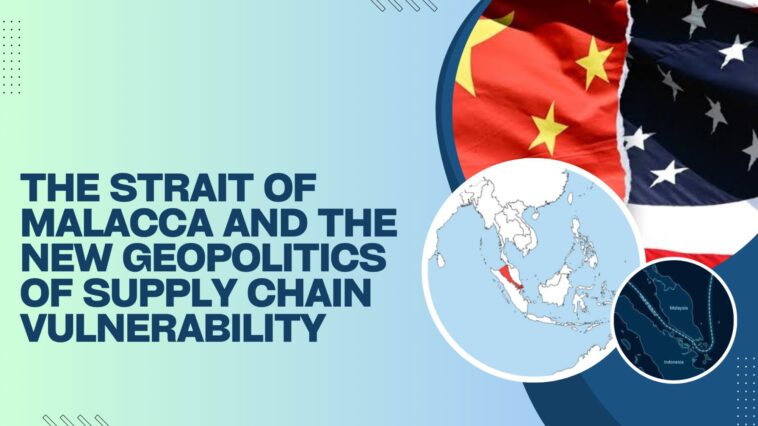
To understand why, it is necessary to understand exactly what the Strait of Malacca is and what moves through it. The Strait of Malacca is a crucial waterway linking the Andaman Sea and the South China Sea, spanning 500 miles with a funnel shape that narrows to just 40 miles in the south. The volume of trade that passes through it annually reaches $3.5 trillion, representing one third of all global trade, two thirds of China’s maritime trade volume, and 40 percent of Japan’s maritime trade.
As of the first half of 2025, the strait handled an estimated 23.2 million barrels of oil per day, accounting for 29 percent of total global maritime oil flows. Crude oil and condensate made up most of the volume at 16.6 million barrels per day, while liquefied natural gas flows through the waterway reached approximately 9.2 billion cubic feet per day. China remained the single biggest destination, taking in 7.9 million barrels per day, representing 48 percent of total import volumes.
Each year, roughly 6.4 billion deadweight tons of cargo pass through the strait, with about ten vessels entering or exiting every hour. Most of these shipments consist of fossil fuels from the Middle East and Africa. China is the world’s largest energy consumer, accounting for 25 percent of global energy consumption, and over 83 percent of its oil imports transit the Strait of Malacca.
These are not logistics statistics. They are a description of the circulatory system of the global economy. At its narrowest point near Singapore, the strait contracts to just 2.7 kilometres, barely wider than the length of a modern container ship. If the strait were a country, the value of goods passing through it annually would rank it among the world’s largest economies.
The Geopolitical Contest Nobody in the Global South Asked ForThe Strait of Malacca sits inside the Malay Archipelago, a vast island network of more than 25,000 landmasses stretching from the South China Sea to the Pacific. The principal parties to the strait itself are Indonesia, Malaysia, and Singapore, three sovereign states with their own foreign policy positions and their own strategic interests. Singapore hosts Changi, a significant American military logistics hub. The Philippines, a broader archipelago nation, hosts nine American military bases positioned directly facing the South China Sea. These installations exist under the doctrine of freedom of navigation, a phrase that has always meant something specific in practice: freedom for American naval power to project into waters adjacent to China.
What makes the current moment distinctive is that the balance of political alignment is shifting. The Strait of Malacca between Malaysia and Indonesia is a chokepoint through which around 40 percent of global maritime trade passes, and an important Chinese military education text explains that at present and for a certain period in the future, the main route of China’s maritime transport is from the South China Sea into the Indian Ocean and the Red Sea through precisely this waterway.
Indonesia, the largest state in the archipelago, is among the ten full members of BRICS, having joined on 6 January 2025. Malaysia is a BRICS partner state. Vietnam and Thailand, both significant archipelago nations with coastlines along the South China Sea, are also BRICS partner states. These countries are not declaring themselves enemies of Washington. They are doing what the Global South has increasingly learned to do: pursue parallel relationships, maintain strategic ambiguity, and refuse to be conscripted into a binary choice between Washington and Beijing.
Washington, under the current administration’s doctrine of containment, will most likely wish to counter that. Chinese exports to ASEAN surged 22.5 percent in July 2025, reaching $57.1 billion, while exports to the United States plunged 33.1 percent to $31.6 billion, making ASEAN China’s top export destination. Further, the region is deeply integrated into global supply chains, with many multinational firms implementing a China Plus One strategy, shifting production to countries like Vietnam, Thailand, and Malaysia while maintaining close ties with Chinese manufacturers.This means that any American attempt to use military or political leverage over the Malacca corridor to contain China would disrupt not just Chinese exports but the entire Southeast Asian production network that has become the world’s alternative manufacturing base. It would disrupt the Global South’s access to the goods, the industrial inputs, and the development infrastructure that currently flows through that waterway.
What This Means for Africa, East Africa, and Uganda Specifically
The connection between the Strait of Malacca and the price of goods in Kampala’s markets is not abstract. It is a supply chain relationship that operates through identifiable, traceable routes.
Chinese manufactured goods bound for East Africa travel by container vessel from ports in Guangzhou, Shanghai, and Shenzhen through the South China Sea, through the Strait of Malacca, across the Indian Ocean, and into the Port of Mombasa or the Port of Dar es Salaam. From those entry points, goods travel overland through the Northern Corridor or the Central Corridor to reach Uganda, Rwanda, Burundi, South Sudan, and eastern DRC. Every kilometre of that journey passes through infrastructure that ultimately depends on the navigability of the Strait of Malacca.
Landlocked countries such as Uganda, Rwanda, Zambia, and the DRC, which rely heavily on the Central Corridor through Dar es Salaam, face uncertainty in routing, timing, and costs whenever any link in that chain is disrupted. Border crossings affected by broader regional tensions further compound these difficulties, leaving freight forwarders and shippers managing trade in and around East Africa with standard lead times that are no longer reliable.
The Hormuz crisis of 2026 produced an extraordinary reversal that illustrated just how exposed this regional architecture is. In a rare reversal of regional dynamics, Kenya formally reached out to Uganda seeking access to its fuel reserves as delays in global shipments pushed the country toward a potential supply crunch. Kenya’s fuel system, heavily dependent on imports through the Port of Mombasa, came under strain after cargo delays disrupted supply flows, with officials warning that operational stocks could fall to critical levels by mid-April 2026. A landlocked country was more energy secure than a coastal one, exposing the risks of just-in-time import models and highlighting why strategic reserves have become a non-negotiable policy priority.
That reversal is instructive but it is not a solution. Uganda’s energy security in April 2026 reflected earlier strategic investment in reserves, not a structural resolution of its vulnerability. A Malacca disruption, which would affect the entire Indian Ocean supply corridor rather than just the Gulf route, would reach Uganda through multiple channels simultaneously: higher prices for Chinese manufactured goods, disrupted fertiliser imports, stalled industrial inputs for Chinese-funded manufacturing projects, and constrained access to the EV components and green technology products that are increasingly important to the continent’s energy transition.
Uganda is under comparable difficulties to Ethiopia when it comes to fertiliser supply chains, due to its reliance on imports and structurally weak demand-side resilience. In East Africa broadly, fertiliser demand is high and expanding due to staple crop output and government-sponsored input subsidy programs, but the risks are progressively increasing as geopolitical tensions continue to affect maritime chokepoints.
The South-South Framework Is the First Casualty
There is a dimension to this analysis that goes beyond the immediate economics. China-Africa trade currently accounts for approximately 22 percent of the continent’s total trade. The entire Global South accounts for roughly 40 percent of China’s exports, and a large portion of that movement passes through the Strait of Malacca on its way to Indian Ocean destinations. This is the operational infrastructure of South-South cooperation, the framework through which the Global South has built genuine alternatives to Western-dominated trade and financial architecture.
The post-Second World War supply chain architecture was designed to serve Washington and its allies. The BRI, the African Union’s industrialisation agenda, China’s industrial parks across the continent from Ethiopia to Nigeria to Ghana, and the duty-free access that African exporters now have to the Chinese market are all, in varying degrees, corrections to that original design. They represent decades of institutional building aimed at giving the Global South the capacity to participate in global commerce as producers rather than merely as sources of raw materials.
A disruption to the Strait of Malacca, whether through military action, targeted destabilisation, or the kind of escalatory miscalculation that geopolitics specialises in, would take those gains back by decades. It would not be oil prices alone sparking economic uncertainty. It would be the price of every product labelled made in China. It would threaten the African farmers who have just made their first exports to the Chinese market under duty-free arrangements. It would threaten the Western industries investing in African manufacturing that depend on the same supply chains for components and capital equipment. It would threaten the electric vehicle transition on which Africa’s energy future depends, because the battery supply chains for EV technology run directly through the factories and ports of the Malay Archipelago.
The disruptions and rising costs from chokepoint pressures are not affecting all countries equally. Small island developing states and least developed countries are experiencing the worst impacts. An analysis found that sustained rises in container freight rates could push global consumer prices up by 0.6 percent, with the impact on the most vulnerable economies potentially reaching 0.9 percent, and processed food prices rising by 1.3 percent. These are headline figures. The lived reality at household level in Kampala, Kigali, or Juba is significantly more severe.
The Question Africa Cannot Afford to Defer
In the forming world order, no power is purely benevolent and no chokepoint is permanently secure. The Global South’s strategic interest is not alignment with Washington against Beijing or with Beijing against Washington. It is the maintenance of the supply chain stability on which its development trajectory depends. That stability requires active engagement, not passive observation.
African governments need scenario planning frameworks that map their supply chain exposure to Malacca-level disruptions, not just Hormuz-level ones. African businesses, particularly the growing cohort of startups operating across logistics, agritech, health supply chains, and manufacturing, need to understand that geopolitical risk is not a background condition but a primary operational variable. African individuals who depend on Chinese manufactured goods, Chinese-built infrastructure, and Chinese-funded industrial capacity need to understand that the waterway in the Malay Archipelago that they have never heard of is already embedded in the price of the device in their hand.
The Strait of Malacca carries one third of the world’s trade through a passage 2.7 kilometres wide. It is controlled by three sovereign states, two of which have chosen multipolarity. It is coveted by a superpower that has demonstrated in the Persian Gulf what it is willing to do when chokepoints stop serving its interests.
The Global South did not build that waterway. It did not draw those borders or station those military assets or design that dependency. But it lives with the consequences. The question is whether it will live with them passively, or whether it will begin now to build the strategic reserves, the alternative routes, the regional supply chain architectures, and the political frameworks that would allow it to absorb the next disruption rather than simply suffer it.
The answer to that question will determine how much of the 21st century’s prosperity the Global South actually keeps.
This post was created with our nice and easy submission form. Create your post!

Written by
<a href="https://benjaminwatchblog.wordpress.com/">Benjamin WATCH blog</a>, Community Manager <a href="http://afrobloggers.org.zw/">Afrobloggers</a>, Social Media and Africa Lead Coordinator Africaniwa, Real Estate enthusiast, Team Manager <a href="https://kyambogorugby.com/">Kyambogo Rugby </a>
Did this story move you? Every gift goes directly to Musanjufu Benjamin Kavubu — writers on Muwado earn from reader appreciation, not algorithms. Even $1 makes a difference.






Muwado weekly chart
Get Africa’s top 10 stories every Thursday
No account needed — just your email.
Want to follow Musanjufu Benjamin Kavubu and get notified every time they publish?
Create a free Muwado account →