

 Shanine L Ahimbisibwe
For so long, I have thought about the anomalous situation many of us find ourselves in.
I am a Mukiga, born to a Mukiga father from Kigezi, whose family relocated in the 70s in search of greener pastures, and a Mukiga mother from Kigezi too, whose family remains rooted in the land, cultivating it and returning the love it gives them.
This is as Mukiga as it gets.
My parents both came to Kampala later in life, pursuing education. Let’s call them academic migrants. My siblings and I were born in Kampala, if we can generously call this small, organically sprouted village-cum-suburb-cum-parish on Masaka Road that.
We understood Rukiga and spoke it perfunctorily. Our parents spoke it to us and we spoke it back to them, though quite rarely amongst ourselves and even more rarely outside ourselves.
We spoke Luganda too. This is Buganda, after all. It is therefore unsurprising that we spoke it fluently. It was the playground language, the language in which we asked for soap, sugar, and paani at the shops.
We spoke English. We learnt how to read and count in English. It was an aspirational language too. Raised on American movies, British sitcoms, Celine Dion lyrics, and the occasional Nigerian film, there were more English influences in our pop culture than all other languages combined.
At school, there were punitive consequences for speaking any language other than English. I always found this strange, considering the teachers themselves, who happily doled out punishment for vernacular-speaking, often struggled to speak the same English they beat us for not speaking correctly, or for the typos we made in exams. I wish they knew we still make typos and now rely on computers to correct them.
Perhaps they simply wanted a better life for us.
English was the language. Good grammar, polished diction and the confidence to go with them were akin to being smart, cool, rich, and generally destined for greatness. In primary school, it gave you a place in the pecking order, determined the friends you made and influenced how teachers treated you. Things changed a little the older we got and, fortunately, by university, much of this notion had been dispelled.
Rukiga. Luganda. English.
Rukiga surrounded us in many ways. Our lives echoed it. So did our mannerisms. I have a distinct memory of my father pulling out a copy of Engesho z’aBakiga and having us read a few pages together. And another on totems and clans. Our hearts, bodies, and minds knew the language belonged to us, and we spoke it back when spoken to, but there was barely any room to exercise the Rukiga muscle between school and playgrounds and markets where only Luganda was spoken and, sometimes, understood. Six years of secondary school, nine seasons of Desperate Housewives, and volumes of Jackie Collins later, English became the language we spoke with ease, the language we thought in, argued in, and inhabited most naturally.
Rukiga merely peppered our conversations, giving them texture in the way slang does. It delivered a sweet punchline. Eventually, it became little more than that. Our parents, too, eventually contended with it.
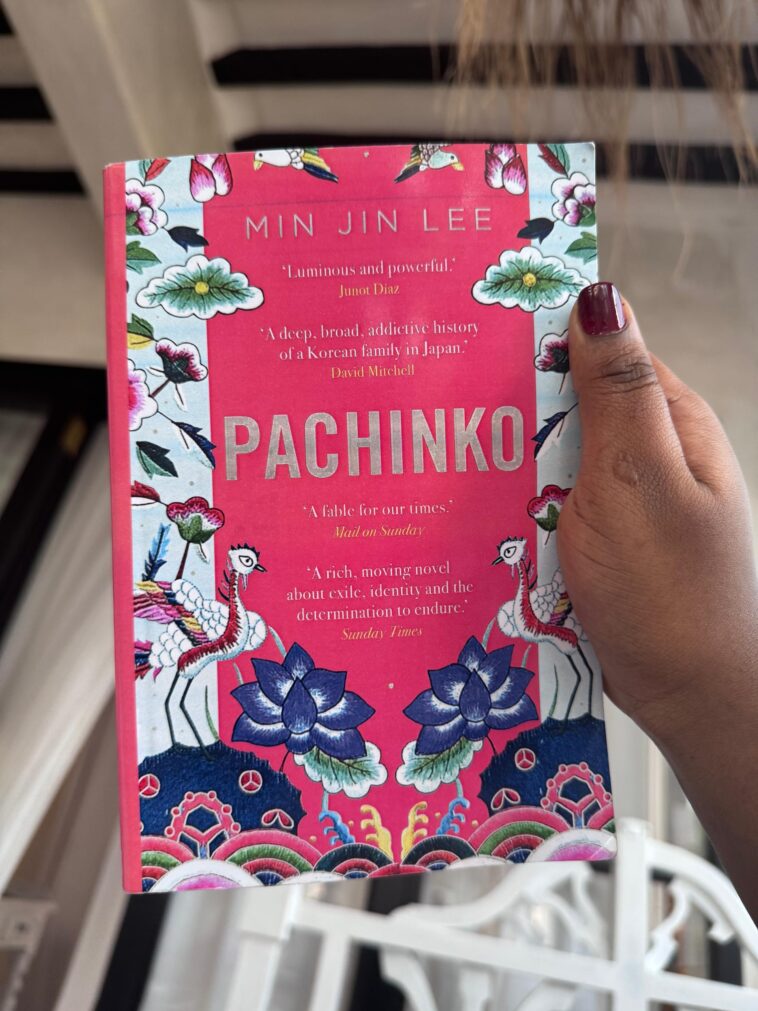
Now, reading the final pages of Pachinko, where third generation Japanese-Koreans in Japan contend with identity, feels deeply relatable. Certainly their identity questions and experiences extend beyond language, but relatable all the same.
A language, culture, and way of being that was forced upon their predecessors, they adopted for survival, continues to remind them that it no longer wants them. At the end of World War II, the same Japan that had colonised Korea and shipped able-bodied men and women from Seoul to Kyoto in droves refused to grant them citizenship, relegating them and their descendants to alien status.
In Pachinko, the Japanese do not fully accept Koreans. They think they are lazy, angry, thuggish, beneath them, lower caste. Though they are born in Japan, have Japanese names, and embody Japanese customs, they are not Japanese because Japanese society refuses to share that identity with them.
They are neither North Korean nor South Korean. They are simply Korean because, when their families first came to Japan in the early twentieth century, there was only one Korea. It was also a colony of Japan so whether they were in Osaka, Pyongyang, or Seoul hardly mattered.
Then, through the 1980s, the period in which much of the book is set, they remained clothed in a new language, culture, beliefs, cusine… desperately holding onto their own in hope of one day returning to it. Only for it to have slipped from their memories and bodies by the time they could.
It is 1985. Japan is thriving. They are thriving too. Yet their identity remains a stone lodged in the throat, something they cannot fully explain or understand. They are too lowly for Japanese, too uppity for South Koreans, and too… well, who knows what North Koreans think.
Back to me.
I generally hold my own comfortably, but a conversation lasting more than five minutes reveals just how questionable my Rukiga is. Things become even more complicated when I cross the Equator and, while happy to hear the familiar language all around me, realise I have more to say than I actually can because the speed of thought cannot keep up with the translation happening in my head. When I’m nursing a drink with my tribesmen and the language, jokes, and colloquialisms flow effortlessly off their tongues. When my friend makes a joke and I have one better, but translating it from English to Rukiga does not happen in time and the delivery falls flat…
When I know English mitigates and pacifies, but also smooths over the rough edges I sometimes want to preserve in conversation. When my Rukiga runs out midway through a sentence and breaks apart, and the whole thing feels borderline embarrassing.
Luganda, my other language, I speak with my chest all the same, but find myself severely deficient in the mannerisms, tact, and delivery that accompany it. It remains there: helpful, enjoyable, good to know, but not entirely mine. In this language, I am, like my parents were, a visitor.
English, which became the de facto language of comprehension and fluency, the language in which I think and speak freely, is another person’s language too. Another whose ownership feels distant now that we are a proud republic. In this language as well, I am, like my parents were, a visitor.
A Kampala Mukiga. A Japanese Korean.
Our identities remain “all over the place.”
This post was created with our nice and easy submission form. Create your post!
Written by
Did this story move you? Every gift goes directly to Shanine L Ahimbisibwe — writers on Muwado earn from reader appreciation, not algorithms. Even $1 makes a difference.





Muwado weekly chart
Get Africa’s top 10 stories every Thursday
No account needed — just your email.
Want to follow Shanine L Ahimbisibwe and get notified every time they publish?
Create a free Muwado account →