

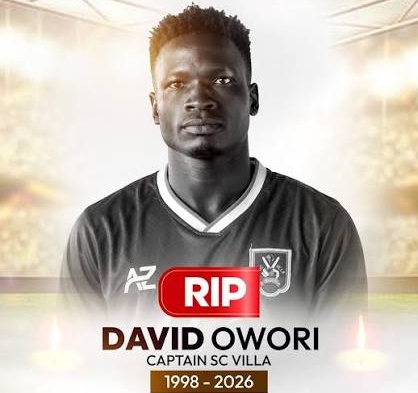
 Tema Innocent

Justice for David Owori. Justice for Sydney Gongodyo. Safety for Every Citizen. The Time for Empty Words Is Over.
The phone call came just after midnight. David Owori’s father, Eriasaf Osinde, picked up, expecting to hear his son’s voice. Instead, he heard the words no parent should ever hear.
By the next morning, the 27 year old SC Villa captain was dead. Beaten with paving stones by robbers just steps from his Makindye home. Another young life snatched. Another national talent gone. And once again, Kampala’s streets had claimed a son of the game.
August 4, 2026. 8 PM. Makindye.
Owori was walking home. His residence was in sight. Then the shadows moved.
A group of unidentified assailants ambushed him. They wanted his phone, his belongings. What happened next suggests Owori fought back. The attackers responded with terrifying brutality, striking him repeatedly with paving stones until he lay unconscious on the dark road.
Passersby found him. Rushed him to a nearby facility. Then to Case Clinic for specialised care. The doctors tried. They really tried.
But the injuries were too severe.
On August 5, SC Villa confirmed the devastating news. Their captain was gone.
This is not an isolated tragedy.
Barely two months earlier, on June 5, another sports star had died in equally senseless circumstances. Sydney Gongodyo, 27, a forward for the Uganda Rugby Cranes and Stanbic Black Pirates, was attacked by a mob in Bukoto. CCTV footage later showed the truth: he was an innocent passerby. Actual bag snatchers had fled on a motorcycle. But the crowd did not wait for evidence. They set upon him. Punched. Kicked. Struck repeatedly with a heavy wooden log. Even after he collapsed, the beating continued.
He died that same evening at Mulago National Referral Hospital.
Two young men. Both 27. Both national team players. Both killed in Kampala within weeks of each other.
Owori was born September 23, 1998, in Tororo, eastern Uganda. Football was in his blood from the start.
His father encouraged him. The boy moved through the ranks with quiet determination, training at Nsambya Young Stars Academy, Wembley Soccer Academy, and Lukuli United. He earned a place at Vipers SC in 2016. By 2018, he had joined SC Villa, the club that would become his true home.
A brief adventure in Europe followed, with stints at Vélez CF in Spain and Utsiktens BK in Sweden. Then he returned to the Jogoos in 2023.
That is when he truly flourished.
Versatile. Disciplined. Tireless. Owori became the engine of the side. He helped SC Villa end a 20 year title drought and claim the Uganda Premier League crown. He wore the captain’s armband with humility and steel. He extended his contract into 2027.
Fans saw a player still rising. Teammates saw a brother.
They called him “Colgate.” Nobody seems to remember exactly why. But everyone who knew him says the nickname fit perfectly, always smiling, always bright.
The reaction was immediate and raw.
On X, posts poured in from ordinary Ugandans, journalists, fans, and public figures.
“Maaan the tragedy death of David Owori has painted a bad image to Uganda, everyone is asking ‘how..why?'” one user wrote.
“Uganda is turning into a death trap,” another posted. “With rising insecurity, thugs now hold the power to decide who lives and who doesn’t. RIP David Owori, RIP Syden Gongodyo.”
SC Villa called him “a leader, brother and friend.” FUFA described a man who “led with courage, humility and passion” and who “carried the hopes of a nation” in the Cranes jersey. The National Council of Sports spoke of a troubling trend. Parliament observed a minute’s silence.
His number 15 shirt will be retired. Vigils are planned in Kampala. Burial arrangements point toward his hometown of Tororo.
But grief is laced with anger.
People are connecting the dots. “Disturbingly, David’s death comes mere weeks after rugby player Gongodyo was killed by a violent mob. It is alarming that people continue to lose their lives to such crimes while the regime claims peace and security have been restored.”
Political voices have weighed in, linking the violence to broader governance failures. Ordinary citizens ask the same question: How many more must die before something changes?
Kampala has long struggled with street crime, including phone snatching, opportunistic robberies, and the ever present risk of mob justice. What makes these two deaths especially painful is the profile of the victims.
These were not anonymous faces. They were athletes who trained hard, represented their country, inspired young people, and carried the hopes of fans across Uganda. When such figures can be cut down near their own homes or while simply walking the streets, the message to every citizen is chilling.
No one is safe.
Police have opened investigations.
They have already made arrests in the Gongodyo case. They promise to pursue leads and bring perpetrators to justice.
Yet public trust is strained. Many Ugandans express frustration that statements of concern are not matched by visible, sustained improvements in security. Lighting remains poor in many suburbs. Response times can be slow. The culture of impunity that allows robbers to escalate to murder and mobs to act as judge, jury, and executioner continues to claim lives.
David Owori’s story is also a human one.
Behind the captain’s armband was a young man who studied at several Ugandan schools and later at St. Lawrence University. He spoke of his father’s influence and of dreaming big. He returned from Europe determined to succeed at home.
Teammates and coaches remember a hard worker who organised play, pressed high, and led by example. In the days after his death, stories circulated of his kindness off the pitch and his commitment on it.
Those memories now sit alongside the brutal final images, a man left unconscious on a Kampala street.
The same is true of Sydney Gongodyo. A Makerere University student. A club stalwart. A national team forward. Teammates called him a unifying presence. His family was shattered by a senseless mistake that turned lethal.
These deaths demand more than mourning. They demand action.
First, the investigations into both killings must be thorough, transparent, and conclusive. Every person involved must face the full force of the law. Partial arrests are not enough; the public needs to see justice delivered without fear or favour.
Second, security in Kampala’s residential suburbs must be dramatically strengthened. Increased police patrols, better street lighting, expanded CCTV coverage, faster emergency response systems, these are no longer optional. Makindye and Bukoto require particular attention.
Third, the culture of mob justice must be confronted head on. Public education campaigns, community policing partnerships, and swift prosecution of those who participate in lynchings are essential. Citizens must be empowered to report crime without taking the law into their own hands. And they must trust that the state will respond effectively.
Fourth, sports institutions, including FUFA, the Uganda Rugby Union, clubs, and the National Council of Sports, should use their platforms to keep pressure on authorities while supporting the families of the fallen. Retiring jerseys and holding memorials matter. But sustained advocacy for safer streets matters more.
Finally, political leaders at every level must treat citizen safety as a nonnegotiable priority. Statements of regret after each tragedy ring hollow if they are not followed by measurable reductions in violent street crime.
David Owori should have been preparing for the next match. Leading his teammates. Chasing another title. Earning more caps for the Cranes. Instead, his family is preparing a funeral.
Sydney Gongodyo should have been training for the next rugby season. Instead, his name is spoken in the past tense.
How many more must we lose before the streets of Kampala become safe again? How many more talented young Ugandans will be sacrificed to robbery and rage?
The answer cannot be “more.”
Justice for David Owori. Justice for Sydney Gongodyo. Protection for every citizen.
The time for half measures is over. Uganda’s sporting heart is heavy. It is also watching, and demanding change.
Rest in power, Captain. Rest in power, Sydney.
This post was created with our nice and easy submission form. Create your post!
Written by
A sports Journalist with RabSports Uganda, Advocate for Children’s Rights and Youths, Amazing Storyteller with DW Akademie and UNICEF, Independent Researcher, Student at Muni University
Did this story move you? Every gift goes directly to Tema Innocent — writers on Muwado earn from reader appreciation, not algorithms. Even $1 makes a difference.





Muwado weekly chart
Get Africa’s top 10 stories every Thursday
No account needed — just your email.
Want to follow Tema Innocent and get notified every time they publish?
Create a free Muwado account →