

 Dr. Vijayakumar Parameswaran Unnithan

In the morning, a man refused the food and money and asked only to be heard.
This is the detail that changes everything. Not the voice, not the studio, not the six hundred thousand people who would listen within a month. The beginning of the story, the hinge on which the whole of it turns, is simply a man sleeping on a Mumbai pavement who, when food and money were offered, said no. And asked instead for something the person offering had never been asked for before.
I — THE LANE
What the city could not hear
Mumbai is a city of nineteen million people and a thousand cities within it. One of those cities moves through the lanes of Masjid Bunder, the old trading heart near the docks, where young men push handcarts loaded with scrap metal, their days measured in kilograms and rupees, and, for a few, their nights spent on the pavement that is both bedroom and dining room.
Mukesh Mahadev is an orphan. He grew up without parents in a city that does not slow down for anyone. He found work in the scrap trade, not glamorous, not visible, but honest and built from it a life of bare sufficiency. The people in his lane, with the particular affection of people who notice something in someone they cannot quite explain, sometimes called him a great singer. Jokingly. The way you name a thing that seems too large for the circumstances it inhabits.
He sang in the lanes. He sang to himself. He had never been inside a recording studio, never met a music director, never learned the grammar of what he carried. He simply had a voice. And something beneath the voice, a rūci- an innate inclination-, toward music that the scrap trade and the pavement and the daily arithmetic of survival had not been able to extinguish.
For years, the city could not hear it. Not because it was not there. Because no one had yet stopped to listen.
II — THE REFUSAL
Sir, please listen to my singing
Hussain Mansuri walks the streets of Mumbai distributing food to those who need it. He grew up in Mahim, a neighbourhood where scarcity was the daily weather, wearing second-hand clothes, working odd jobs while still in school. He knows, from the inside, what it feels like to need and to be unseen. His tagline, known now to nineteen million Instagram followers, is a line from Urdu: “Tu bas dua kama.”Phir tujhse ameer koi nahi”. Just earn blessings. Then no one is richer than you.
On this particular morning, it was Mukesh who approached him. Mansuri was distributing food. As he did, as he always did, Mukesh came toward him from the roadside. Mansuri assumed he was hungry or needed money.
Mukesh came to him.
When someone from Mansuri’s team offered the food packet, “Sir,” Mukesh continued. “I don’t want the food. I don’t want the money. Please just listen to my singing.”
Mansuri stood very still for a moment. In all his years of walking these streets, handing out food, offering money, meeting people at their lowest and their most urgent, he had perhaps never received a request quite like this. Not food. Not money. Not help with a form, a hospital or a missing document.
A song.
Mukesh filled the silence. “I sell scraps. I sleep on the road. People who know me jokingly call me a great singer. I aspire to be a good singer one day — but I don’t know anyone who can help. I don’t know where to go.” A pause. “At least, sir, could you listen?”
Mansuri stayed.
Mukesh sang — a couple of lines, with the particular mixture of excitement and terror that comes when a person is about to put something carried privately for years into the presence of another human being for the first time.
Someone filmed it. Mansuri posted it on Instagram.
“Mukesh did not ask for an audition or an introduction or a plan. He asked for the one thing that costs nothing and means everything. A witness. Someone to be present while the aspiration was enacted.”
III — MERE MAULA
My Lord — the song that was always there
Suyyash Rai, a music director, watched the video. He replied to Mansuri’s post. “Get him to the studio. At least one dream of his will be realised”
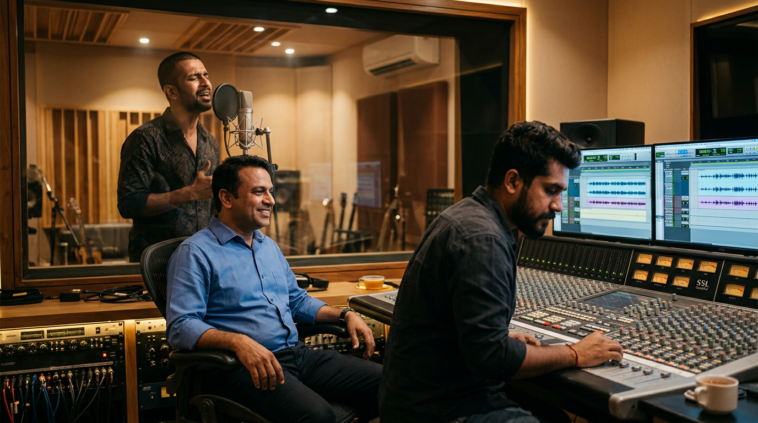
On the day of the recording, Mukesh arrived at Tiger Paw studio wearing a new shirt, new trousers and new shoes. Clothes of this kind he had perhaps never owned, worn for the first time for the most important act of his life. He was not dressing up. He was crossing over.
He had never learned the grammar of recording. He did not know the studio vocabulary — the takes, the cues, the condenser microphone inches from his face. He simply followed the music director’s instructions.
And he sang.
Mere Maula. My Lord.
For an orphan, a man who has lived his life without parents, without the warmth of people who know you by blood, these two words carry a weight they cannot carry for anyone else. They are not just a song title. They are the address of the only constant presence his life has known. The prayer of someone who learned, early and without choice, to find belonging not in a family but in something larger and less visible.
When the recording ended, he could not stop crying. He hugged everyone in the studio. The music director, the engineers, the technicians, Mansuri, everyone within reach. These were not the tears of relief alone. They were the tears of a person who has been carrying something for a very long time and has finally, completely, given it to the world.
The rūci had found its context. The voice that had been singing in the lanes of Masjid Bunder for years, to no one, for nothing, was now in a studio, on a hard drive, moving through the world.
Within weeks, hundreds of thousands of people were listening. A second song followed — Itna Mujhe Bata Do, Tell Me Only This Much. A production house, a composer, a professional lyricist. The orphan scrap collector of Masjid Bunder had become, within a month, a recording artist with six hundred thousand followers and a career that no career counsellor could have designed, because no career counsellor had imagined it as possible.
IV — THE SIZE OF THE ROOM
What the current moment is offering
The Career Architect keeps this story close. He does not use it to argue. He plays the song. Sometimes in a conversation, sometimes at the end of a long day when someone has spent an hour explaining why the moment is not yet right, why they are not yet ready, why the world will not receive what they carry.
The song does the rest.
While sitting with it, he notices something specific about this moment. A voice singing in the lanes in 1990 would have been heard by the lanes. The same voice, recorded on a phone and shared with another person in 2026, reached 600,000 people within a month. Not because the voice was different. Not because the aspiration was larger or the talent greater.
Because the room’s size had changed.
The world has built, without fully intending to, as a side effect of everything else it was building – the infrastructure of witness. A platform where one act of enaction, offered once, to one person willing to stop and listen, can travel farther and faster than any previous generation could have imagined. The aspiration shared does not merely become real. In the current moment, it can find the people it was always meant for. Across cities, across countries, across the particular loneliness of people who have been carrying the same thing in different lanes and did not know anyone else was carrying it too.
Mukesh did not know this. He was not thinking about infrastructure, scale, or reach. He was thinking about the lines of a song and a stranger who had stopped to distribute food.
That is what enaction looks like from the inside. Not a strategy. Not calculation. Just the aspiration. Small, unpolished, trembling slightly. Offered into the available space.
The first song is called Mere Maula. My Lord. It moves now through phones and earphones and late-night commutes and quiet kitchens, carrying something that began on a pavement in Masjid Bunder and found, through one refusal and one request and one stranger who stayed to listen, the world it had always been meant for. The Career Architect plays it sometimes in the early morning, before the day has begun its acceleration. As a reminder of something simple and frequently forgotten. That the career does not begin when the world is ready for you. It begins the morning you walk toward a stranger and ask- not for food, not for money – to be heard.
——————————————————————————————–
About the Author: Dr. Vijayakumar Parameswaran Unnithan is a scholar- practitioner working at the intersection of career theory, employability, and organisation development. He is the originator of the Post-Skill Professional (PSP) Framework and Career Architect at Careertotus Consultants Pvt Ltd. He is the President of Asia Organisation Development Network (AODN) and publishes in leading management journals. Views are Personal. Pic credits: Perplexity AI
This narrative is inspired by the real encounter between Mukesh Mahadev, Hussain Mansuri, and music director Suyyash Rai — and by the technology that gave a pavement song its audience. Listen to Mere Maula here: https://www.youtube.com/watch?v=xIN0hkx4bSQ&list=RDxIN0hkx4bSQ&start_radio=1
This post was created with our nice and easy submission form. Create your post!

Written by
Did this story move you? Every gift goes directly to Dr. Vijayakumar Parameswaran Unnithan — writers on Muwado earn from reader appreciation, not algorithms. Even $1 makes a difference.






Muwado weekly chart
Get Africa’s top 10 stories every Thursday
No account needed — just your email.
Want to follow Dr. Vijayakumar Parameswaran Unnithan and get notified every time they publish?
Create a free Muwado account →