

 Denzel Maniple Everd

Title: Card on The Table
Written and Produced by: Shirleen Wangari
Director: Victor Gatonye
I chose to engage with Cards on the Table through the thematic lens of “a heist driven by love,” and in doing so, the film reveals itself as a crime-comedy story with an intimate exploration of human connection under pressure. Beneath the tension of looming consequences of a failed robbery, the film consistently returns to one central idea: love. Messy, unresolved, and deeply motivating love.
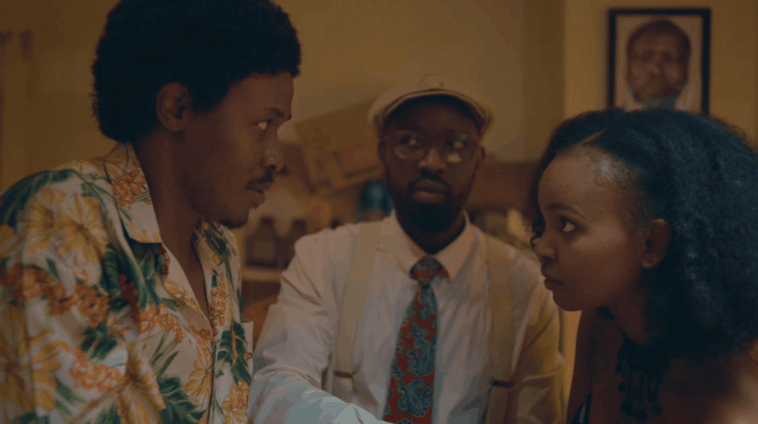
What engaged me first was the chemistry between the two leads, Jackso (Nyakundi Isaboke) and Beth (Shirleen Wangari). Their dynamic feels real, as though we are stepping into a relationship that never truly ended. Written as ex-lovers forced into proximity by circumstance, their dialogue carries the weight of a complicated shared history. Every exchange is layered with subtext; the things they are not saying are often shouting louder than the actual dialogue. There is a lingering tenderness between them, expressed through subtle glances, dry humor, and the occasional emotional slip. It becomes clear that this heist is merely a vehicle for the real story that lies in what still binds them together.
Their motivations initially appear different, but ultimately converge under the same emotional truth: their immense love for each other. Jackso enters the heist to save his mother, who requires an expensive surgery, a direct and selfless act of love. Beth, on the surface, is motivated by material desire, chasing luxury items and financial gain. However, her willingness to engage in such a risky operation, particularly with Jackso, suggests something deeper. She even willingly opts to sacrifice her freedom so that Jackso can help his mother. It feels like she is trying to reclaim time, even if briefly, with someone she once loved. Jackso, too, could have chosen a safer or more strategic partner, yet he chooses Beth. Both characters, in their own ways, are drawn back to each other, using the heist as an excuse to reconnect. In this sense, every action in the film, no matter how reckless, is driven by love.
The supporting character, Inspector Kip, adds another layer to this thematic exploration. While interrogating and holding the protagonists hostage, he repeatedly laments how the case is keeping him away from his wife. His declarations of love are constant and very exaggerated, which adds to the character’s humour, especially when he finds himself momentarily tempted by Beth. His insistence on his loyalty, even in moments of contradiction, paradoxically turns love into a sincere and absurd concept. Through him, the film highlights the contradictions within human relationships, reinforcing the idea that love is rarely straightforward.
The setting, beautifully designed by Mariam Valcour, plays a crucial role in amplifying the emotional tension. Although there are other locations throughout the film, we never feel taken out by the impracticability of the sets, and with much of the film unfolding within the confined space of the inspector’s office in Nairobi, the set transformed it into a pressure cooker for truth, which worked for the narrative. The physical confinement symbolizes the emotional entrapment of the characters in their own ego. As the threat of spending Christmas in jail looms, the stakes become both external and internal. The longer they remain in that space, the more they are forced to confront their situation. Their conversations unravel like Russian dolls, each layer revealing deeper vulnerabilities and motivations, unresolved conflicts, and lingering affection. The setting, though limited, becomes a powerful narrative device, pushing the characters toward emotional exposure.
Cinematographically, the film, which is shot by Jim Bishop, embraces a run-and-gun style that heavily relies on handheld shots. A choice that aligns perfectly with the nature of the characters, a P.O.V of hustlers navigating an imperfect world. The handheld camera introduces a sense of immediacy and unpredictability, reflecting the chaos of their situation, but it never sacrifices clarity. At the same time, it allows for fluidity in blocking, capturing complex movements without losing the emotional focus of the scene. Moments like Beth running as money spills to the ground visually emphasize the improvised and fragile nature of their heist. Similarly, the camera’s reactive movements during conversations allow subtle shifts in framing as new information is revealed, highlighting the shifting emotional dynamics between the characters. This approach keeps the film visually engaging even though it’s a largely single-location film.
Lighting by Gregory Kiwo further enhances the emotional landscape of the film by using warm, standard lighting, which creates a sense of familiarity and comfort despite the situation, allowing the comedic elements to land naturally. It grounds the film, making the characters feel relatable despite their criminal circumstances. At the same time, the lighting design is used symbolically. Characters move in and out of shadows depending on the nature of their revelations and emotional state of mind. When secrets are exposed or morally questionable plans are discussed, they step into darkness. When moments of vulnerability or affection emerge, they return to the light. This interplay subtly reinforces the film’s central idea of complicated human love.
The director, Victor Gatonye, demonstrates a clear understanding of rhythm and engagement, particularly in how the scenes in the film are staged. By constantly shifting the actors’ positions within the set, he avoids the stagnation that often accompanies dialogue-heavy scenes. He uses movement as a tool for storytelling, reflecting the emotional shifts within each conversation. Victor also paces the film beautifully, coordinating the actors to time jokes perfectly or perform emotional lines with brevity. He masterfully utilizes the actors’ emotional range to drive the emotional highs and lows of the film with care and precision, which allows us, the audience, to care for their needs and wants.
Even though it is in a confined space, the film feels energetic, never allowing the audience to settle into visual monotony. The use of Kenyan music further anchors the narrative in Nairobi, giving the film a strong sense of place and cultural identity. It situates Jackso and Beth within a recognizable world, enhancing the authenticity of their struggles.
Finally, the editing by Mark Kitana ties everything together with precision. The cuts are largely seamless, guiding the audience through conversations, action sequences, and moments of tension without drawing attention to themselves. This invisibility allows the story to flow naturally, maintaining immersion. When cuts are noticeable, such as during flashbacks, they are intentional and serve a clear narrative purpose. These moments disrupt the present flow of the narrative, offering glimpses into the past that inform the characters’ current emotional states and sometimes creating a comedic effect. The editor’s restraint ensures that the film’s pacing remains tight, balancing its emotional depth with its comical elements.
In the end, for me, Cards on the Table succeeds because it understands that its heist is not about the money, but about the people involved. Every narrative choice, plot, characterization, setting, cinematography, lighting, directing, and editing works in service of a central theme. Love, in all its complexity, drives the story forward. It is the reason the characters take risks, make mistakes, and ultimately confront themselves. The film becomes about Jackso and Beth realizing what they mean to each other and finding the courage to express that to themselves, even though, unfortunately, it leaves the matter of Jackso’s mother’s surgery unresolved.
This post was created with our nice and easy submission form. Create your post!

Written by
Storyteller, amateur poet and photographer (IG: @denzel_everd || @some_things_denzel_sees), and film-maker.
Did this story move you? Every gift goes directly to Denzel Maniple Everd — writers on Muwado earn from reader appreciation, not algorithms. Even $1 makes a difference.





Muwado weekly chart
Get Africa’s top 10 stories every Thursday
No account needed — just your email.
Want to follow Denzel Maniple Everd and get notified every time they publish?
Create a free Muwado account →