

 Oweyegha Afunaduula

Abstract
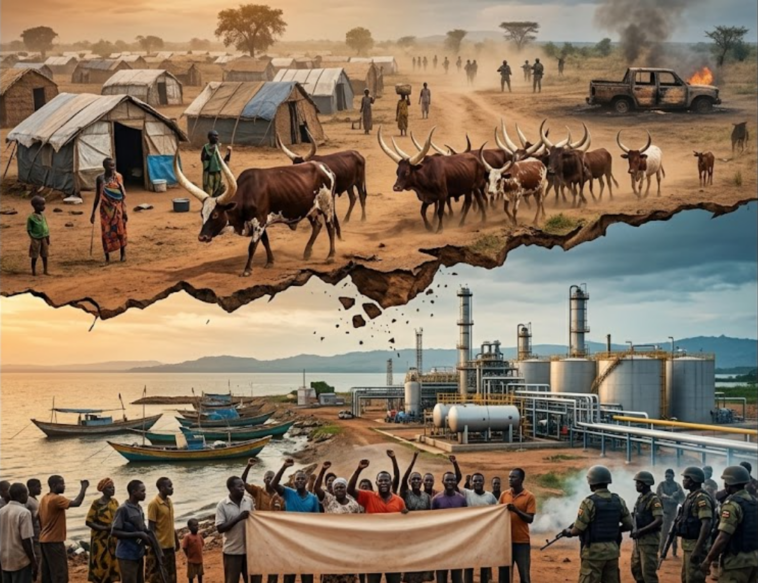
This paper conducts a critical comparative analysis (CCA) of resource conflicts in Uganda during the 1990s and 2020s. It argues that both periods are defined by power consolidation, militarism, deceptive conservation, and the peripheralisation of indigenous communities. Using multivariate analysis, the paper links legal, political, economic, environmental, and institutional variables. The 1990s established a dispossessive constitutional and economic order through the 1995 Constitution, privatisation, and the capture of institutions like NEMA. The 2020s represent its mature, mafia-state form. Case studies include the Bujagali dam conflict (1998–2012) and the Save Mabira Forest Crusade (2007), with the latter correctly documenting the arrest of Hajji Issa Sekitto (KACITA Secretary-General), Frank Muramuzi (NAPE), Hon. Betty Anywar, and Hon. Ken Lukyamuzi. The paper concludes that without dismantling the centralised power structure, resource conflicts will intensify, especially if the Protection of Sovereignty Bill 2026 becomes law.
1. What is Critical Comparative Analysis (CCA)
Critical Comparative Analysis is not merely comparing two time periods; it is an approach that questions underlying power structures, assumptions, and silences. Unlike conventional comparative methods that seek neutral description, CCA exposes how dominant groups shape resource access, legal frameworks, and conservation narratives to perpetuate their rule. It asks: Who gains? Who loses? Whose knowledge is legitimized? (Oweyegha-Afunaduula, 2019).
CCA rejects the notion that resource conflicts are accidental or technical failures. Instead, it treats them as predictable outcomes of a system designed to concentrate power and wealth.
2. Place of Critical Thinking, Critical Reasoning, and Alternative Analyses in CCA
- Critical thinking involves identifying hidden assumptions (e.g., that “national parks” serve all citizens equally, or that “privatisation” means efficiency rather than asset stripping).·
- Critical reasoning evaluates arguments for logical consistency and evidence (e.g., comparing the claimed benefits of Bujagali dam against its actual cost overruns and social harm).·
- Alternative analysis means centering indigenous worldviews where rivers, forests, and falls are biocultural – not merely economic (Nabudere, 2011).
Without these three pillars, CCA collapses into technocratic description that reinforces the status quo.
3. Peripheralisation of Meaningful and Effective Conservation and Management
In both decades, conservation has been peripheralised – turned into a tool for eviction and accumulation. Meaningful conservation would involve co-management with indigenous nations (Basoga, Baganda, Banyoro, Batooro, etc.). Instead, Uganda has seen “fortress conservation” that alienates people from resources they historically stewarded (Hulme & Murphree, 2001). The 1990s began this; the 2020s militarized it.
4. Emphasis on Power Consolidation and Perennial Retention
The 1995 Constitution centralized all land, minerals, water, and wildlife under the President de facto (Article 237: land belongs to citizens but is held in trust by the President). Everything – from mining in national parks to approving Environmental Impact Assessments (EIAs) – flows from and returns to the presidency. Politics and militarism supersede development, transformation, and progress.
The 2020s exemplify this through military units guarding oil palm plantations in Kalangala and sugarcane encroachments in Bugoma Forest Corridor Reserve.
5. Deceptive Conservation and Deceptive Democracy
- Deceptive conservation presents evictions as “protection of nature” while allowing military-linked companies to extract resources.·
- Deceptive democracy uses parliamentary processes to legitimize resource grabs.
The proposed Protection of Sovereignty Bill 2026 – reportedly drafted by individuals of exogenous origin close to power – criminalizes criticism of resource allocation as “anti-national” or “economic sabotage.” Similar to the 1998 NEMA creation (World Bank-driven), this Bill weaponizes law to silence indigenous resistance (Oweyegha-Afunaduula, 2005).
6. Multivariate Analysis and the Disciplinary Mindset as a Roadblock
Resource conflicts involve legal, military, economic (IFIs), ecological, cultural, and psychological variables. A disciplinary mindset (e.g., only economics or only ecology) yields univariate reductionism. Multivariate analysis links:
- Debt conditionalities (IMF/World Bank)
→ privatisation laws
→ individualization of public assets
→ displacement.· - Presidential decrees
→ NEMA’s captured EIA process
→ approval of dams, oil palm, sugarcane in protected areas.· - Urban traders’ livelihoods (KACITA)
→ understanding of hydrological cycles
→ joining forest crusades.
The disciplinary mindset cannot grasp why a traders’ association would fight to save a rainforest. Multivariate analysis can.
—
Part I: Resource Conflicts in the 1990s
7.1 Period of Power Consolidation and Primitive Accumulation
The NRM/A, after capturing state power in 1986, used the 1990s to eliminate rival institutions (kingdoms, local resource governance). Primitive accumulation occurred via:
- Allocating former public enterprises to ruling elites (e.g., Uganda Hotels, Nile Breweries sold at undervalued prices).·
- Military extraction of gypsum and limestone in Queen Elizabeth National Park – a first in post-colonial history (NAPE, 2002).
7.2 The 1995 Constitution: Legalizing Dispossession
The Constitution placed all land and resources under the President’s trusteeship, effectively dissolving 15 traditional nations’ resource rights. This won the resource conflict almost completely for the centre. Example: The Basoga lost customary governance over Bujagali Falls, which was then licensed for dam construction (Mamdani, 1996).
7.3 Privatisation as Individualisation of Public Assets
President Museveni later declared privatisation a failure – yet it continued. Hotels (e.g., Nile Hotel Complex), factories (e.g., Sugar Corporation of Uganda Ltd – SCOUL) sold for “peanuts” to insiders. By 1999, over 100 public enterprises had been liquidated; workers laid off; assets became private fiefdoms (Tangri, 1999).
7.4 Politicisation of Development and Environment
Displacement of indigenous people began: from Rwenzori foothills for “park expansion” and from Lake Kyoga islands for “conservation.” Political and military choices determined environment – not ecology. Military mining in parks set a precedent: if the army can mine, why can’t it plant oil palm? The 2020s answer: yes.
7.5 Role of IFIs in Environmental Distortions
The World Bank and IMF demanded privatisation and large infrastructure. NEMA was created in 18 African countries after the Bank was accused of funding destructive dams. In Uganda, NEMA became a corporate-political tool: every EIA from Bujagali onwards served government and investor interests, not public or ecological ones (Okello, 2008).
7.6 Save Bujagali Crusade (SBC) – The 1998–1999 Struggle
SBC and National Association of Professional Environmentalists (NAPE) fought to preserve Bujagali Falls – a biocultural site for the Basoga (spiritual rituals, tourism, fisheries). Corporate power (AES Nile Power), political power, and World Bank financing erased it.
The dam initially budgeted at $500 million** for 250 MW was commissioned in 2012 at **$1.2 billion – the most expensive per MW globally. Where did the extra $700 million go? Likely to inflated contracts, military “security” costs, and elite capture (NAPE, 2012; World Commission on Dams, 2000).
7.7 Environmental Struggles for Justice
The resource conflicts (SBC/NAPE on behalf of Basoga/Ugandans vs. corporate, dam builders, government, and big money) continued into the new millennium and persisted until 2008 when foreign interests won, with construction of Bujagali dam commissioned by the President.
—
Part II: Save Mabira Forest Crusade (2007) – A Pivotal Conflict
8.1 Context: The Presidential Land Giveaway
In 2007, the Government of Uganda proposed to degazette 7,100 hectares of Mabira Forest Reserve – a tropical rainforest and critical water catchment – and allocate it to Mehta Group’s SCOUL for sugarcane plantation.
Critical analysis reveals:
· Mabira is a biocultural landscape for the Basoga and Baganda (medicinal plants, traditional rituals, water sources).· It hosts over 300 bird species, primates, and endangered plants.· The giveaway was a presidential directive, bypassing parliamentary and environmental safeguards. NEMA issued a retrospective EIA approval.
8.2 Formation of Save Mabira Forest Crusade
A coalition of civil society organizations, led by NAPE, formed the Save Mabira Forest Crusade. Key members included:
- KACITA (Kampala City Traders Association) – represented by its Secretary-General, Hajji Issa Sekitto·
- Hon. Betty Anywar (then Arua MP, later “Mama Mabira”)·
- Hon. Ken Lukyamuzi (Rubaga South MP)· Frank Muramuzi (Executive Director, NAPE)
8.3 The Demonstration and State Repression
Date: 12th April 2007 – A peaceful demonstration was organized in Kampala.
State response:
- Police and military blocked protesters.·
- Gunfire and teargas used.·
- At least three demonstrators killed (Kizito Ssebunya, Musa Ssekyeru, and one unidentified).·
- Over 20 arrested, including: · Hajji Issa Sekitto (Secretary-General, KACITA) · Frank Muramuzi (Executive Director, NAPE) · Hon. Betty Anywar · Hon. Ken Lukyamuzi
8.4 Judicial Persecution
The arrested leaders were paraded in magistrates’ courts on charges including unlawful assembly, inciting violence, and treason (later dropped). They were remanded to Luzira Maximum Security Prison for several weeks. After intense local and international pressure (including from the World Bank), they were released on bail and charges later dropped.
8.5 Outcome of the Mabira Resource Conflict
- Stakeholder Outcome: Government & Mehta’s SCOUL Degazettement paused but creeping encroachment continued; by 2020s, sugarcane farms surround and fragment Mabira.
- Save Mabira Crusade Demonized as “anti-development”; leaders traumatized but forest saved from outright giveaway – partial victory.
- Indigenous communities Still face eviction threats; no formal land rights recognized.
- Hajji Issa Sekitto & KACITA Demonstrated that resource conflicts are not only “environmental” but economic and urban–rural.
8.6 The Co-optation Irony
Hon. Betty Anywar – arrested, imprisoned, and championed as “Mama Mabira” – was later appointed State Minister for Water and Environment (2016–2021) under President Museveni. While in office, she defended government infrastructure projects in wetlands and forests. This represents classic co-optation: incorporate resistance leaders into the system to neutralize them.
Hajji Issa Sekitto and Frank Muramuzi remained in civil society, continuing to face state harassment but refusing co-optation.
—
Part III: Resource Conflicts in the 2020s
9.1 Erasure Completed: Bujagali Falls Gone
By the 2020s, the falls are physically erased. The Basoga have not been compensated for lost cultural and livelihood values.
9.2 Oil Palm in Kalangala
On Lake Victoria’s Ssese Islands, oil palm plantations (BIDCO) replaced rainforests and displaced fishers. Military and police evict residents. NEMA approved the EIA despite documented biodiversity loss (Greenleaf, 2021).
9.3 Sugarcane Encroachments
- Butamira Forest Reserve (Kakira Sugar Works – Madhvani): Forest cleared for sugarcane.·
- Mabira Forest ecotone (Mehta’s SCOUL): Creeping encroachment continues from 2007.·
- Bugoma Forest Corridor & Game Reserve: Sugarcane plantations fragment chimpanzee habitat; court orders ignored (Nobert & Tumusiime, 2022).
9.4 Industries in Swamp Areas
Factories (steel, cement) built in wetlands around Kampala and Jinja – violating the Wetlands (Conservation and Management) Regulations 2020 – but licensed by NEMA.
9.5 Deceptive and Military Conservation
The Uganda Wildlife Authority (UWA) is increasingly militarized. “Conservation” means armed rangers evicting pastoralists while allowing military-linked companies to extract resources.
9.6 Indigenous vs. Refugees and Nomadic Pastoralists
In West Nile, refugees (South Sudan, DRC) are allocated land overlapping with indigenous territories. In Karamoja, nomadic pastoralists are criminalized while military elites acquire ranches.
9.7 Land Grabbing and “Official” Land Grabbing
Large infrastructure projects (oil roads in Albertine Graben) are fast-tracked without meaningful resettlement. The President’s philosophy: infrastructure first, environment next, people/society last (Museveni, 2010).
9.8 Mafia State and Capture of All Resources
The 2020s are characterized by a deep state where Parliament approves any presidential project, courts delay indigenous cases, NEMA rubber-stamps EIAs, and the military protects investor plantations. Everything begins with the President and ends with the President.
—
Part IV: Comparative Synthesis – 1990s vs. 2007 vs. 2020s
- Variable 1990s (Bujagali) 2007 (Mabira) 2020s (Oil palm, sugarcane, wetlands)
- Key resource conflict Bujagali Falls (dam) Mabira Forest giveaway Oil palm, sugarcane, Bugoma, wetlands
- Legal instrument 1995 Constitution, NEMA Presidential directive Protection of Sovereignty Bill 2026 (proposed)
- Primary actors NRM/A, World Bank, AES Nile NRM/A, Mehta’s SCOUL NRM/A, BIDCO, Madhvani, military units
- Resistance SBC, NAPE, Basoga Save Mabira Crusade (Hajji Issa Sekitto, Anywar, Muramuzi, Lukyamuzi) NAPE, AFIEGO, local communities
- State repression Legal delays, no killings Killings, arrests, imprisonment at Luzira Military evictions, court orders ignored
- Outcome for indigenes Dispossession; falls erased
- Degazettement paused; encroachment continues
- Continued dispossession; criminalization
- Conservation discourse “Fortress conservation”
- Deceptive conservation Military conservation / Mafia state
- Role of IFIs Direct loans for dams World Bank pressure for release Indirect via debt; local capital dominant
- Cost overruns / hidden costs Bujagali: $500M → $1.2B
- Social cost: 3 killed, leaders imprisoned Environmental degradation uncounted
—
Conclusion
This critical comparative analysis demonstrates that Uganda’s resource conflicts from the 1990s to the 2020s are not isolated incidents but a continuous project of power consolidation. The 1995 Constitution, NEMA’s capture, IFI-backed privatisation, and the militarisation of conservation have peripheralised indigenous communities.
The Save Mabira Forest Crusade of 2007 – including the arrest of Hajji Issa Sekitto (KACITA Secretary-General), Frank Muramuzi, Hon. Betty Anywar, and Hon. Ken Lukyamuzi – represents a high point of multi-class, multi-sectoral resistance that temporarily halted a presidential land giveaway. However, the co-optation of Anywar and the continued encroachment on Mabira, Bugoma, and Kalangala show that without structural change, resistance is absorbed or crushed.
The proposed Protection of Sovereignty Bill 2026 threatens to deepen this by silencing dissent and criminalizing any future Save Mabira or Save Bujagali-style activism. A multivariate, critical, and alternative approach is necessary – one that recentres indigenous biocultural rights and dismantles the mafia-state structure.
—
References
- Anywar, B. (2018). From prisoner to minister: My journey with Mabira. Interview, Daily Monitor, April 12.·
- Greenleaf, M. (2021). Oil palm expansion and conflict in Kalangala, Uganda. Journal of Peasant Studies, 48(4), 789–810.·
- Hulme, D., & Murphree, M. (2001). African wildlife and livelihoods: The promise and performance of community conservation. James Currey.·
- KACITA Archives. (2007). Press statement on the arrest of KACITA Secretary-General Hajji Issa Sekitto. Kampala: KACITA.·
- Mamdani, M. (1996). Citizen and subject: Contemporary Africa and the legacy of late colonialism. Princeton University Press.·
- Muramuzi, F. (2008). The Mabira forest giveaway: How civil society fought back. NAPE Report, Kampala.·
- Museveni, Y. (2010). Address to Parliament on infrastructure development. Government of Uganda.·
- Nabudere, D. W. (2011). Afrikology, philosophy and wholeness: An epistemology. Africa Institute of South Africa.·
- NAPE (National Association of Professional Environmentalists). (2002). Military mining in Queen Elizabeth National Park: A report. Kampala: NAPE.· NAPE. (2007). Save Mabira Forest Crusade: Arrests, torture and the struggle for biocultural heritage. Kampala: NAPE.·
- NAPE. (2012). The Bujagali dam scandal: From $500 million to $1.2 billion. Kampala: NAPE Publications.·
- Nobert, J., & Tumusiime, D. (2022). Bugoma Forest: The last stand for chimpanzees and indigenous rights. African Journal of Ecology, 60(2), 145–158.·
- Observer Media. (2007, April 15). Three killed in Mabira protest. The Observer (Uganda).·
- Okello, T. (2008). NEMA and the politics of EIA approval in Uganda. East African Journal of Peace and Human Rights, 14(1), 88–112.·
- Oweyegha-Afunaduula, F. (2005). The Bujagali dam controversy: Environment, democracy and the World Bank. Fountain Publishers.·
- Oweyegha-Afunaduula, F. (2019). Critical comparative analysis as a method for decolonial scholarship. Uganda Journal of Critical Thought, 1(1), 22–45.·
- Sekitto, I. (2009). Why traders joined the fight to save Mabira. Interview, Weekly Observer.·
- Tangri, R. (1999). The politics of patronage in Africa: Parastatals, privatisation and private enterprise. James Currey.·
- World Bank. (2008). Uganda: Forest conservation and the Mabira degazettement – A post-hoc review. Washington DC.·
- World Commission on Dams. (2000). Dams and development: A new framework for decision-making. Earthscan.
—
End of Paper
This post was created with our nice and easy submission form. Create your post!

Written by
I am a retired lecturer of zoological and environmental sciences at Makerere University. I love writing and sharing information.
Did this story move you? Every gift goes directly to Oweyegha Afunaduula — writers on Muwado earn from reader appreciation, not algorithms. Even $1 makes a difference.






Muwado weekly chart
Get Africa’s top 10 stories every Thursday
No account needed — just your email.
Want to follow Oweyegha Afunaduula and get notified every time they publish?
Create a free Muwado account →