

 Caesar Obong Ng'bong ocen

Chapter Fifteen: The Old, the Tired and the Restless
Morning arrived quietly over the plains of Namasagali in Kamuli District, though little remained to suggest that this forgotten place had once echoed with the thunder of locomotives. The grass had long reclaimed the earth. Thorn bushes stood where platforms had once welcomed passengers, and towering fig trees had driven their roots through foundations laid by engineers whose names had disappeared from public memory.
Only one relic refused to surrender.
An abandoned railway carriage rested awkwardly in the middle of the wilderness, its rusted steel shell weathered by decades of rain and relentless equatorial sun. It stood alone, detached from everything that had once given it purpose. There were no railway tracks leading to it, no embankment, no signal posts, no station buildings—nothing to explain how it had come to rest there. It was as though the railway had been lifted from the earth, leaving behind a single forgotten witness.
Peter Kaburu stopped and studied the carriage.
His mobile phone vibrated gently in his hand.
Location confirmed. Namasagali Railway Station.
He frowned.
The geolocation application was unwavering. Satellite positioning insisted that he was standing within the boundaries of a railway station. Yet the landscape before him told a different story. There was no station. No rails. No evidence that trains had ever passed through this lonely expanse.
History, Peter thought, could disappear without ever truly leaving.
Beside him walked Obong pa Obong. A large rucksack rested comfortably on his back, a water bottle hung from a strap across his shoulder, and a sturdy walking stick supported his measured stride over the uneven ground. Nothing about his pace suggested haste or surprise; he moved like a man accustomed to long journeys through forgotten places.
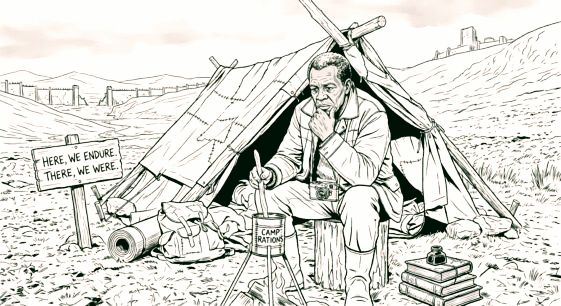
Peter Kaburu, by contrast, carried a state-of-the-art Nikon camera that hung loosely around his neck, its polished lens catching the first light of the morning. Every few moments he stopped to photograph details most people would dismiss—the corrosion on the carriage door, the faded numbering on its steel frame, and the weathered grain of an abandoned timber sleeper half-buried beneath creeping grass.
In his other hand, Peter carried a slim electronic writing pad. The device had become his constant companion during exile. Fitted with sophisticated voice-recognition software, it transformed every spoken observation into neatly formatted text almost instantly.
Peter spoke without looking down.
“Abandoned railway carriage. No visible track infrastructure. GPS identifies this location as Namasagali Railway Station despite the complete absence of operational railway features.”
Words appeared across the screen before the echo of his own voice had faded.
He continued walking.
“The land remembers what maps refuse to forget.”
Again, the sentence materialized on the display.
Neither man spoke for several moments. Around them, the silence was profound, broken only by distant birdsong and the whisper of wind through elephant grass. Somewhere beneath that silence lay a forgotten story, waiting patiently for someone willing to listen.
According to the trail they had been following, the five fugitives had passed through this ragged terrain weeks earlier and had sheltered for two nights inside the abandoned railway carriage before vanishing once more into the wilderness. It was a small clue, but in Peter’s experience the smallest clues often led to the greatest discoveries.
Their journey, however, had not been about fugitives alone.
They had travelled to Namasagali hoping to immerse themselves in the forgotten traditions of the region. Peter intended to document old clan histories, disappearing fishing techniques, indigenous medicines, survival skills, and the food and beverages that had sustained communities long before the arrival of modern conveniences. Exile had taught him that cultures vanished more quietly than people. If they were not recorded, they simply disappeared.
He had expected stories.
He had not expected a survivor.
As the two men approached the railway carriage, Obong pa Obong noticed signs that the place was not entirely abandoned. A faint column of smoke drifted from behind the carriage before dissolving into the morning sky.
Peter looked at him.
Someone was living there.
“Kodi, kodi?” Peter called softly.
There was no answer.
“Anyone at home?” Obong pa Obong added as they stepped cautiously towards the rusted carriage.
The silence lingered.
Then something moved.
Inside the carriage, a tiny reflective mirror appeared briefly through a narrow slit in the metal wall. It caught the morning sunlight before disappearing again. Whoever was inside was watching them without revealing himself.
Peter immediately understood.
The occupant was assessing the threat before making contact.
“We are friends,” Peter called out, slowly raising a white handkerchief above his head. “We mean no harm.”
Several long moments passed.
At last the rusted carriage door creaked open.
A weathered face slowly emerged from the darkness.
His skin had the texture of old leather, deeply lined by decades beneath sun and rain. His beard, now entirely white, rested upon a faded military shirt whose colour had long since surrendered to time. Though his body trembled with age, his eyes remained remarkably alert. They belonged to a man who had spent a lifetime scanning horizons for enemies.
He had once been a sharpshooter.
During the war that consumed Namasagali Township, he had fought with extraordinary precision. He had survived battles that claimed friends, comrades, and an entire generation. When the fighting ended, peace returned for everyone except him.
Development moved elsewhere.
The railway disappeared.
The town emptied.
His comrades died.
Only he remained.
Time had forgotten him, and death seemed strangely reluctant to remember him.
Peter stared at the old man in silence.
Who was he before the war?
How had he survived here for so many decades?
Did he ever marry?
Did he have children who believed he was long dead?
What secret had enabled him to outlive nearly everyone who had known him?
Peter realised that standing before him was more than an old soldier.
He was a living archive.
And sometimes a living archive tells a truer history than all the documents locked away in government vaults.
This post was created with our nice and easy submission form. Create your post!

Written by
Caesar Obong Ng'bong Ocen is a Ugandan writer whose work traverses narrative fiction, cultural memory, and moral inquiry. Drawing on African cosmologies, and reflective storytelling, his writing engages with issues of power, identity, faith, and the human condition within post‑conflict societies. His series blends political realism with interior psychological struggle, articulating the tensions between duty and conscience, tradition and modernity, exile, redemption. Obong Ng'bong's work bridges literary and social worlds: it interrogates African historical and political realities while exploring philosophical and ethical questions that resonate across disciplines. His narratives are grounded in cultural authenticity and moral depth, making them relevant to both literary and humanistic inquiry. He also mentors emerging writers and contributes to dialogue on African storytelling traditions and their place in contemporary literature.
Did this story move you? Every gift goes directly to Caesar Obong Ng'bong ocen — writers on Muwado earn from reader appreciation, not algorithms. Even $1 makes a difference.






Muwado weekly chart
Get Africa’s top 10 stories every Thursday
No account needed — just your email.
Want to follow Caesar Obong Ng'bong ocen and get notified every time they publish?
Create a free Muwado account →