

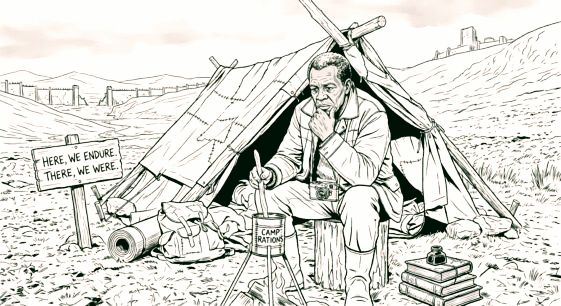
 Caesar Obong Ng'bong ocen

Chapter Eighteen: The Mark of the Chosen One
We had spent several weeks inside that cave, and during that time our bodies had undergone significant changes without our knowledge. To our own eyes, we appeared normal. We still recognised ourselves in mirrors, still carried the same scars, the same mannerisms, the same familiar faces.
Yet to strangers, we had become something else entirely.
The lorry driver who rescued us from the wilderness had transported us to what he described as a safer location. I later learned it was Soroti. By a strange twist of fate, Peter Kaburu and I found ourselves dining among some of the most influential evangelists in East Africa—perhaps even among men whose reputations extended far beyond the continent.
If someone had told me, while I was roasting bats beneath the earth and drinking water dripping from ancient stone, that I would soon be seated in a luxury hotel among internationally acclaimed preachers, I would have laughed and asked what they had been smoking.
Yet there I was.
The hotel overlooked the town below. Crystal chandeliers hung from the ceiling, casting warm reflections across polished wooden tables. The scent of roasted goat, fried fish, fresh bread, and expensive perfume drifted through the dining hall.
Around us sat men whose names dominated radio stations, crusade posters, television broadcasts, and social media platforms.
Some claimed they could heal the blind.
Others claimed they could cure paralysis, infertility, cancer, and every disease known to mankind.
The more they spoke, the more uncomfortable I became.
Not because I doubted miracles.
I had witnessed things throughout my life that could not be explained by science alone.
No.
What troubled me was the performance.
The rehearsed testimonies.
The carefully timed declarations.
The dramatic pauses.
The subtle transformation of human desperation into spectacle.
Peter appeared equally unimpressed.
He listened politely while slicing a piece of roasted meat from his plate.
One preacher seated across from us leaned back confidently.
“I have cured more than three hundred cases this year alone.”
Another nodded in agreement.
“The Spirit reveals every illness before the patient even speaks.”
A third smiled.
“There is no disease that cannot be removed.”
Peter and I exchanged a glance.
Neither of us said a word.
The truth was more complicated than either faith or science wished to admit.
Long before Soroti.
Long before Kamuli.
Long before the cave.
Peter and I had encountered phenomena neither medicine nor religion could adequately explain.
The cave had only deepened that mystery.
Something had happened to us beneath the earth.
Something neither of us fully understood.
The weeks following our escape had been strange.
Cuts healed with unusual speed.
Fatigue rarely lingered.
Bruises disappeared almost overnight.
Sometimes I could hear conversations occurring at distances that should have made them impossible to detect.
Peter reported similar experiences.
He claimed that on several occasions he knew where someone would move before they moved.
Neither of us discussed these things openly.
In truth, we barely discussed them with each other.
The memory of the underground city remained too fresh.
The bats.
The tunnels.
The underground rivers.
The strange bioluminescent plants growing beside hidden streams.
The resonance from the ancient pot.
The inscriptions.
The impossible sensation of floating through darkness.
Whatever had happened beneath the earth had left its mark.
Not upon our skin.
But somewhere deeper.
A preacher’s voice pulled me back to the present.
“You seem distracted, brother.”
I smiled politely.
“Just listening.”
He nodded.
“Then you know that miracles belong only to the chosen.”
At those words, Peter looked up.
His expression changed immediately.
Not anger.
Not amusement.
Recognition.
As though he had heard those words before.
Somewhere ancient.
Somewhere buried beneath stone.
The chosen.
The phrase echoed through my mind.
For a brief moment I remembered the symbols we had seen in the cave.
The carved figures.
The forgotten language.
The repeated references to one who would return.
Suddenly a pressure formed behind my eyes.
My vision blurred.
The dining hall vanished.
In its place appeared a vast underground chamber illuminated by an eerie blue light.
Stone pillars stretched endlessly into darkness, forming a perfect spiral that expanded outward beyond sight.
It was the same mysterious glow we had followed while escaping through the tunnels to Lango sub region.
While underground, I had believed we were chasing an unusually bright firefly.
Now I realised I had been wrong.
The vision revealed something else entirely.
Memories collided.
Stories from Busoga.
Legends about people walking on water.
Glowing stones.
Ancient travellers disappearing beneath the earth.
Tales dismissed as myths suddenly seemed less impossible.
Voices chanted in a language older than memory.
At the centre of the chamber stood figures.
Not one.
Not two.
Hundreds.
Perhaps thousands.
Their forms resembled shadows draped in darkness.
Only their eyes were visible.
Glowing.
Watching.
Waiting.
Each raised their right palm.
Upon every palm burned clusters of dotted symbols.
The same symbols Peter and I now carried.
The same symbols from the pot.
The same symbols from the cave.
The Mark.
I blinked.
The vision disappeared.
The hotel returned.
Conversations continued uninterrupted.
No one seemed to have noticed.
Except Peter.
He was staring directly at me.
His face had gone pale.
“You saw it too, didn’t you?” he asked quietly.
A chill crawled down my spine.
“Yes.”
Peter slowly lowered his fork.
For several seconds neither of us spoke.
Then he whispered words I shall never forget.
“The mark wasn’t describing a person.”
“What do you mean?”
He glanced around to ensure nobody was listening.
Then leaned closer.
“I think it was describing a condition.”
The noise of the dining hall faded into the background.
“What condition?”
Peter’s eyes never left mine.
“I think the cave changed us.”
For the first time since our escape from the underground city, I began to fear we had not truly left it behind.
Peter remained silent for a moment before suddenly leaning towards the preacher seated across from us.
“Let me see your palm.”
The preacher blinked.
“My palm?”
“Yes,” Peter replied. “If it resembles ours.”
The table became quiet.
The preacher smiled uneasily.
“Ra-ba-sha-ka-rahhh,” he replied theatrically. “Healing hands do not require markings.”
Peter did not smile.
Neither did I.
For a brief second the preacher’s confidence faltered.
Then he reached into the pocket of his expensive suit and removed a neatly folded handkerchief.
What happened next remains difficult for me to explain.
The moment the cloth appeared, something inside me reacted.
Not fear.
Not anger.
Recognition.
My body moved before my mind understood why.
One moment I was seated.
The next I was on my feet.
Before I could stop myself, my arm swung forward with astonishing force.
CRACK!
The sound echoed through the dining hall.
The preacher flew sideways from his chair.
A tooth bounced across the polished floor.
Silence followed.
A terrible silence.
Every eye in the room fixed upon me.
Then chaos erupted.
People shouted.
Some rushed toward the fallen preacher.
Others began speaking in tongues.
“Rumba ba sheh!”
“Shah baba baba!”
Chairs scraped violently against the floor.
Several pastors demanded that I be restrained.
Peter stared at me in complete disbelief.
To be honest, I was equally shocked.
I had no memory of deciding to strike the man.
It was as though my hand had acted independently of my will.
Within minutes hotel security arrived.
I was escorted into a small side room while angry voices filled the corridor outside.
Everyone wanted an explanation.
I had escaped the Busoga cave only to find myself facing arrest in Soroti.
Freedom, I had come to learn, was a gift granted only in limited editions.
I was already a fugitive of circumstance.
Running from mistakes.
Running from consequences.
Running from Maggie Okello, whose household I had thrown into turmoil after impregnating her maid.
Ironically, when we crossed paths again, Maggie had shown no anger.
Only relief that I was alive.
Life in exile had taught me many things.
Chief among them was this:
We are never entirely free to be free.
Eventually a local police officer arrived.
I was transported to the nearby police station near the old Soroti Flying School.
The officer led me directly into an interrogation room.
The door slammed behind us.
He shoved me into a chair and fixed me with bloodshot eyes.
The kind of eyes that have seen too many criminals and no longer expect innocence.
By then my hands were already handcuffed.
“Why did you assault him?” he demanded.
The answer escaped my mouth before I could think.
“Mbugumbugu.”
The officer frowned.
“What?”
“Mbugumbugu.”
He stared.
“What about it?”
“The handkerchief contained Mbugumbugu.”
His expression changed instantly.
“You mean the drug?”
“Yes.”
The room fell silent.
The officer immediately reached for his phone.
Calls were made.
Instructions issued.
Within an hour forensic personnel arrived.
Samples were collected.
Evidence was secured.
Peter, standing beside the doorway, slowly nodded.
“It is true,” he said.
The handkerchief contained traces of the substance.
Not enough for an ordinary person to notice.
Not enough even to produce obvious symptoms.
But enough.
Enough for Peter and me.
That realisation disturbed me more than the arrest itself.
Months earlier, Maggie Okello had nearly become a victim of the same dangerous powder.
What initially appeared to be an isolated criminal case had drawn Peter and me into a much larger investigation.
Our search for the source of the drug had carried us across districts, through forgotten archives, abandoned settlements, and hidden networks.
Eventually it led us to the tunnels beneath Kamuli.
To the underground city.
To the darkness.
To mysteries neither science nor faith could adequately explain.
Ironically, our original objective had been entirely different.
We had been investigating how a group of fugitives escaped Uganda through routes believed to connect with Kenya.
Instead, we found ourselves trapped beneath Busoga.
Exiled beneath the soil.
Separated from time.
Separated from reason.
Separated from our own understanding of reality.
We spent weeks underground eating bats and drinking water that dripped from stone.
We breathed smoke from strange bioluminescent plants Peter discovered growing beside hidden streams.
The plants emitted a faint glow and appeared to attract insects using their own light.
Even now I do not know whether they were natural or something else entirely.
By the time we emerged from the tunnels, we had lost count of the days.
Perhaps even the months.
Now, seated in a detention room in Soroti, I found myself wondering whether we had ever truly escaped.
Because the moment that handkerchief appeared, my body recognised Mbugumbugu before my mind did.
And if Peter and I could detect traces invisible to everyone else—
If our bodies could heal unnaturally fast—
If our senses had become something beyond ordinary human experience—
Then whatever had happened to us beneath the underground city was far from over.
It was only the beginning.
The following morning brought another an unexpected visitor into the facility.
The detention facility was unusually busy. Officers moved through the corridors with greater urgency than before, and whispered conversations seemed to follow every new development in the Mbugumbugu investigation.
Then the atmosphere changed completely.
General Okello had arrived.
Even before I saw him, I heard the sudden silence that followed his presence. Men who had been speaking confidently moments earlier lowered their voices. Others stood straighter.
Okello entered the room and surveyed everyone with the calm expression of a man accustomed to being obeyed.
His eyes settled on the investigating team.
“Do you realise he is my son-in-law?” he asked.
Nobody answered immediately.
The question itself carried enough weight.
Finally, one of the senior officers cleared his throat.
“General, we are simply following procedure.”
Okello nodded.
“And procedure has led you to detain the man who exposed a drug lord disguised as a holy man.”
The room fell silent.
“Release him immediately.”
No one argued.
The evidence against the preacher had grown overnight. More traces of Mbugumbugu had been discovered. Financial records were being examined. Witnesses were beginning to talk.
What had started as a simple assault case was rapidly becoming a major criminal investigation.
A few minutes later, the door to my holding room opened and as I stepped into the corridor, I noticed one of the officers approaching.
He was limping.
The limp was subtle, but to my eyes it appeared as clearly as a wound illuminated by a spotlight.
Something strange happened.
The moment I looked at him, information seemed to emerge from nowhere.
I could almost see the injury.
Not with my eyes.
With something else.
A pressure formed behind my forehead.
My vision sharpened.
The officer stopped.
“Are you all right?” Peter asked.
I ignored the question.
Instead, I looked directly at the officer.
“How long have you been suffering?”
He frowned.
“Suffering from what?”
“Your hip.”
The officer’s expression changed.
“Nearly seven years.”
The corridor became quiet.
I pointed towards a wooden examination table against the wall.
“Come here and lie on that table.”
The officer laughed nervously.
“I beg your pardon?”
“Lie down.”
He glanced at the others, embarrassed.
Even Peter looked uncertain.
Yet something in my voice convinced him.
Slowly, he obeyed.
I stood beside him.
To this day, I cannot fully explain what happened next.
I placed my hands upon him.
At first, I felt nothing.
Then a warmth began flowing through my arms.
Not heat.
Energy.
The same sensation I had experienced beneath the earth in the forgotten city.
The same sensation that had accompanied the strange visions.
The same sensation that had grown stronger since our escape from Kamuli.
The officer gasped.
His body trembled.
Several witnesses stepped backwards.
The warmth intensified.
For a moment I thought I saw faint patterns moving beneath the skin of my hands, like streams of light flowing through invisible channels.
Then, just as suddenly as it began, it stopped.
The officer sat upright.
Confusion spread across his face.
He stood cautiously.
Then he took a step.
And another.
His eyes widened.
The limp was gone.
He began walking up and down the corridor.
Faster.
Then faster still.
A laugh escaped him.
Before anyone could stop him, he broke into a run.
The sight was almost comical.
A fully grown police officer sprinting through the station with the excitement of a child discovering his legs for the first time.
“Thank you, Lord!” he shouted.
“Thank you, Jesus!”
The cries echoed throughout the building.
Officers emerged from offices to see what had happened.
The man continued running along the corridor, raising his hands in celebration.
I remained where I stood.
My own hands were trembling.
Peter stared at me.
“So you felt it too?” I asked quietly.
He nodded.
Neither of us spoke for several seconds.
Something had changed.
Something impossible.
As the joyful cries of the healed officer echoed through the station, I found myself remembering the darkness beneath Kamuli.
The ancient city.
The forgotten symbols.
The shadow that had watched us from the depths of the cave.
A chill passed through me.
For the first time, I began to wonder whether we had brought something back with us.
Not a disease.
Not a curse.
Something far older.
Something that had slept beneath the earth for centuries.
And standing there in that police station, watching a man run as though he had been given a second life, I felt a familiar presence stirring somewhere beyond sight.
Perhaps the invisible shadow had returned.
Or perhaps it had never left us at all.
This post was created with our nice and easy submission form. Create your post!
Written by
Caesar Obong Ng'bong Ocen is a Ugandan writer whose work traverses narrative fiction, cultural memory, and moral inquiry. Drawing on African cosmologies, and reflective storytelling, his writing engages with issues of power, identity, faith, and the human condition within post‑conflict societies. His series blends political realism with interior psychological struggle, articulating the tensions between duty and conscience, tradition and modernity, exile, redemption. Obong Ng'bong's work bridges literary and social worlds: it interrogates African historical and political realities while exploring philosophical and ethical questions that resonate across disciplines. His narratives are grounded in cultural authenticity and moral depth, making them relevant to both literary and humanistic inquiry. He also mentors emerging writers and contributes to dialogue on African storytelling traditions and their place in contemporary literature.
Did this story move you? Every gift goes directly to Caesar Obong Ng'bong ocen — writers on Muwado earn from reader appreciation, not algorithms. Even $1 makes a difference.





Muwado weekly chart
Get Africa’s top 10 stories every Thursday
No account needed — just your email.
Want to follow Caesar Obong Ng'bong ocen and get notified every time they publish?
Create a free Muwado account →