

 EJIKU Justine

I am writing to you from the rural plains of West Nile, where the earth still remembers the footsteps of Tanzanian soldiers and Ugandan guerrillas who chased Idi Amini Dada.
Here, we are no strangers to sorrow dressed as order. We saw how a man could vanish in the morning mist and how his name returned only as a whisper on trembling lips. So I write to you not as one telling a new story, but as one recognizing an old script, one that Chinua Achebe warned us about, where the center does not hold and things fall apart.
On 29 July 2026, Besigye and his co-accused arrived in Baguma’s Court as usual, surrounded by an overwhelming cordon of armed security officers, as though the greatest threat to the Republic was an ageing prisoner whose strongest weapon was his voice. As Baguma and his money minded lawyers attempted to force themselves on Besigye and Lutale, Besigye rose in protest, his frail voice echoing through the courtroom: “Stop raping our Constitution! We fought in Luweero. Many people died. Stop this nonsense! Stop! Stop! Stop!” They were not merely the cries of an accused person resisting a trial; they sounded like the desperate alarm of a man watching the very Constitution for which countless Ugandans sacrificed their lives being stripped of its dignity in open court.
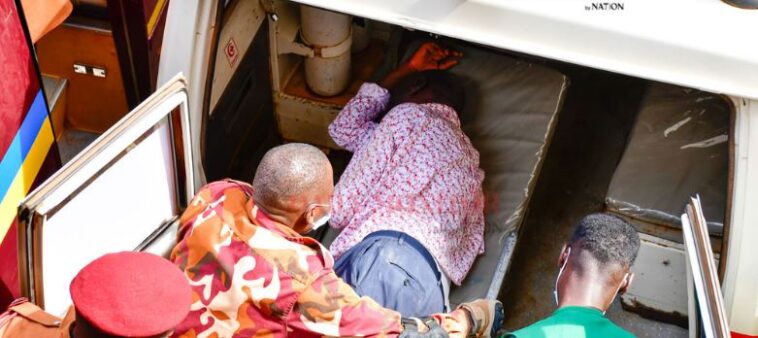
Moments later, amid the commotion, he was restrained in handcuffs. In visible agony, his voice changed from defiance to pain as he repeatedly cried, “You are hurting me… you are hurting me.” Then, before the eyes of the court, his exhausted body gave way. He collapsed. The man who had survived battlefields, exile, imprisonment, tear gas, torture, and decades of political persecution lay unconscious on the courtroom floor.
Breaking News: Dr. Kizza Besigye has collapsed in court. He has been rushed to the Intensive Care Unit at Mulago National Referral Hospital. He is unconscious. That is what the headlines told the world. They were wrong. The man admitted to the ICU is merely flesh and blood. The real patients have occupied those hospital beds for years: Uganda’s Church, gasping for the courage to speak when truth became costly; the Judiciary, struggling to detect the pulse of justice beneath the weight of power; Parliament, sedated into comfortable silence while constitutional promises bleed away; the Executive, mistaking coercion for governance; and the Military, standing armed over a hospital bed as though an unconscious citizen were a battlefield to be conquered.
Besigye did not collapse alone in that courtroom. With him fell every institution that had the constitutional duty to ensure that no Ugandan, regardless of politics or popularity, would ever have to fight for the most basic guarantees of justice while his body surrendered before the law could awaken.
History has an unsettling habit of introducing itself under different names. In 1963, the apartheid regime in South Africa assembled the Rivonia Trial, placing Nelson Mandela and his comrades in the dock on charges of sabotage and conspiracy to overthrow the state. The courtroom was dressed in the garments of legality, but the world soon recognised it as a theatre where law was deployed to preserve political power rather than dispense justice. The prosecution relied on documents seized at Liliesleaf Farm and alleged acts of sabotage to portray liberation leaders as enemies of the state.
Yet the trial produced something its architects never intended: it transformed Mandela from a South African dissident into a universal symbol of resistance against oppression. The dock became a podium, the accused became the conscience of a nation, and the prison sentence became an indictment of the regime itself. Uganda today presents a haunting image that invites comparison, though with one profound distinction.
Nelson Mandela openly acknowledged leading uMkhonto we Sizwe and defended the moral justification for armed resistance against apartheid. Dr. Kizza Besigye, by contrast, has consistently rejected the allegations underlying the treason case against him and maintains that the charges are politically motivated. Yet, as in Rivonia, the greater question extends beyond the particulars of an indictment. It is whether the machinery of justice is being perceived as an impartial guardian of the Constitution or as an instrument through which political rivalry is resolved.
Every application dismissed, every complaint of inadequate legal representation, every allegation of mistreatment, and every image of an ageing opposition leader collapsing in the courtroom while protesting the proceedings only deepens that question. If Rivonia taught the world anything, it is that history rarely remembers the wording of the charge sheet; it remembers whether the courts stood with justice or merely stood with power.
One might have thought we still had a Judiciary in the tradition of Ben Kiwanuka, a Judiciary that understood that the law exists to protect the weak from the powerful and not the powerful from the law. Now the handling of Besigye’s case tells us what exactly the Judiciary is. A captured arm of government obeying commands of individuals who never stepped in a Law School.
Every criminal prosecution ultimately rests on one indispensable foundation: public confidence that justice is being pursued rather than a predetermined outcome. It is for that reason that the chronology of Dr. Kizza Besigye’s case continues to invite difficult questions. If the State believed it had sufficient evidence to arrest him, why was he permitted to depart Uganda through Entebbe International Airport, passing through immigration controls without interference, only to be apprehended later in Nairobi, Kenya, in November 2024? Could this have been a ploy to account for misused money?
Why was a Ugandan civilian first arraigned before the General Court Martial, only for the Supreme Court of Uganda to later hold that military courts lack jurisdiction to try civilians? If that court lacked jurisdiction, what does that say about the months spent prosecuting him there? And why would a military officer in the person of Capt. Oola have his file transferred to the civilian court with Besigye’s and yet he is not a civilian? These questions are not academic. They go to the heart of whether justice is merely being done or is also seen to be done.
The concerns deepened as the proceedings unfolded. Dr. Besigye’s lawyer, Eron Kiiza, was convicted of contempt of court during the military proceedings and imprisoned, an episode that attracted significant public attention. Later, his lead counsel, Erias Lukwago, was himself arrested and charged in separate proceedings for concealing information he received from his clients. Martha Karua, one of the lawyers associated with Besigye’s defence, was denied entry into Uganda and returned to Kenya after being declared persona non grata and her phones stolen in an international airport.
Against that backdrop, the High Court directed that state-funded counsel remain on record despite objections from the accused, who insisted on representation by lawyers of his own choosing under Article 28 of the Constitution. Whether one agrees with those objections or not, the optics are striking: a defendant facing one of the gravest charges known to law repeatedly protesting that he cannot freely exercise his constitutional choice of counsel while the State insists the trial must proceed.
Then there is the prosecution narrative itself, which, as reported in open court, invites careful examination. The state’s main witnesses allege that he met Dr. Besigye in Switzerland on 24 January 2023 regarding plans to overthrow the government, and yet publicly available material indicate that on 23 January 2023, Dr. Besigye appeared on Sanyuka TV in Uganda and that on 25 January 2023 he appeared before the Buganda Road Court, raising questions about the alleged meeting and whether travel records or other objective evidence support the timeline.
The witness alleges that on 24 July 2024 he gave Dr. Besigye US$1,500 to transport recruits to Kisumu for training. If the witness says he had been engaged to provide the alleged training, why would he also finance the transport of those he was supposedly being hired to train? If the same testimony suggests that the group travelled to Kisumu on 24 July, yet also indicates that the witness only arrived there at the end of that month to receive them, how should those timelines be reconciled?
A case with such suspicious facts cannot be one for which the accused persons are stripped of their rights. Centuries of legal wisdom have likened a judge to a watchman standing upon the tower. The watchman does not carry a sword; he carries vigilance. He does not defend the king against the people; he defends the people against the excesses of power. His duty is to remain awake when everyone else has fallen asleep. If the watchman sleeps, the city is overrun. If the watchman chooses silence over courage, the liberties of the citizen perish long before the gates are breached.
That is why courts occupy a sacred place in every constitutional democracy. They are not extensions of the Executive, nor spectators to the exercise of state power. They are the last fortress between the individual and the immense machinery of the State. Yet the proceedings in Dr. Kizza Besigye’s trial have prompted many Ugandans to ask a deeply unsettling question: Has the watchman remained faithfully at his post, or has he looked away at the very moment his vigilance was most needed?
Those questions do not arise merely because rulings were made against the accused; courts rule against litigants every day. They arise from the manner in which the proceedings have unfolded before the nation. As publicly reported, when Dr. Besigye seeks to address the court on matters affecting his legal representation and the fairness of the proceedings, exchanges become increasingly tense.
His application seeking the judge’s recusal have been rejected, and the trial continues under the same judicial officer. Whether those decisions were legally justified is ultimately a matter for the appellate courts. But justice draws its strength not only from legal correctness, it also depends upon public confidence that every accused person has been heard with patience, impartiality, and dignity.
When a courtroom begins to resemble a contest of raised voices rather than a forum of measured justice, and when an accused leaves that courtroom not simply with adverse rulings but eventually collapses before the eyes of the nation, the old legal proverb echoes with renewed force: if the watchman on the tower falls asleep or is perceived to have ceased watching, the liberties of the citizen are placed in grave peril. In such moments, history does not merely examine the accused. It also turns its gaze upon the watchman himself.
History teaches us that whenever injustice rises, God raises voices to confront it. When King Ahab in the Bible abused his power and took Naboth’s vineyard, God sent the prophet Elijah to stand before the throne and declare, “You have murdered and also taken possession.” Elijah did not fear the king because he feared God more. When King David sinned, the prophet Nathan walked into the palace and boldly said, “You are the man.” He did not soften the truth to protect his comfort. When King Herod lived in open wrongdoing, John the Baptist rebuked him publicly, knowing that his courage would cost him his freedom and eventually his life.
During the struggle against colonialism, many Independent African Churches became sanctuaries of resistance, preserving African dignity when colonial administrations sought to extinguish it. They preached not only salvation of the soul but also the liberation of the oppressed. In South Africa, Desmond Tutu transformed the pulpit into a tribunal of conscience, denouncing apartheid when doing so invited harassment and danger. In what is now the Democratic Republic of the Congo, the Catholic Church emerged as one of the few national institutions willing to challenge the excesses of the regime of Mobutu Sese Seko.
One might have expected the Church and the Mosque to speak with that same courage. I imagine that the flock waited for bishops, pastors, apostles, sheikhs, and reverends to remind the nation that that all of bears the image of God. Now we know that silence has occupied the altar where prophecy once stood. The prophet Amos warned us against such church leaders when he said they “sell the righteous for silver and the needy for a pair of sandals.” It is no surprise that they are dead silent because if we were to trace the land titles where some of their churches sit, we might very well trace them to some political office.
No institution better illustrates the anxiety surrounding this case than the military. In every constitutional democracy, the armed forces are entrusted with defending the sovereignty of the nation and protecting its citizens from external threats. They are not intended to become participants in political contests or substitutes for civilian justice. Yet the public narrative surrounding Dr. Kizza Besigye’s case has repeatedly drawn the military into the centre of national debate.
The military abducted him, arraigned him initially in their court, tweeted that they would hang him, abducted his lawyer, tortured him and made public mockery of him, deported his lead lawyer and grabbed her phones in an international airport. Instead of providing security at the airport, they became an insecurity themselves.
Meanwhile the executive and parliament on whose instructions the judiciary and military seem to be acting have suddenly become blind with their leader claiming Besigye is refusing trial meanwhile a parliamentarian Ofwono Opondo has publically stated that Besigye and Lukwago were faking sickness.
Besigye’s life reminds us of what happened in the Congo, Patrice Lumumba elevated a young army officer named Mobutu Sese Seko, believing him to be a trusted ally in the struggle to build a new nation. History would record a bitter betrayal. Lumumba was overthrown, handed over to his enemies, and ultimately killed, while Mobutu went on to rule for decades.
Uganda’s own history presents an irony that I find difficult to ignore. During the bush war, Dr. Kizza Besigye served as a medical doctor to the National Resistance Army and treated Yoweri Museveni and other combatants in circumstances where survival often depended upon the skill and loyalty of those around them. Few could have imagined that decades later, doctor and patient would stand on opposite sides of Uganda’s political divide.
The comparison should end there, for history never repeats itself in precisely the same form. Yet it raises an uncomfortable question worthy of reflection. How does a liberation movement arrive at a point where one of its own senior veterans repeatedly appears in the dock, in prison, and eventually in intensive care while still insisting that his constitutional rights are being denied?
Whether one supports Dr. Besigye’s politics or rejects them entirely, the images of an ageing opposition leader protesting in court, collapsing before the proceedings concluded, and receiving treatment under heavy military guard have become symbols far larger than one man’s legal case. They compel Ugandans and indeed the international community to ask whether the ideals that animated the struggle in Luweero are being faithfully preserved or gradually eclipsed by the imperatives of political power.
This post was created with our nice and easy submission form. Create your post!
Written by
Did this story move you? Every gift goes directly to EJIKU Justine — writers on Muwado earn from reader appreciation, not algorithms. Even $1 makes a difference.






Muwado weekly chart
Get Africa’s top 10 stories every Thursday
No account needed — just your email.
Want to follow EJIKU Justine and get notified every time they publish?
Create a free Muwado account →