

 Oweyegha Afunaduula

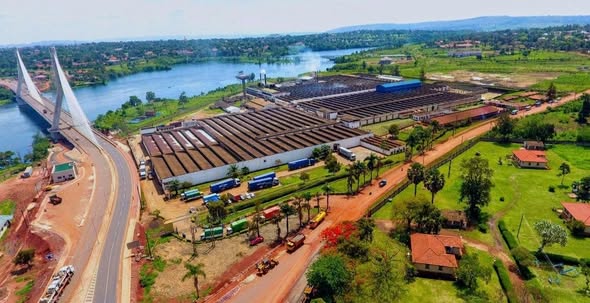
Before President Tibuhaburwa Museveni captured the instruments of power in Uganda in 1986 through the barrel of the gun, with the assistance of Rwandan Tutsi refugees who wanted to use Uganda’s resources also to capture power in Rwanda, the country had developed an enviable industrial base since colonial times. It had an industrial town Jinja, in Busoga, which had a diversity of interlinked factories. Unfortunately, in the wake of his bush war, leading to the capture of power, Jinja lost most of its factories through vandalism by his combatants. There are claims that some of the vandalized factories had their infrastructure dismantled and parts carried off to Rwanda.
Hopefully, at an opportune time, thorough research will be conducted to establish what exactly happened when the combatants of Luwero entered Jinja. However, the remaining functional factories, and the vandalized ones were sold off by the combatants in government mostly to themselves, but also to some select Indians, who were sold as foreign investors, although they were given public money as start-up capital, almost free labour (since the regime removed minimum wage), 10-year tax holidays and allowed to repatriate all their profits back to their country – India.
Once the industrial sector suffered destruction by combatants, it was clear the new regime government would set on a new path of rebuilding and reconstruction of the sector. However, the NRM leaders are doing this in light of the laissez-faire paradigm (Obwona, et.al., 2014), which does not allow for direct government intervention in the industrial process.
Many thinkers have written about Uganda’s industrial sector since President Tibuhaburwa Museveni captured the instruments of power and presided over the destruction of the industrial sector. Obwona, et.al. (2014) and Shinyekwa, et.al. (2016) discussed in writing the evolution of industry in Uganda. They believed the non-interventionist policy has not been adequate to propel Uganda’s industrialisation. They called for the direct interventionist approach to industrialisation in Uganda. Such an approach shows that the government is interested in industrialisation and may reduce corruption of manipulators of the sector by locals who quickly strike venture deals with so-called foreigners that may even serve as fronts for them.
Ortega (2025), in the article in the Observer ” What Museveni got wrong about industrialisation”, seems to suggest that the President perceived industrialisation as just a scattering of factories on the biocultural landscape of Uganda without interconnections between them. In this case, the more factories, the more industrialisation! However, Ortega (2025) teaches us that a factory is not industrialization. Even many factories are not necessarily industries. Those are Katwe-like installations that may disappear because they are equivalent to what we ecologists call “ecological islands”. An industry is a self-sustaining ecosystem of factories, which feed into and originate from each other, mutually reinforcing each other and continually achieving high levels of integration with each other.
One thing is true. Many Ugandans are convinced that a new industrialisation is taking place in Uganda. Industrial parks have been established, unfortunately, without an environmental vision. This means that Uganda’s industrial rebuilding and reconstruction is potentially replete with ecological-biological, socio-economic and sociocultural disruptions that Ugandans never imagined.
Many disconnected factories are located in areas formerly occupied by swamps, which were acting as sinks for wastes, including carbon dioxide. However, without a clear environmental vision, many industrial parks are likely to be ecologically perturbed by floods. Floods can greatly reduce the value of industrialisation and the incomes of industrial actors, as we recently saw recently in the areas close to the assaulted Nakivibo Channel.
My present article is not about industrialisation per se. It is about linking industrialisation and intellectual activity. The article title “Uganda: Industrial Revolution Without Intellectual Debates” suggests that industrialisation without intellectual debates is a stale economic-political undertaking.
Indeed, Stearns (3015) stressed the value of debating the industrial revolution. As he noted, the industrial revolution was and is a huge development as one of the fundamental changes in human experiences in the modern world. It adds a lot of value when intellectuals -public and institutional – are busy debating the changes engendered by industrialisation.
The British Industrial Revolution was the transition to manufacturing processes that occurred from about 1760 to some time between 1830 and 1843. Machines took over from hand production methods, new chemical manufacturing and iron production processes, improved efficiency of water power, the increased use of steam power and the development of machine tools characterized the industrial revolution. Thinking and rethinking of most aspects of British society became inescapable. Intellectuals based in the Social Sciences and the Humanities became active, putting forward new theories of change and discarding the old ones. Indeed, the old intellectual and academic elite gave way to new academic and intellectual.
The old elite received their status from landed wealth. The new story that unfolded was different. A new elite was to receive its status from industrial wealth. The new elite debated the roles of natural resources, foreign investors, government, intellectuals, the new industrialized society and the emerging social relations and social dynamics, and other industry-related issues in Britain.
In Uganda, however, the situation is different. The 40 years of President Tibuhaburwa Museveni has seen the President becoming everything in everything. He initiates industry and stops industry. He invites foreign investors and tells them what he wants, but goes on to give them start-up capital, cheap labour ( by removing minimum wage), tax holidays and a leeway to take all their profits out of the country, leaving the country to gain nothing. Since he is the President and the substantive Minister of Finance, he decides how much money is given to the different investors as start-up capital. He even decides how much money is forgiven.
The Parliament of Uganda, which is more or less lucky when and who comes in as an investor. There are or were times when the President sent Ugandan soldiers to outside countries and then deceptively sought the permission of Parliament retrospectively. The best example of an investor who was single-handedly picked by the President is the Lubowa Specialized Hospital (or the International Specialized Hospital of Uganda) investor, an Italian-Arab woman said to be related to fallen Libyan ruler, Mammuar Gaddafi, and called Enrica Pinetti.According to a Daily Monitor article of 8th March 2025 by Damali Makhaye UgX 774.4 billion of taxpayers’ money had been released by the Parliament of Uganda to the investor since 2021, but there was no hospital and no completion date committed to by the investor. Like other projects in the country project has not benefited from public or university-based intellectual debates because there is intellectual death in the country.
Young people, who should have got humanizing employment, are retained at home as domestic slaves or exported to the Middle East as international slaves, but the evil slave network is cast by the government as a lucrative source of employment for young people, which also praises it as a major conduit for foreign exchange being earned through the slave labourers.
As if all this is not enough, the NRM government policies emphasizing politics and political survival have disintegrated the science (humanities, social science, humanities and natural sciences, preferring natural sciences in the universities because it is the social scientists and humanists who have, since the colonial time, that have actively sustained intellectual debates, often challenging the policies and choices of power. To silence them, the President of Uganda has overhyped natural scientists by paying them far more, even if they hold the same experience and qualifications as their counterparts in the humanities and the social sciences.
Fear and silence on the university campuses are now integral to academia. There is virtually no intellectual production and intellectual challenges to government choices or policies. Even in the Departments of Political Science, there is a deep sea of silence and fear. What now matter are academicism, scholasticism and careerism. The government is happy that there is so much fear and silence on the university campuses that it cannot be challenged intellectually on anything. It does whatever it wants without expecting contradictory messages from the campuses. It values its Kyankwazi-bred intellectual fat more because they are committed to power retention by him and his NRM party.
The weaponized schemes of Myooga, Operation Wealth Creation and Parish Development Model are passing the test of time, succeeding in the impoverishment of whole communities. Meanwhile, the government continues pumping billions of shillings into the schemes, unchallenged by present-day inactivated intellectuals in the universities.. This is also true of the model of factorization being cast as industrialisation. It is equally terrible in society. The space for public intellectuals has been captured by nincompoops and ignoramuses, who now posit themselves as public intellectuals, mainly to immunize the regime in power and its choices in various sectors of the economy from intellectual inquiry and questioning and from public scrutiny.
In one sentence, industrialization in Uganda is more or less a one-man show and is devoid of intellectual debates, unlike what obtained during the British industrial revolution.
There is intellectual death both on the university campuses and in the greater society of Uganda. Therefore, meaningful and effective intellectual debates are absent in academia and in the public space.
This does not augur well for Uganda of the 21st Century. The President of Uganda has been able to achieve the intellectual death of Ugandans in and outside the universities. If there are any gains for the NRM regime to talk about, this must rank high on the list of gains.
It is now a choice between survival and extinction of the nation of Uganda before the 21st century ends and the 22nd century begins. The NRM regime is lucky because most of the people it governs are so intellectually poor and politically underdeveloped that they are unaware of what is going on. They have largely been stupefied by money.
The ten-million-dollar question is: Who gains, who loses?
For God and My Country.
This post was created with our nice and easy submission form. Create your post!

Written by
I am a retired lecturer of zoological and environmental sciences at Makerere University. I love writing and sharing information.
Did this story move you? Every gift goes directly to Oweyegha Afunaduula — writers on Muwado earn from reader appreciation, not algorithms. Even $1 makes a difference.






Muwado weekly chart
Get Africa’s top 10 stories every Thursday
No account needed — just your email.
Want to follow Oweyegha Afunaduula and get notified every time they publish?
Create a free Muwado account →