

 Oweyegha Afunaduula
Introduction: The Patriotism ParadoxIn what may be one of the most ironic political developments of Uganda’s 2026 election cycle, the national flag – a symbol designed to unite all citizens – has become a contentious political artifact. The sight of opposition supporters waving the black, yellow, and red banner now triggers police intervention, while government officials issue increasingly urgent warnings about the “proper use” of national symbols. At the heart of this controversy lies a fundamental question: who owns patriotism?
The regime of President Yoweri Tibuhaburwa Museveni, in power since 1986, finds itself in the uncomfortable position of appearing to criminalize the very national emblem it claims to protect. This article traces how presidential candidate Robert Kyagulanyi, popularly known as Bobi Wine, successfully weaponized the Uganda flag as a mobilization tool, and how the government’s response reveals deeper anxieties about political space and national identity.
Historical Roots: A Symbol Born in Unity
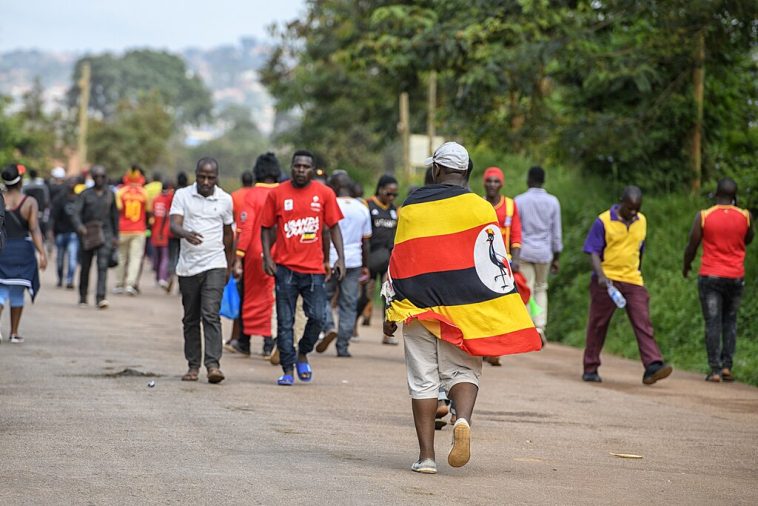
When Uganda gained independence from British rule on October 9, 1962, the new flag carried deliberate symbolism. The six horizontal stripes – black, yellow, red, black, yellow, red -represented the people, sunshine, and African brotherhood. The central grey crowned crane, facing the flagpole, symbolized the nation moving forward. Based on the flag of the Uganda People’s Congress that led the country to independence, it was intended as an inclusive emblem.
For decades, the flag flew at state functions, schools, and international events without controversy. That changed dramatically as the 2026 elections approached and the political temperature rose.
The Opposition’s Masterstroke: Reclaiming the Flag
Bobi Wine’s National Unity Platform (NUP) executed what political analysts now call a “symbolic jujitsu.” After the government banned the NUP’s distinctive red berets in 2021 – declaring them a uniform reserved for military forces – the opposition needed a new, legally protected identifier. They found it in the most obvious place: the national flag.
Strategic Adoption:
· At rallies, supporters now wave thousands of Uganda flags instead of party banners
· Vehicles in opposition convoys prominently display the flag
· Bobi Wine himself often appears wrapped in or holding the flag during speeches
· Social media campaigns use #OurFlagOurCountry to mobilize youth
Narrative Framing:
Bobi Wine’s rhetoric cleverly frames the flag as a patriotic alternative to partisan symbols.”They banned our berets, but they cannot ban our national flag,” he declared at a recent rally. “This flag belongs to every Ugandan, not just those in State House.” By positioning himself as the true patriot defending national symbols from government overreach, he flipped the usual script on patriotism.
Government Response: Legality Versus Political Reality
The state’s reaction has been characterized by what observers call “fidgeting” – a series of increasingly strained justifications for restricting national flag use.
The Legal Argument:
Police Spokesperson, ACP Rusoke Kituuma, cited the National Flag and Armorial Ensigns Act, stating that using the national flag in political activities requires “prior authorization from the Minister of Justice and Constitutional Affairs.” The Act does contain provisions about “proper use,” but historically these were rarely enforced against ordinary citizens.
Escalating Rhetoric:
· Chief of Defence Forces Gen Muhoozi Kainerugaba warned on social media platform X: “Anyone caught misusing the national flag will be brought to law.”
· Security forces have begun confronting individuals carrying flags at opposition events
· Government-aligned media have run segments questioning the opposition’s “true motives” in using the flag
The Transparency Problem:
When pressed, authorities struggle to explain why flag-waving suddenly became problematic after decades of tolerance. The disconnect between the law’s existence and its sudden enforcement reveals the political nature of the crackdown.
International Context: When Governments Fear Their Own Flags
Uganda is not alone in grappling with contested national symbols. Several governments have restricted flag use when it serves opposition movements:
Russia: In 2021, veteran human-rights activist, Lev Ponomarev, was arrested for carrying the Russian flag during an unsanctioned protest on Flag Day. Police claimed he was “resisting arrest,” but observers noted the flag’s presence made the protest appear more patriotic and thus more threatening to authorities.
Iran: The Islamic Republic strictly controls flag symbolism. Displaying the pre-revolutionary Lion-and-Sun flag is illegal, and even the current flag’s use is regulated to prevent “improper” political statements.
India: The Flag Code contains detailed restrictions on how the national flag may be displayed, though outright bans on carrying are uncommon. The code has been invoked politically at times.
Comparative Insight: What distinguishes Uganda’s situation is the blatant timing – the restrictions coincide precisely with election campaigning and target specifically the opposition’s most visible symbol. This pattern suggests less about protecting the flag and more about controlling political expression. Human rights activists see it as a continuation of repression in elections.
The Deeper Significance: What’s Really at Stake?
Political analyst and now incarcerated Dr. Sarah Bireete notes: “This isn’t about fabric or colors. It’s about narrative control. The government’s patriotism campaigns have struggled to resonate, particularly with the youth. Now they see ordinary citizens embracing national symbols with genuine enthusiasm – but for a different political project. That’s profoundly threatening to any long-standing regime.”
The flag controversy exposes several underlying tensions:
1. The Generational Divide: Young supporters of Bobi Wine see the flag as representing the Uganda they want to build, while the government treats it as representing the Uganda they built.
2. Ownership of Nationalism: Who gets to define what patriotism means? The state or citizens?
3. Legal Selective Enforcement: Laws existing for decades are suddenly invoked for political containment.
4. Symbolic Escalation: As opposition space shrinks, symbols become battlegrounds. After berets, after slogans, after rallies – now the flag itself is contested.
Conclusion: The Flag as Democracy’s Barometer
As Uganda approaches the 2026 elections, the national flag flies at the center of a democratic paradox. Designed to represent unity, it now highlights division. Meant to symbolize sovereignty, it reveals contested authority.
The government faces a no-win situation: continue cracking down and appear to fear its own national symbol, or back down and concede symbolic ground to the opposition. Meanwhile, Bobi Wine’s campaign gains moral advantage from what looks like a state afraid of its citizens’ patriotism.
Ultimately, how this flag controversy resolves will signal much about Uganda’s political direction. Will the flag return to being a unifying symbol, or will its very display continue to indicate political allegiance? The answer may depend less on laws about fabric and more on whether Uganda’s political space can accommodate competing visions of patriotism.
One thing remains clear: in the battle for Uganda’s future, the six stripes and grey crane have become as politically significant as any policy manifesto or campaign promise. The flag, once merely a symbol of the nation, has become a measure of its democracy.
For God and My Country
Image: Wikimedia
This post was created with our nice and easy submission form. Create your post!

Written by
I am a retired lecturer of zoological and environmental sciences at Makerere University. I love writing and sharing information.
Did this story move you? Every gift goes directly to Oweyegha Afunaduula — writers on Muwado earn from reader appreciation, not algorithms. Even $1 makes a difference.





Muwado weekly chart
Get Africa’s top 10 stories every Thursday
No account needed — just your email.
Want to follow Oweyegha Afunaduula and get notified every time they publish?
Create a free Muwado account →