

 Caesar Obong Ng'bong ocen

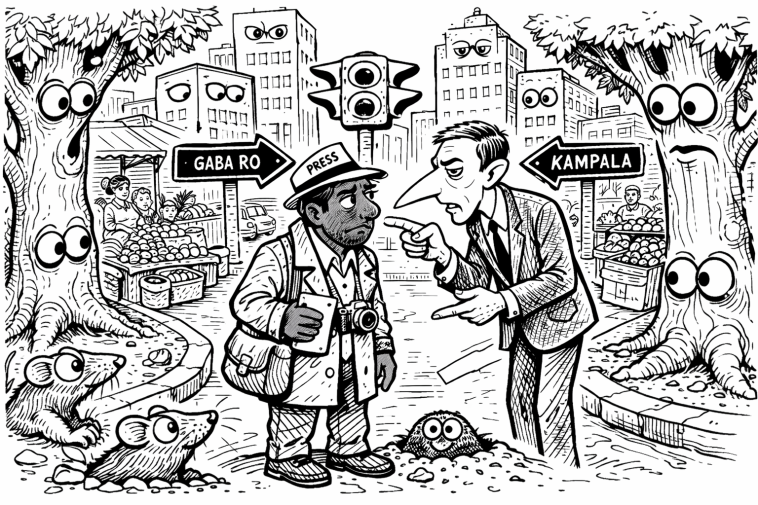
Kampala is a city of many ears and many eyes. She never sleeps. She wakes before she speaks, and when she does, it is a whisper—soft, precise, deliberate. She listens, calculates, prosecutes. She records every step, gesture, and word of anyone foolish enough to draw attention. In Kampala, even silence carries weight. Ambiguity becomes evidence. Innocence is a liability.
By the time Professor Rochet and I stepped out of Ethiopian Village in Kabalagala, the streets were alive. Boda engines growled like caged beasts unleashed, weaving through the early traffic with mechanical precision. Vendors shouted the day’s first bargains, their voices slicing through the hum of the city. The air was thick with the smell of roasted coffee, frying oil, dust, and exhaust—a pungent, inescapable perfume that clung to skin, lungs, and clothing.
The city had been awake long before us, listening, watching, remembering.
Rochet paused at the doorway, adjusting his scarf, though the morning was warm. He always adjusted something when he was thinking. His angular face, framed by silver streaks, seemed sharper against the chaotic blur of Kabalagala. He scanned the streets, eyes narrowing, calculating like a general surveying a battlefield.
“You see?” he asked quietly.
“See what?” I replied.
“The rhythm has changed,” he said, voice low, almost a whisper. Across the street, a fruit vendor arranged pineapples with geometric precision. Two young men leaned against a taxi, silent, counting the flow of pedestrians as if mapping patterns. Even the laughter of a woman into her phone felt rehearsed, then hushed as we passed.
“The city is aware,” I said.
Rochet’s hands dug deeper into his pockets. “And so are we.”
I shivered despite the warmth.
Weeks earlier, I had posted a story on Muwado recounting a night I spent drunk, sleeping on the polished floor of a luxury hotel in Kampala. I had been careful: no names, blurred timelines, softened details. Nothing that could implicate anyone.
Or so I believed.
A week later, another blogger dissected my piece like a crime scene. Timelines were mapped, public appearances cross-referenced, and my drunken misadventure aligned with a private meeting between a high-ranking government official and a clergyman at the same hotel. The blogger’s conclusion was deliberate, triumphant:
“The drunk journalist unknowingly documented the encounter.”
Documented.
I had written only about the cold marble under my cheek, the faint smell of polish, waking to a security guard tapping my shoe with polite irritation. Yet someone had turned these mundane observations into a weapon.
The politician grew visibly unsettled—not by my writing, but by what someone else inferred. Questions emerged about cameras, recordings, whether I had noticed him, whether I had written it all down. My story had become coded testimony, and I hadn’t even realized it.
Rochet, reading my blog on a renowned Ugandan pastor—a friend of the poor, admired nationwide—wasn’t pleased. To him, my stories had grown heavier, sharper, more political. Unlike Ernest Bazanye, whose work is lighthearted, interactive, and fun, my stories carried weight, resonance, and risk.
“What you write… it’s sharp,” he murmured. “It points to a known figure… a legendary one. If misunderstood, or worse, used maliciously… it could be fatal.”
His words tightened my chest. Every street we passed, every honk, every shouted greeting pressed against my nerves like the city itself was squeezing, measuring, judging.
“Dangerous… heavier… darker,” he repeated. His words mirrored the pounding in my chest, a drumbeat of impending consequence.
Rochet pulled out his phone. “Look at this,” he muttered.
I leaned over. A TikTok video played: two bloggers dissecting my writings, voices exaggerated, performative, daring. Behind them, computer-generated images of high-ranking figures flickered—disturbingly real. My fingers tightened around my notebook, knuckles white.
“They’ve taken it too far,” Rochet whispered. “This is no longer commentary… it’s digital manipulation. Computer Misuse Act territory.”
Heat surged through me. Every honk, every shouted greeting, felt amplified—the city pressing in, judging, watching.
“And I am being watched too,” Rochet said, hands shaking slightly, as though the weight of Kampala pressed not just on him but on everything around us.
“They flagged my university account. Tracked my movements. Analyzed my lectures, citations, even engagement with your stories. They are not interested in literature. They are watching resonance. And your resonance… is dangerous.”
My pulse thundering, I swallowed hard. Across the junction, a black vehicle crawled forward, engine idling, observing.
“They asked whether you could be guided,” Rochet murmured.
Guided. The word rolled cold and heavy through my mind. My heartbeat went erratic. The city’s roar became a background hum to the drum inside me.
“Toward stability. Constructive influence. Alignment.”
The same word from an anonymous message weeks ago. My fingers trembled against my notebook.
Hours later, in a quiet café hidden behind flowering hibiscus, Rochet sipped coffee slowly, observing me as much as the city outside.
“You think these are just stories,” he said. “You write, they interpret, and sometimes, they predict. Your words carry weight. Resonance. Alignment. Others will try to guide, redirect, or exploit it. You have to understand the chain before you break it.”
I nodded, heart still racing. “But how do you even measure that?”
Rochet smiled faintly, knowingly. “By watching the watchers. By knowing who responds, and how. By distinguishing coincidence from orchestration. And by never assuming innocence is invisible.”
I left the café at dusk. Kampala had changed again. Shadows deepened. Streetlights flickered. Black vehicles prowled like sentinels. Vendors lingered, eyes glinting with curiosity—or calculation. Boda riders swerved past, engines growling in rhythm with my heartbeat.
From the corner of my eye, a man in a black suit paused, checked his phone, glanced in my direction. My stomach tightened. General O? Perhaps. Or maybe just another citizen.
The city had learned to watch.
My phone vibrated. Another private message from The_Observer_256:
“Kampala does not forgive mistakes. It measures. It watches. It waits.”
I exhaled slowly. The city hummed around me—alive, dangerous, beautiful. And my heart, still pounding, knew it had become part of the story.
Every step, every word, every glance—recorded, interpreted, waiting.
Kampala had learned to listen and watch. And it would not forget.
Author’s Notes
This story is a work of fiction. All characters, organizations, and events are products of the author’s imagination. Where real names appear, including Ernest Bazanye, it is for literary, comparative, or illustrative purposes only. Any resemblance to real persons, living or dead, is purely coincidental, and no real individual is implicated in the events of this story.
This post was created with our nice and easy submission form. Create your post!

Written by
Caesar Obong Ng'bong Ocen is a Ugandan writer whose work traverses narrative fiction, cultural memory, and moral inquiry. Drawing on African cosmologies, and reflective storytelling, his writing engages with issues of power, identity, faith, and the human condition within post‑conflict societies. His series blends political realism with interior psychological struggle, articulating the tensions between duty and conscience, tradition and modernity, exile, redemption. Obong Ng'bong's work bridges literary and social worlds: it interrogates African historical and political realities while exploring philosophical and ethical questions that resonate across disciplines. His narratives are grounded in cultural authenticity and moral depth, making them relevant to both literary and humanistic inquiry. He also mentors emerging writers and contributes to dialogue on African storytelling traditions and their place in contemporary literature.
Did this story move you? Every gift goes directly to Caesar Obong Ng'bong ocen — writers on Muwado earn from reader appreciation, not algorithms. Even $1 makes a difference.





Muwado weekly chart
Get Africa’s top 10 stories every Thursday
No account needed — just your email.
Want to follow Caesar Obong Ng'bong ocen and get notified every time they publish?
Create a free Muwado account →