

 Caesar Obong Ng'bong ocen
It was a Monday morning—one of those mornings that feel ordinary until they redefine everything you thought you knew about danger, power, and survival.
I remember the knock. Not loud. Not urgent. But deliberate. Each tap carried an authority that demanded attention.
When I opened the door, I found Pastor Okello—the Stallion himself—standing there in full combat military attire. Not ceremonial robes, not the flowing garments of a preacher, but hardened khaki, reinforced boots, and a vest that looked capable of stopping bullets. A chill ran through me, a shiver that began in my spine and radiated outward.
Behind him were Drake, Felix, and Maggie. Armed, disciplined, silent. Their eyes measured the room as though danger lurked in the corners.
“Where is Mary?” Okello asked.
“She’s… bathing,” I replied, my voice faltering.
He stepped past me without waiting. The others followed, filling the room with the gravity of inevitability.
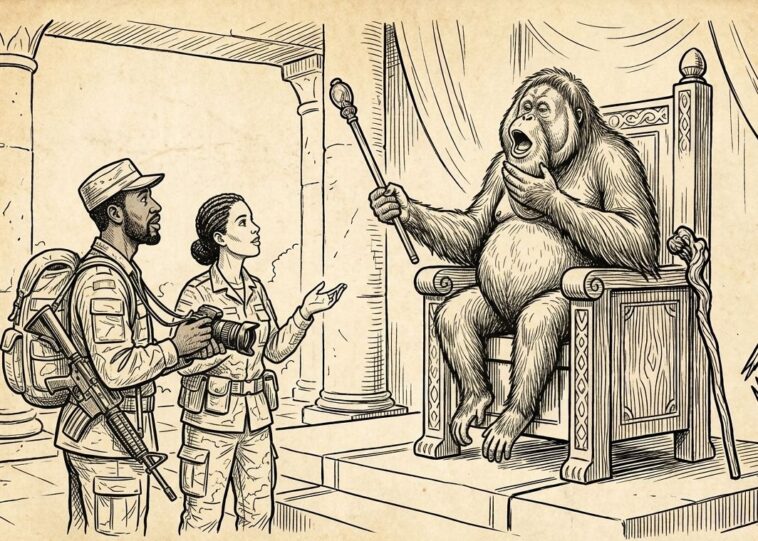
“Get ready, you have work to do Mr. Camera man.” he said. “We’re heading to Murchison Falls. Rebellious tribes may resist. But we are prepared.”
Resistance.
The word did not belong in my house.
“Move.”
Mary was already dressed when I returned to the bedroom.
Green. Military. Form-fitting yet utilitarian. Her hair was tied back with purpose, her hands steady as she prepared tea and chapatti in the kitchen.
“You knew?” I whispered.
She did not answer.
Maggie appeared behind me, placing a folded uniform on my bed.
“Dress,” she said. “This is not Sunday school.”
Camouflage. Vest. Boots. Bulletproof.
I put them on, feeling like an imposter in my own body.
Breakfast was subdued. The steak, tinned bread, and tea seemed irrelevant compared to the weight of the unknown that pressed against the walls.
Then we left.
The motorcade surged north along the Kampala–Gulu highway.
Bwaise. Kawempe. Kagoma. Places I knew, sliding past like fragments of a dream.
Inside the vehicle, the air vibrated with silent tension. No one spoke. Every movement was calculated, every glance measured.
By Kawanda, the world outside seemed to shrink, as if aware we were intruding upon forces invisible to ordinary eyes.
By the time we reached Bombo and Wobulenzi, unease had settled fully in my chest. My palms were professionally sweaty and clumsy. My throat dry and itch as if I had longed spent days without cigarettes.
“You knew about this?” I asked Mary again clearing my throat from the dry cough and spitting out the thickened sliver and mucus fussed together.
She stared ahead, eyes fixed on the road.
“Yes.”
Nothing more.
Luwero came next. The heat pressed down differently, thick and heavy. I felt it in my bones.
By the time we reached Nakasongola, I realized: this was not just a journey. It was a crossing into another world.
Then we intentionally brunches off towards a feeder road Nakasongola barracks was just a stone thrown away, by this time my sweat became visible and my beady eyes teary that was when fear became tangible.
Soon we were at the airfield runway and then straight into the hanger where the smell of oil, gunpowder, and metal assaulted the senses. Rows of weapons—rifles, pistols, AK-47s, Kochs—lined the hangar. Crates of ammunition stood like monuments. An Apache helicopter rested nearby, a predator in wait.
Drake handed me a short gun
“Hold it,” he said.
I hesitated.
“Be fast before I sink my boots into your Barracks,” a few old officers who were there laugh others crackle as my hands trimboled as I held the koch label German made short gun.
“Hold your breath, aim and …” The small thing wailed a thunderous cry as it spited a small pallet out of its mouth and from it’s side and empty shell emarges. “The first time is always the hardest but after that everything becomes normal, it’s like eating food. No one shows you where your mouth is. Isn’t it my friend?” Drake said as lessons after lessons continued, it was a master class in weapon handling and maintainence.
He adjusted my grip. Showed me how to load, aim, fire, and reload. My heart raced with the absurdity. I had never touched a weapon in anger.
“Our soldiers have been magnetized and are being clearly monitored by state opparatives,” he said, lowering his cracking voice. “That’s why civilians like you are needed.”
I did not respond. But I remembered it.
Then we were each assigned a vehicles. Ugandan-made open roofed 110cc mini jeep, rugged and dust-worn, each prepared for the unpredictable terrain ahead. Drake tossed me a set of keys.
“You drive your own from now on words we are not your servants to keep driving you all around.”
I climbed in. The seat was hot. The leather smelled of dust and machine oil. A rifle rested beside me, pistols secured in holsters. I also noticed a communication device resemblance to a cell phone.
Then there was a final reminder from General Okello himself, “what ever we have given you is for your own personal safety protect it at all cost, do not abandon your weapon or your radios and if you must die, I prefer finding your gun intact with your dead body.”
Mary entered her own jeep. She did not look at me. And just like that the engines roared.
Okello’s engine roared. One by one, we moved out—not a motorcade anymore, but a formation, each one of us was an individual unit in a silent army.
The journey north was long.
But sooner enough we were at Karuma trading centre, we reassembled at the bridge and lined into a single file crossing the bridge with ease.
By this time the Uganda wild life authority team had joined us they had with them a truck loaded with bananas, sweet finger like bananas. I didn’t question why, I just followed command.
The Nile flowed beneath, deceptively calm, hiding currents and histories older than memory. For a moment, it seemed to pause, holding its breath. Then it surged again.
We turned left onto the Karuma–Pakwach road. Less traffic, more silence. The landscape shifted: scrubland, acacia clusters, the faint traces of wildlife paths.
That was when nature began manifesting a tired elephant cow, a pride of lioness, lizards, crocodile, park of wolves, in the plains of Africa I wondered. But just then, without announcement, we branched left again. Into the wilderness.
The forest swallowed us immediately. Light fractured through the canopy, filtering down in uneven beams. Every sound—the roar of the jeeps, snapping branches, distant birdcalls—was amplified in the stillness. The air smelled of earth, dung, and something older, something that did not belong to the surface world.
And then I saw it.
Below the waters of the Nile from my vicinity was a rare glimpse of an object that did not exist.
A relic.
One end a spear, the other a lance—broken cleanly in two. A school of fish circled it slowly, deliberately, almost ritualistically.
I slowed the jeep. My hands shook.
Through the radio, I tuned into Mary’s channel.
“Do you see what I’m seeing?” I asked.
Static.
Then her voice, calm yet trembling.
“Yes.”
A pause.
“But not the same way.”
“Stay with it,” she added. “Don’t blink.”
I snapped photographs—rapid, uneven shots. The fish did not scatter. They continued their circular dance, precise, ceremonial.
At the church someone had said that the staff of king Qashqash was levitating above the Nile somewhere in this location, this was under the Nile.
Then—the water stopped. Completely.
No current. No ripple.
The fish froze mid-motion.
The broken lance hung suspended, untouched by time. It was a mirage of the same image below.
My breath caught.
The world lost its orientation. Above felt like below. Movement felt like memory. Then—vanished.
The river resumed, fish scattered, and the forest resumed its deceptive calm.
Ahead, the shrubs moved with intent.
Okello reacted instantly, leaping from his jeep with fluid precision. Drake, Felix, and Maggie followed. I think they forgot their weapons in the viecle all of them, because this was fast. They disappeared into the undergrowth without a sound.
Mary and I stopped the engines breaking at once. Silence engulfed us.
Then they came.
From every direction.
Primates—organized, intelligent, disciplined. No chaos, no hesitation. Absolute authority.
We were taken.
Time dissolved in their domain. The forest thickened, mist curling around us like living fingers. Then—the Nile appeared above us,it was as if we were in an aquarium but that wasn’t true, above you could see a school of fish swimming overhead, and circling around the Brocken Lance and the in the middle of the lance potition at 90 degrees was the staff that was long talked about, light refracting impossibly through the suspended water. The broken lance and staff now floated above our head, split and frozen, a memory pinned in time. I rose my camera and took the photo as proof.
“This is real,” Mary whispered.
I said nothing.
We were brought before the Monkey King.
His dent smelled of earth and age. He did not speak. His gestures were precise, layered, intentional. I understood more than I should have.
“Why are you trimbling and smelling bad?” The body gestures of shaking his belly and pocking his nostrils was vivid.
“Because here is frightening,” I replied by dragging my shoulder up and down.
He looked at Mary. Then back at me again.
A finger and vocal gestures which I translated as “Why does she not speak?”
Before I could answer, he understood.
Laughter filled the chamber. Not mockery—recognition. In their world, ownership and possession held no power. Silence was choice, not imposition.
Else where, unseen, Okello and the others fought. But their weapons were rendered useless by the invisible force of nature, The Invisible lashes struck them, consequences rather than combat. Violence had no authority over invisibility in this land.
The King observed me.
“I brought a gift,” I said with finger gestures and facial expressions
He watched. Unmoved.
I gestured toward Mary—then realized the gift was not physical. It was meaning. Connection. Recognition. I stepped away, releasing her completely.
The chamber fell silent. The nod came. Freedom.
Time collapsed on our return. We emerged from the forest to find four of the ATV’s Overturned and vandalised Okello, Drake, Felix, and Maggie were no where. So I took one of the ATV sitting side by side I drove off towords the trails marked by our coming, lark was on my side as we continued I coughed glips of Okello trotting without shoes, his clean neat uniform was torn and worn-out from constant lashes. Drake and Felix were bleeding from the lashes and Maggie Okello’s wife was bleeding from her nostrils, it seems the weeps and lashes knew no gender or age. These area was marked by unseen lashes. I carried the trip and Maggie to a safe zone where the banana lorry was waiting but Okello was to return with us, to which when told I could see the fear in his eyes and body language, he had suffered humiliation beyond reasonable doubts.
We returned with the bananas. Exchange completed. Wounds healed immediately by shallow clastered water, undone as if by time itself had no existence here.
Then the King showed a vision. cities rising, falling, civilizations collapsing under their own force. The broken lance, again and again, echoing history’s fragile violence.
This image was about empires and after that the king thanked us for visiting and flagged us off, after the bananas were offloaded the monkeys help reload the vandalised ATVs on to the lorry.
Of course only two jeeps survived—mine and Mary’s. And Drake, Felix and Maggie shared my Jeep while Okello drove the lorry Naked, only his underclothes. We retraced our way back to Nakasongola Barracks where Okello was wiskerd in Naked and Naked he stood before the tribunal only to be saved by my camera saying evidence. The wildlife ever since has acknowledged this spot as a top secret spot. My camera and all it’s contents were confiscated from me, I tried to file a follow up of the equipment but they said it’s either in Nakasongola, Bombo or Nambya. As for Felix and Drake coming back with torn uniforms and lost equipment means punishment and so they are still serving their sentence somewhere in a facility in Luwero, Okello’s wife Maggie did not lose her Gun so she is safe and has ever since gone back to serving the lord.
And now for me and Mary. We were lucky to have been captured by the monkey troops so we returned the borrowed equipment to Nakasongola barracks and we were awarded with medals without cash. Now back in Kampala, ordinary life resumed. But nothing was ordinary.
The photographs remained in archives, sealed, hidden somewhere I don’t know.
Weeks had passed and I was sorted alone with a field radio.
I do not know why I turned it on.
Static. Silence.
Then—a voice.
“…do you see what I’m seeing?”
I froze. My voice, yet not my memory. Not imagination.
Before I could respond, Mary’s voice came through.
“Yes.”
A pause.
“But not the same way.”
The radio went dead.
Somewhere beneath the world we know, forces exist that do not resist.
They simply wait.
And sometimes—they listen.
This post was created with our nice and easy submission form. Create your post!
Written by
Caesar Obong Ng'bong Ocen is a Ugandan writer whose work traverses narrative fiction, cultural memory, and moral inquiry. Drawing on African cosmologies, and reflective storytelling, his writing engages with issues of power, identity, faith, and the human condition within post‑conflict societies. His series blends political realism with interior psychological struggle, articulating the tensions between duty and conscience, tradition and modernity, exile, redemption. Obong Ng'bong's work bridges literary and social worlds: it interrogates African historical and political realities while exploring philosophical and ethical questions that resonate across disciplines. His narratives are grounded in cultural authenticity and moral depth, making them relevant to both literary and humanistic inquiry. He also mentors emerging writers and contributes to dialogue on African storytelling traditions and their place in contemporary literature.
Did this story move you? Every gift goes directly to Caesar Obong Ng'bong ocen — writers on Muwado earn from reader appreciation, not algorithms. Even $1 makes a difference.



Muwado weekly chart
Get Africa’s top 10 stories every Thursday
No account needed — just your email.
Want to follow Caesar Obong Ng'bong ocen and get notified every time they publish?
Create a free Muwado account →