

 Caesar Obong Ng'bong ocen
General Okello had gone to Area 56 and returned, bringing with him something people did not have a name for, so they called it the elixir of life, which he used to cure his wife. The news spread like wildfire, changing shape with every retelling, and soon even it became very difficult to escape this new topic in town, about pastor’s going underwater and bring back powers that can bring back to life a dead person.
Not only in my drinking joint but also in churches especially the bornagain ones where some pastors were being overheard saying that Pastor Okello had gone beneath the water, made a deal with a lord of the depths, and traded countless lives to restore one. Whether truth or exaggeration, no one could deny that a man does not return from such a place unchanged.
That Sunday morning, Mary Mwaibako—my wife-to-be—and I walked to church as usual. I carried a Bible in one hand, a pen in the other, and a camera with a tripod slung over my shoulder. Faith, record, and proof. To most, Sunday was a day of worship; to me, it was work as usual.
But that morning, something felt… misaligned.
Mary’s fingers tightened around my wrist.
“Do you feel it?” she whispered.
I nodded, though I could not explain it.
After the service, as we made our way toward our usual place for Sunday deep fried chicken and plantain banana roast that was always my venue every Sunday.
As we began to munch and gnaw the testy chicken drum stick, a tall, dark man of Sudanic ethnicity approached us. He moved with purpose—not curiosity.
“You’ve been… to the water,” he said.
“Yes,” I replied cautiously but which water was he talking about, surely here in Uganda we are surrounded by water, rivers and lakes. “We’ve been near it.” I answered without a second thought.
Mary said nothing. Her eyes studied him carefully.
“What lies beneath it?” he asked.
Mary stood. “Come. Not here.”
She led him to the counselling room, away from the murmurs outside, I followed them too, and while there, the man sat across from us. Light filtered through the window in long, silent beams.
“The water is not a body,” he said. “It is a passage. It listens. It responds. It opens… but not for everyone.”
“You speak as if you’ve been there,” I said.
“No,” he replied. “But I know what it is, many years ago during the reign of king Qashi who resigned giving the instruments of powered to his son….” before we could listen more, he was abstracted by a rangcouriois cry loud enough to raise suspicion.
Later, I would learn he was Nubian, his lineage tracing back to Sudan. He had not come by chance—he had come with purpose.
Mary leaned forward slightly. “Say what you came to say.” she said.
“There was a king,” he began. “Before your maps. Before your borders.”
“Qashqash,” Mary said.
“You know the name.”
“We know more than that,” I added.
“The staff,” Mary said softly.
“It is missing,” he replied.
“Displaced,” I corrected.
The room fell silent.
I looked into Mary’s eyes. The world outside—the churchyard, the sunlight, the distant voices—faded into nothing. Without hesitation, without thought, we spoke at the same time:
“resonance!”
The word rang through the room like a struck bell—sharp, deliberate, alive. It was not agreement. It was alignment. Recognition. Preparation.
Mary’s voice lowered. “We know what we’re dealing with. Every step will be watched. And if the staff is still… active, mistakes will be deadly.”
“resonance,” I repeated, now as a vow.
“What is this resonance that you people keep talking about?” the man asked, his voice edged with skepticism.
I gestured for patience and called in the elders.
Soon, Drake, Okello, and Maggie Okello stood beside us. Mary began to explain, but Okello interrupted sharply.
“This is a blind expedition into children’s play and curiosity.”
Drake added, “If this staff truly existed, it would have rotted years ago.”
The Nubian man stood firm. “No. It was forged from a rare element. Indestructible. Untouched by time.”
It was then that Maggie spoke—calm, deliberate, and precise.
“Finding the staff is one thing,” she said. “But are we ready to risk regional war with our neighbors for it?”
She stepped forward slightly.
“The truth is this—Qashqash came to Area 56 searching for his father. But after receiving the instrument of power, his father stole the walking staff and fled north along the Nile… to Pakwach.”
She paused, then continued:
“Some secrets are better left unearthed. Sound is one of the most powerful weapons on this planet. The staff is not a symbol—it is a device. It generates sonic wavelengths capable of manipulating matter, energy… even consciousness itself. King Qash was right to hide it from his brutal son.”
By this time, Drake was so absorbed that his mouth was wide opened, it was as if he was listening with teeth—every vibration, every nuance registering in him beyond comprehension. He was no longer trying to understand. He was receiving.
As the discussion deepened, a middle-aged man appeared from nowhere suddenly, stopped at the doorway. Something in our conversation had reached him.
He stepped inside without invitation.
“The staff is there,” he said immediately.
We turned toward him.
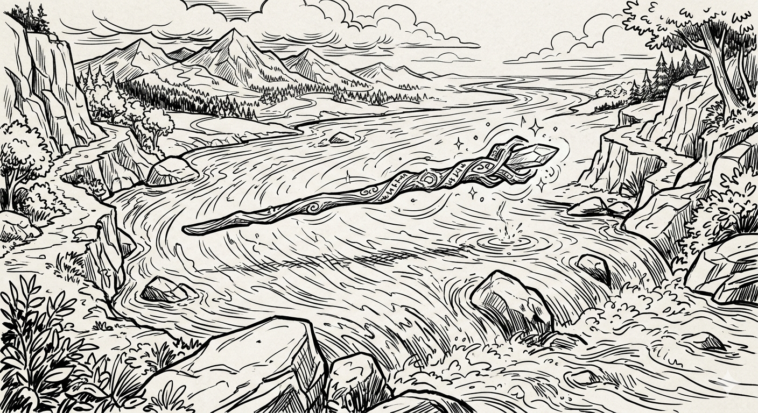
“But no one can retrieve it. It remains lodged in the Nile—beyond the rapids of Karuma but before the pakwach bridge”
Silence filled the room.
“And even if you could reach it,” he continued, “seeing it comes with consequences. There are things the gods buried for a reason.”
No one spoke.
“The staff is not alone,” he added. “The axe. The trumpet. All of them lie within the hunting grounds of Pakwach.”
A chill spread through the room.
Before anyone could question him—before a single word could form from any of us—he turned…
and vanished.
Not hurried.
Not hidden.
Gone.
The air grew heavy.
The staff was no longer myth.
It was real.
It was active.
And it was waiting.
“Did you make good use of your equipment, sir?” Okello asked, looking at me straight in the eyes, his tone calm but probing.
I turned instinctively to my camera, lifting it with urgency. Proof. Evidence. Something to hold onto.
But as I checked—frame by frame, sound by sound—my breath slowed.
There was nothing.
No image.
No sound.
No trace.
The recordings were empty, as though the moment itself had refused to exist.
“That’s not a malfunction,” Drake said quietly.
Maggie nodded. “It’s a warning.”
The words settled heavily.
Go there at your own risk.
Mary gripped my hand tightly. No words—just certainty. We had seen enough.
Without another glance back, we turned and walked out of the counselling room.
Drake followed closely behind us, unusually silent.
Inside, only Okello, Maggie, and the Nubian man remained. What they discussed after we left, I would come to learn much later—though even now, I suspect some things were never meant to be shared.
Outside, the world carried on as if nothing had changed. The distant hum of the city, the fading echoes of Sunday hymns—it all felt disconnected from what we now knew.
As for us—Mary, Drake, and I—there was an unspoken agreement between us as we stepped into the open air.
Whatever lay hidden within the depths of the Nile…
we were not ready to face it.
This post was created with our nice and easy submission form. Create your post!

Written by
Caesar Obong Ng'bong Ocen is a Ugandan writer whose work traverses narrative fiction, cultural memory, and moral inquiry. Drawing on African cosmologies, and reflective storytelling, his writing engages with issues of power, identity, faith, and the human condition within post‑conflict societies. His series blends political realism with interior psychological struggle, articulating the tensions between duty and conscience, tradition and modernity, exile, redemption. Obong Ng'bong's work bridges literary and social worlds: it interrogates African historical and political realities while exploring philosophical and ethical questions that resonate across disciplines. His narratives are grounded in cultural authenticity and moral depth, making them relevant to both literary and humanistic inquiry. He also mentors emerging writers and contributes to dialogue on African storytelling traditions and their place in contemporary literature.
Did this story move you? Every gift goes directly to Caesar Obong Ng'bong ocen — writers on Muwado earn from reader appreciation, not algorithms. Even $1 makes a difference.





Muwado weekly chart
Get Africa’s top 10 stories every Thursday
No account needed — just your email.
Want to follow Caesar Obong Ng'bong ocen and get notified every time they publish?
Create a free Muwado account →