

 Caesar Obong Ng'bong ocen

Prev: General O the Stallion with Fangs
After the capture of the Necromancer, Okello continue to haunt the survivors of the Necromancers batalion as a sharp shooter, his knowledge, science and Survival instinct kept him alive, these was long before men began calling him General O, there were operations that carried no name, no witnesses, and no record beyond their outcome. Subsurface Silence was one of them.
It happened behind enemy lines, where command maps ended and survival depended not on rank but on restraint.
General O did not lead from distance that night. He went where doctrine thinned and certainty disappeared, alone beneath the land the enemy believed was safe beneath their feet.
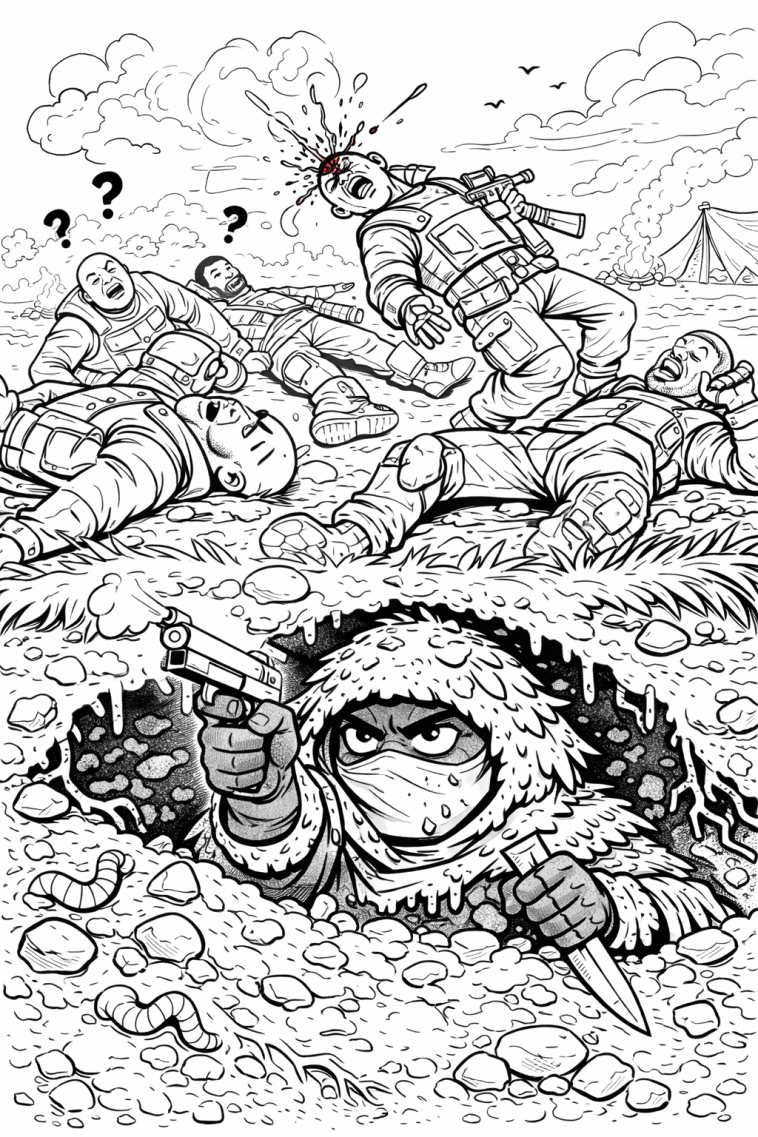
He entered the bog hours before the patrol arrived, lowering himself into the cold earth with the help of a body bag that kept him worm and safe away from the leaches and other parasite that drilled through the skin making him a pray, the patience of someone who understood that war was not always fought standing upright. Nearly a metre below the surface, he shaped the ground around his body until it no longer resisted him. The peat absorbed his weight, his heat, his presence. By the time he settled, the land had already begun to forget him.
His rifle came down with him, wrapped and sealed like something meant to survive longer than its bearer. Fabric softened every contact point. Polythene held back the damp that killed careless weapons. Only the muzzle extended forward through a narrow passage, cut low and level, never rising above the ground. To lift it even a fraction would have been to announce himself and General O never announced.
This was enemy territory. There would be no reinforcement, no correction, no rescue if the land rejected him. The rules he followed were not written orders but habits forged through survival: identify without doubt, fire once, and allow silence to finish the work.
Through the thermal optic, the world appeared stripped of illusion. The bog glowed faintly cool, broken by the brighter shapes of approaching soldiers. Their boots pressed heat into the ground. Hands warmed metal. Breath bloomed briefly, then vanished. They were close and more closer than their training allowed them to imagine danger.
They moved like men expecting fire from afar. Their attention stayed outward, optics lifted toward trees and shadows, searching for distance. Their thermal scans skimmed the surface, hurried and confident, unable to read what lay beneath saturated earth.
General O waited.
At this range, there was no need for adjustment, no reliance on devices that betrayed position. He watched patterns form, who paused, who drifted, who unconsciously isolated himself. He timed the land’s own sounds, the soft collapse of boots, the low friction of gear, the brief murmurs of men who did not yet know they were already inside a kill zone.
The first shot was released into existing noise. The bog swallowed what little sound escaped the suppressor. The soldier folded forward, and to the others it looked like a misstep, another consequence of unstable ground.
General O did not move or even betray his potion darkness filled the earth, patience was the language of survival, minutes passed. Heat signatures rearranged themselves. Confusion had not yet learned to speak.
The second man fell the same way, one round, deliberate, final. Then another, and another, each separated by patience. He never fired twice in haste, never allowed rhythm to form. After every shot, he reassessed, letting uncertainty fracture the enemy’s cohesion more effectively than fear ever could.
By the sixth body, discipline had thinned. The patrol slowed. Weapons lifted toward imagined threats in the distance. No one looked down. No one questioned the ground that continued to hold them.
The final two were taken only after the group began to break apart, when isolation presented itself naturally. Eight soldiers lay dead within a space so confined it existed entirely inside General O’s narrow field of view.
What baffled analysis and forensic team was that no gunshot was heard and later, those tasked with explanation would struggle. Forensics would place the firing distance under twenty metres. Analysts would cite suppressed fire, subsonic rounds, terrain absorption. None of it would fully explain how death had moved so close without revealing itself.
General O remained buried long after the last heat faded. He slowed his breathing until his warmth returned to the earth, until even thermal memory softened. When he withdrew, the bog closed behind him, smooth and indifferent.
That was the lesson Subsurface Silence left behind enemy lines:
that dominance did not always announce itself, and that sometimes the most decisive ground in war was the ground beneath one’s own feet.
This post was created with our nice and easy submission form. Create your post!

Written by
Caesar Obong Ng'bong Ocen is a Ugandan writer whose work traverses narrative fiction, cultural memory, and moral inquiry. Drawing on African cosmologies, and reflective storytelling, his writing engages with issues of power, identity, faith, and the human condition within post‑conflict societies. His series blends political realism with interior psychological struggle, articulating the tensions between duty and conscience, tradition and modernity, exile, redemption. Obong Ng'bong's work bridges literary and social worlds: it interrogates African historical and political realities while exploring philosophical and ethical questions that resonate across disciplines. His narratives are grounded in cultural authenticity and moral depth, making them relevant to both literary and humanistic inquiry. He also mentors emerging writers and contributes to dialogue on African storytelling traditions and their place in contemporary literature.
Did this story move you? Every gift goes directly to Caesar Obong Ng'bong ocen — writers on Muwado earn from reader appreciation, not algorithms. Even $1 makes a difference.






Next: https://muwado.com/general-o-the-wilderness-trial/