

 David Bernard
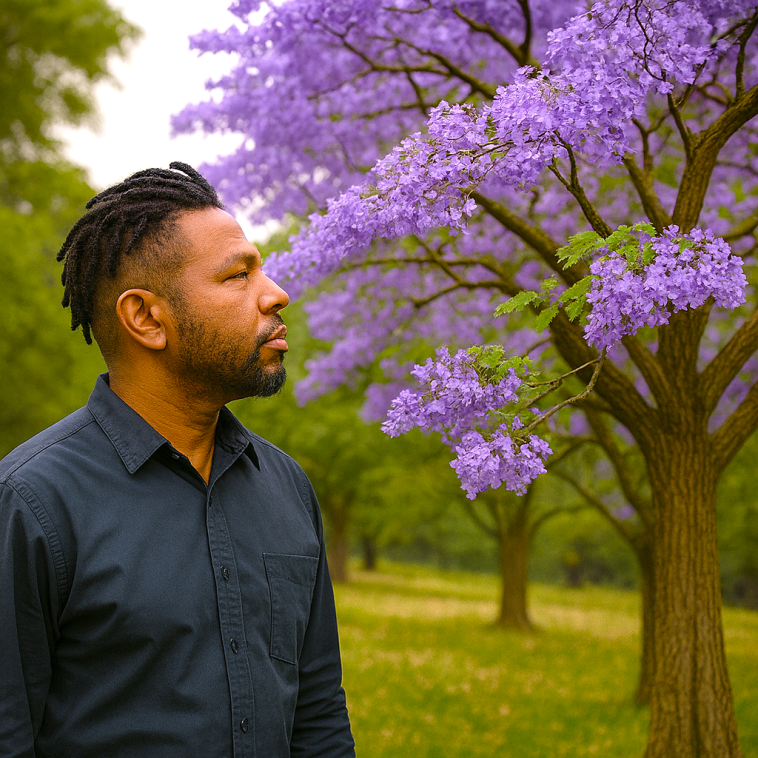
Some poems whisper, some shout, and some, like Even the Jacaranda Know, calmly tap you on the shoulder and say, “Sit down, breathe, and stop being dramatic.”
So, I opened the page expecting poetry. I ended up getting surprisingly accurate life coaching from a tree.
When I finished reading Resonance of the Soul: Flowers and Harmonics, an anthology authored by Dr. Ivan Edwards, I found myself returning repeatedly to one poem.
It is the longest in the anthology, but also the most layered, the most ambitious, and the most quietly transformative. That poem is Even the Jacaranda Know.
Yes, I liked the entire book – yet this piece stayed with me long after I closed the final page. It felt like a conversation with humanity itself, spoken through many voices but unified by a single, steady presence: the jacaranda. The anthology as a whole is rich with emotional depth, but this poem stands as its central pillar.
This poem is not simply a sequence of monologues. It is a sweeping portrait of human experience, a chorus of individuals who speak from different corners of life.
Each voice confesses a private burden, and each receives a response that is both compassionate and grounding. Through it all, the jacaranda stands as a silent witness, a symbol that gathers the poem’s many threads into one coherent vision.
True, I couldn’t deny it. Edwards writes with a clarity that blends philosophy, empathy, and cultural resonance. Allow me to break it open.
The Jacaranda as the Poem’s Quiet Oracle
The jacaranda is the poem’s anchor. It performs four essential functions that shape the emotional and philosophical structure of the work.
- It observes human struggle.
- It reminds the reader to pause and breathe.
- It grounds each character’s suffering in something larger than themselves.
- It offers continuity, returning again and again in the refrain “still, the jacaranda…”
A line such as “Pause. Breathe. Even the jacaranda hum their song” captures the poem’s meditative rhythm. Another, “Still, the jacaranda dance,” shows how the tree becomes a symbol of resilience and quiet endurance.
The refrain becomes a spiritual reset button. It is the poem’s way of telling us that life continues with a rhythm that outlasts our storms.
The Five Groups the Poem Speaks To
Although the poem features many characters, they fall into five archetypal groups. This structure gives the poem its universality and allows readers to see themselves reflected in its lines.
The first group is the struggling and disadvantaged. These include the jobless man, the single mother, the farmer, the single man, and anyone poor or overlooked. Their voices speak from places of scarcity, exhaustion, and social pressure.
The second group is the ambitious and restless. These include Generation Z, the rich man without peace, and the prime minister’s daughter. They want more, sometimes without knowing why. Their struggle is internal, driven by desire, ego, or confusion.
The third group is the servants of society. These include the teacher, the doctor, the nurse, the firefighter, and the dentist. They carry burdens that others rarely see. Their work is sacred, and their impact is deeper than they realize.
The fourth group is the leaders. These include the president and the mayor, referenced indirectly. Their struggle is the moral weight of leadership, decision making, and legacy.
The fifth group is the everyday human soul. This includes anyone seeking meaning, anyone burdened by life, anyone comparing themselves to others, and anyone who has forgotten to breathe. These voices represent all of us at some point in our lives.
What the Poem Teaches and How It Applies to Daily Life
What moved me most was how each group receives a message that feels both compassionate and practical. The poem is not abstract. It is deeply usable.
For the struggling and disadvantaged, the core message is that worth is not defined by circumstances. Hardship is a season, not an identity. In daily life, this means refusing to measure oneself by society’s standards, developing one skill at a time, and remembering that becoming is a process.
For the ambitious and restless, the message is that ambition without grounding leads to emptiness. In daily life, this means building character before chasing status, recognizing that technology offers shortcuts but not wisdom, and understanding that wealth without peace is another form of poverty.
For the servants of society, the message is that their work is sacred. Teachers influence generations. Doctors and nurses must remember to heal themselves. Firefighters embody courage as purpose in motion. Dentists restore dignity through small acts of repair. Service, the poem reminds us, is a form of greatness.
For the leaders, the message is that power is responsibility. Leadership without integrity collapses. In daily life, this means leading with truth, seeking counsel, remembering that authority fades while legacy remains, and understanding that corruption destroys the corrupt before it destroys the nation.
For the everyday human soul, the message is that everyone is searching for meaning. The jacaranda reminds us to slow down, listen inwardly, let nature recalibrate the spirit, and remember that life is larger than our current struggle.
The Jacaranda as the Poem’s Spine
Every stanza ends with the jacaranda. It hums, dances, sways, whispers, bows, shudders, sings, stands tall, and weeps. This repetition is not ornamental. It is the poem’s heartbeat. It teaches one universal truth: life continues gently and rhythmically even when we are overwhelmed. We can learn from that rhythm.
Final Reflection
I liked this poem because it speaks to everyone without losing its intimacy. It is a mirror for the weary, a compass for the ambitious, a balm for the burdened, and a quiet teacher for the leaders and servants among us. Even the Jacaranda Know is not only the longest poem in Dr. Ivan Edwards’ anthology. It is the one that holds the book’s soul. It reminds us that no matter who we are or what we face, there is always a moment available to us.
Pause. Breathe.
Even the jacaranda know.
Note: “Even the Jacaranda Know” is written by Dr. Ivan Edwards, and appears in his award-winning anthology Resonance of the Soul: Flowers and Harmonics, recipient of the Literary Titan Gold Book Award.
This post was created with our nice and easy submission form. Create your post!

Written by
Did this story move you? Every gift goes directly to David Bernard — writers on Muwado earn from reader appreciation, not algorithms. Even $1 makes a difference.






Muwado weekly chart
Get Africa’s top 10 stories every Thursday
No account needed — just your email.
Want to follow David Bernard and get notified every time they publish?
Create a free Muwado account →