

 Zziwa Zinabala

I revere Ssekajja because of what he stands for. He stands for reality and societal bigotries we refuse to share to the world. People sink in oceans of grief due to failed dreams. People fail to realise that after all, it was just a dream but not the reality. So brace-up as we sail into his realm of poetry – that which correlates and pokes even the stalwart.
Often times, I begin reading a book from the front cover. However, today I broke my own rules as I began from the Praise Quotes: the trio quotes seemed into poking a reader into the reality check, though, some used quite rich diction (probably showing off their expensive English – all jokes.). The most outstanding quote I enjoyed was from Kansiime Dues, he opined: “In this collection, Ssekajja crystalizes the concept of “the dream” to underscore the elusiveness of human desire amidst the chaos of social dysfunction. Deeply rooted in the ‘spoken word’ tradition, his poetry is gently woven on page with a spontaneous echo of its performative pulse on stage. The poetry tastes with sting of hot pepper and flows with the softness of buttered soup.” Indeed! As I was savoring this content, I witnessed every detail the aforementioned praise quote mentioned. This is impeccable literature from the mind of the best male poet in Uganda – yes, he is the best male poet in Uganda- numero uno. Speaking from observation and content read from the many poets in my country.
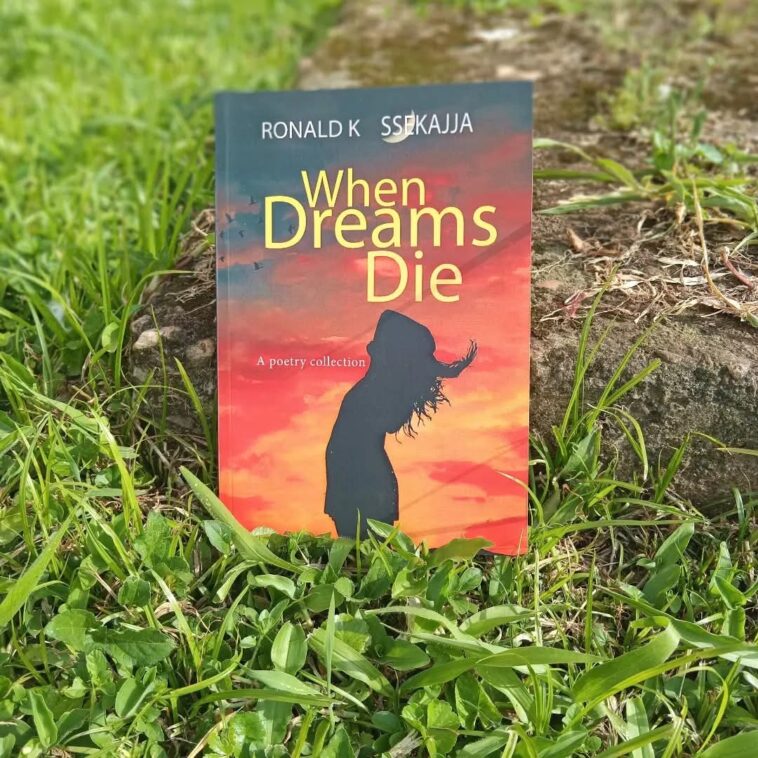
To begin with, the title of the book: “When Dreams Die”. This is a title, a statement, a phrase, or a mantra of pensive think-tank. I believe the writer described the life philosophies at its best. This is to say, whilst I was digesting the poetry, I came to mind that this is a philosophy not a poetry collection. According to Marcus Aurelius in his book called Meditations, he Marcus opined that “Soon you will have forgotten all things: soon all things will have forgotten you.” This he writes in his Book 7. Marcus reflects in this very title. That even yet we dream, dreams forget us and so we sometimes forget the dreams as we perish into the life mysteries and pains.
In slicing the book into thematic emotional vocational calling – how the theologians would call it. Ronald manifested the conundrum faced in the corporate world. That it is not about the suits and the ties. It is more! More about depressions, failed targets, lost dreams and pain-in-the-ass bosses – who only think about results but not the mental health of their subjects. In his poem called “In the Unbearable Loneliness of Sanity”, the persona of the poem in my thinking is seated somewhere reflecting about the corporate lifestyle and the painted cosmetic smiles at work and the anguish to divert the pains. Towards the end, the persona laments //…whose nights table the letters that spell suicide as the images of their dreams juxtapose the naked reality.// furthermore, into this poem and suicidal thoughts of the corporate world. The persona further digs deep into the reality check that people yowl to God yonder in the clouds on the church pews: //so they go to church and yowl “Elio, Elio, lama sabachtani!” loosely meaning, “My God, My God, Why have you forsaken me”. This is a biblical allusion from book of Psalm 22. This is an outstanding usage of technique of literary importance in this very book, which I thus disagree with the quote from Ibrahim Aye Balunywa that Ronald used a free form poetry. No! This is a richly embedded ice on the cake.
The rhythm of poetry in this section further dance into my heart while jeering at some angry personae and empathizing with some. There is a mixed up emotional build-up. While he was writing, a poem called “Where are the men with flowers and rings?’ I almost replied that they are busy in Heaven seated on the right hand of the father and they will come back to judge the living and the dead but then I recalled the women in the corporate world with their expensive perfumes and bleached skins watch too much telemundo and zee-world. So the persona again, reflects upon their lives. As they age but no man comes to at least change their “oil”. They then sort their lives into lamentations of pain still seeking for flowers and perhaps marriage. I do believe in this poem the flowers vividly torch love and affection whilst the ring torch the marriage. A perfect excuse for the poet to say, my poetry is not free verse – and I would gladly agree with him on this.
In a book called “Do Not Disturb” by Michela Wrong. The authoress of this book accounts the murders under the current president of Rwanda – those to whom she categorize as dissenting in nature. With her perfect usage of her mother language – English. Wrong describes the tumults of politics in sub-Saharan Africa – case study Rwanda. So does Poet Ssekajja, in his next thematic concern, called ‘My Country on Sale’ it shows a tired person, perhaps, thinking the country should be sold and the spoils to be shared amongst the citizenry. Who will get the lion’s share? The echoing persona describes two important things; the political gambit – the chessboard and the ponies; the tally-poppy syndrome and hubris syndrome. In my navigation through the heart of the persona, I came to realise that all these poems are a reflection of what Wrong wrote in her book. Wrong also ponders into the mystery deaths and attributes it to the fact that rule number one: “Never Outshine the Master: Always make those above you feel comfortably superior.” In both the poems ‘Molested in yellow pants and 10 Gunshots,’ the author/persona narrates the discipline of rule number one in Robert Greene’s 48 Laws of power. The series of death we see the persona reflecting about are contemporary concerns in this country. Anyone wanting to challenge and outshine the master is deleted. This indirectly reflects the discipline of tally-poppy syndrome as practiced in New Zealand. Tally-poppy are plants or flowers. They are cut to level them, any tally-poppy that comes out, is cut to be leveled back on the same level with the rest of them. This situation analysis has been recurrent in the persona’s country and he wishes to address the need to sell this country and move on. For nothing left to love about it. //Was it the shot that shattered his lungs?…he was the pony in the game of “Kings & Castles’// the persona issues the currency of concern. In his rhetorical questioning. He demands to understand the shock, that someone has been gunned down and nothing is being done – perhaps just a political gambit in the game of hubris syndrome. Furthermore, in the quest of knowledge, peace-within-heart and stability. I will again quote from Marcus Aurelius’ Book 6: “Death is relief from reaction to the senses, from the puppet-strings of impulse, from the analytical mind, and from service to flesh.” Perhaps, the gunned people are better off than our laments of bad leadership. The “10 Gunshots” reflects about deaths rather than the delivery of “10 points” fill in the void of queries. However, Marcus argues that the dead are at their best comfort for they are not bothered by the whims of the living. They are satisfied that nothing will bother them at all. In quest for truth, do you think we should sell this country?
Before forgetting, the persona reminds me of “A Grain of Wheat” by Ngugi wa Thiong’o. Ngugi quizzes what next after the departure of white man. Will Wakenya be able to benefit from this departure? Will the people have a people-centered-delivery of service? This comes as a shocker later, when the Member Parliament to whom Gikonyo had gone to seek assistance does not help him but he instead loots the piece of land Gikonyo had sighted for development. It is the exact replica of reflection in the poem called “When they Left” the persona is under a spell of conundrum why the country is not moving – even after what the mother was telling him about the future after independence. He concludes his meditation with //This country is not moving. This country is starving//. A constant reminder that there is no progress but only looting and thieves in suits and round bellies farting in A.C rooms. Thus bridging this very argument to “Devil on the Cross” by Ngugi – where thieves parade and create an aura that theft is good as long as it is not petty theft. Perhaps, we should sell this country…
In the subsequent themes, the poet navigates quite different sentiments. Some into the swims of erotica. Some into the humor of troubled youths at campus. How to cope up with depression. The most striking poem, that I found nagging was “My Father’s Face”. A father is an important figure in Africa especially in my country – Uganda. A father in many homesteads is the breadwinner. The persona reflects about the father’s senile behaviour and lost hope into winning charmy new girls. His coffers run dry due to the need to educate his children and see ends meet. With finality, the persona introduces an important subject. How often do we love our fathers? They play the provision role in our entire lives – the financial muscle et al. he concludes by saying: //But my father is my father…You too, will understand, your parents.// A philosophical statement! Even Marcus Aurelius paid tribute to his father in his Book 1; “From what they say and I remember of my natural father: integrity and manliness.”
Briefly, as Paulo Coelho says in the Alchemist: “People are afraid to pursue their most important dreams, because they feel that they don’t deserve them, or that they’ll be unable to achieve them.” Please, dear Ronald K Ssekajja do not let your dreams die: strive on and keep writing you are a perfect poem – not poet. You speak from the heart. You are a natural talent, you deserve better. For any dreamer out there stuck, this is a wonderful book for you to read. For Paulo said; “And that no heart has ever suffered when it goes in search of its dreams, because every second of the search is a second’s encounter with God and with eternity.” The Alchemist.
AUTHOR: Ronald K Ssekajja
ISBN: 9789970985449
PRICE: Ugx.30, 000
NUMBER OF PAGES: 110
PUBLISHER: Stubborn Poetry
REVIEWER: Zziwa Zinabala
This post was created with our nice and easy submission form. Create your post!

Written by
Zziwa Zinabala is a poet and playwright. He has written a poetic play called The Muchwezi, The Flower and The Suitor that is being sold at a global level. He is an M&E Specialist and a Population Scientist.
Did this story move you? Every gift goes directly to Zziwa Zinabala — writers on Muwado earn from reader appreciation, not algorithms. Even $1 makes a difference.






Muwado weekly chart
Get Africa’s top 10 stories every Thursday
No account needed — just your email.
Want to follow Zziwa Zinabala and get notified every time they publish?
Create a free Muwado account →