

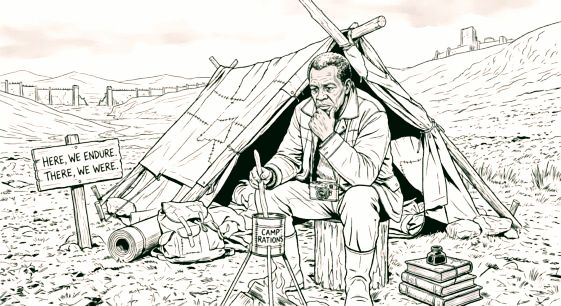
 Caesar Obong Ng'bong ocen

Chapter Twenty-Two: Logistics of Theft Management
The rain followed us.
It followed Peter and me beyond the centre of the settlement, beyond the cooking fires and crowded shelters, beyond the voices of families trying to make themselves comfortable beneath sheets of plastic while the weather dismantled whatever remained of the evening.
Rain struck the tarpaulins with thousands of impatient fingers.
It ran from the roofs in silver curtains.
It filled the narrow paths until the ground became soft beneath our feet, swallowing our shoes with every step.
Peter walked ahead of me.
He did not look back.
I followed.
The notebook was hidden beneath his jacket, pressed against his chest as though it were something alive that needed protection.
Perhaps it was.
I had begun to understand that some things carried danger not because of what they were, but because of what they knew.
The notebook knew too much.
Every few metres, Peter slowed.
Not enough to stop.
Just enough to listen.
I noticed it because I had begun doing the same thing.
A movement beyond a shelter.
A shadow between two trees.
A sudden silence where there had been conversation.
Once, I thought I saw a man standing beside a water tank.
Lightning flashed.
The man disappeared.
I stopped.
Peter continued walking.
“Did you see him?”
Peter did not turn.
“See who?”
“The man near the water point”
He kept walking.
“Don’t look back.”
I obeyed but then I suddenly asked.
“ but why?”
“Because if he is watching us, I don’t want him to know that we know.”
That answer disturbed me more than the sight of the man but anyway we continued.
The further we went, the fewer people we encountered.
The centre of the settlement was alive despite the storm, but the outer section felt abandoned. Shelters stood farther apart. The paths were narrower. Some structures had collapsed and never been rebuilt. Plastic sheets hung from branches like torn flags.
This was the forgotten edge of the forgotten.
Peter finally stopped.
Ahead stood a small structure assembled from timber offcuts, corrugated iron, old tarpaulin and pieces of wooden crates.
A weak yellow light escaped through a gap in the doorway.
Peter looked at me.
“Wait here.”
“No.”
He almost smiled.
“I knew you would say that.”
He stepped toward the door.
I followed.
He knocked twice.
Nothing.
He waited.
Then knocked once more, the kind of knocking that sounded more like a coded message from Okello to Kaburu. Who were these people I wondered and who was o going to…
There was movement inside.
A bolt slid across metal.
The door opened.
An old man stood before us, from his look there was something about him that was wiser kipping a distance away from.
Something in his face suggested a history he had spent years trying to bury.”
He was thin, but not frail.
His beard was almost completely white, and deep lines crossed his face like the marks left by years of weather. One eye was clouded, but the other possessed an unsettling sharpness.
He looked first at Peter.
Then at me.
For several seconds, he said nothing.
Then he smiled.
“Peter Kaburu.”
Peter’s expression remained guarded.
“I see you’re still alive.”
The old man’s smile widened.
“So are you.”
His eyes moved toward me.
“And this must be Obong.”
I felt a strange sensation move through my body.
“You know me?”
The old man stepped aside.
“I know enough.”
He opened the door wider.
“Come in before the rain decides to bury you.”
We entered.
The door closed behind us.
The sound of the rain immediately became muffled.
The shelter was small, but it was not poor in the way I expected.
It was organised.
Almost obsessively so.
Bundles of documents were stacked against one wall. Maps covered another. Old computers sat beneath a plastic sheet. Wooden boxes bearing faded humanitarian logos were arranged beneath a table.
A kerosene lantern stood in the centre of the room.
Its flame trembled whenever the wind pushed against the walls.
The old man locked the door.
Then he turned to Peter.
“You found it.”
Peter removed the notebook.
He placed it gently on the table.
The old man’s face changed.
The smile disappeared.
For several seconds he simply stared at the object.
Then he whispered:
“I wondered if I would ever see that again.”
Peter remained standing.
“You knew about it?”
“I knew what it contained.”
The old man approached the table but did not touch the notebook.
“Do you know how many people died because of that?”
I looked at Peter.
He did not answer.
Neither did I.
The old man pulled out a chair.
“Sit.”
We sat opposite him.
He remained standing.
“My name is Samuel Odongpiny.”
Peter nodded.
“I know.”
Samuel looked at him.
“Of course you do.”
There was something in his voice that suggested they had travelled through different roads toward the same darkness.
Samuel finally sat.
“I worked in humanitarian logistics for seventeen years.”
He paused.
“Three agencies. Four countries. Too many borders to count.”
He glanced toward the maps.
“I monitored shipments. Food. Medicine. Water purification equipment. Blankets. Tents. Emergency supplies.”
His voice was almost conversational.
“I believed I was helping people.”
“What changed?” I asked.
Samuel looked at me.
“The numbers.”
“What numbers?”
“The numbers that refused to make sense.”
He leaned forward.
“A truck would leave a warehouse carrying eight hundred sacks of maize.”
He raised one finger.
“The manifest would say eight hundred.”
A second finger.
“The receiving document would confirm eight hundred.”
A third.
“The warehouse records would confirm eight hundred.”
He paused.
“But the refugees would receive five hundred.”
The room became quiet.
“What happened to the other three hundred?” I asked.
Samuel’s eyes hardened.
“That was the question.”
He looked at Peter.
“And questions are dangerous in places where answers are expensive.”
Peter opened the notebook.
Samuel immediately raised his hand.
“Not yet.”
Peter stopped.
Samuel continued.
“At first, I thought it was ordinary theft.”
He laughed softly.
“I was naive.”
“Then what did you discover?”
“I discovered that theft was only the visible part.”
He stood and walked toward the map.
Red lines crossed the paper.
Some began at ports.
Others moved through cities.
Others disappeared across borders.
Samuel touched one of them.
“One shipment disappears.”
He touched another.
“Then another.”
Another.
“Then another.”
He stepped back.
“Eventually you realise the missing shipments aren’t mistakes.”
His eyes met mine.
“They are the system.”
A flash of lightning illuminated the shelter.
For a moment, the map looked like a living thing.
Red lines.
Black names.
Circles.
Arrows.
Territories.
Borders.
It reminded me of blood vessels beneath skin.
I looked at Peter.
He was staring at the map.
“How far does it go?” he asked.
Samuel smiled without humour.
“Farther than your courage would like.”
Peter said nothing.
Samuel walked to another wall.
There was a second map behind the first.
This one was larger.
It stretched across almost the entire wall.
Uganda.
Kenya.
Rwanda.
South Sudan.
Tanzania.
Eastern Congo.
The Indian Ocean.
I stared at it.
“What am I looking at?”
Samuel turned.
“The board.”
I frowned.
“What board?”
He looked at Peter.
Peter understood before I did.
Samuel said:
“A game of Monopoly.”
The words sounded almost absurd in that small shelter.
I looked at him.
“Monopoly?”
Samuel nodded.
“That is what they call it.”
“Who?”
“The people who own the game.”
He moved toward the map.
“Mombasa.”
His finger touched the coast.
“Entry point.”
Then Kampala.
“Financial coordination.”
Then Kigali.
“Political access.”
Then the eastern Congo.
“Resources.”
Then the border crossings.
“Movement.”
His finger travelled from one point to another.
“Transport routes.”
“Security corridors.”
“Trade agreements.”
“Humanitarian contracts.”
“Political appointments.”
“Everything is connected.”
He stepped back.
“People think borders divide countries.”
He shook his head.
“Borders divide ordinary people.”
His finger returned to the map.
“For the people behind this, borders are opportunities.”
The words settled heavily inside me.
Peter’s voice was quiet.
“Who are they?”
Samuel looked at him.
“You already have some of their names.”
He glanced at the notebook.
“Businessmen.”
“Politicians.”
“Security officials.”
“Contractors.”
“Middlemen.”
“People who publicly condemn corruption while privately investing in it.”
Peter’s jaw tightened.
“And the refugees?”
Samuel looked toward the door.
Beyond it, the rain continued.
“The refugees are the pieces.”
Something inside me tightened.
“Pieces?”
“On the board.”
His voice became colder.
“People displaced by war create emergency markets. Emergency markets attract funding. Funding creates contracts. Contracts create influence.”
He paused.
“And influence creates ownership.”
I understood then why Peter had called them predators.
They were not simply stealing from the victims.
They were creating structures that depended upon victims remaining vulnerable.
Samuel returned to the table.
“The war is not always the business.”
He looked directly at me.
“Sometimes the consequences of war are the business.”
Silence.
No one spoke.
The rain became louder.
Peter slowly closed the notebook.
“So this isn’t about aid.”
Samuel smiled.
“No.”
“Then what is it about?”
Samuel’s answer came softly.
“Control.”
The word seemed to absorb the room.
“Control of what?”
“Everything that can be controlled.”
He began counting on his fingers.
“Money.”
“Land.”
“Trade.”
“Transport.”
“Information.”
“Political influence.”
“Security.”
“Natural resources.”
“Human movement.”
He lowered his hand.
“And eventually, governments.”
I stared at the map again.
Suddenly the lines seemed different.
I had been looking at roads.
They were looking at ownership.
I had been looking at borders.
They were looking at territory.
I had been looking at refugees.
They were looking at numbers.
That was when I understood the true cruelty of the system.
The people on the ground were playing for survival.
The people above them were playing for control.
And they were playing a game in which losing meant someone else died.
Peter leaned forward.
“How long has this been happening?”
Samuel did not answer immediately.
Then he said:
“Longer than you think.”
He opened one of the wooden boxes.
Inside were files.
Hundreds of them.
Some were yellow with age.
Others were stained by water.
Some bore official stamps.
Others carried handwritten notes.
Samuel removed one.
Then another.
Then another.
He placed them on the table.
“Twenty years.”
Peter looked at the files.
“Twenty?”
“Twenty years of missing shipments.”
Samuel opened another folder.
“Twenty years of altered manifests.”
Another.
“Twenty years of forged signatures.”
Another.
“Twenty years of warehouses that existed only on paper.”
He closed the final folder.
“And twenty years of people disappearing whenever they got too close.”
My eyes moved to the scar on his face.
I suddenly understood.
“That’s how you got this.”
Samuel touched the scar.
“No.”
He smiled faintly.
“This is how I survived getting it.”
Peter looked at him.
“Who attacked you?”
Samuel’s expression changed.
“Does it matter?”
“Yes.”
“No.”
He leaned toward us.
“What matters is that they believed I was dead.”
Peter became very still.
The same phrase from earlier returned to me.
A man who was supposed to be dead.
Samuel saw the recognition in my face.
“Yes,” he said quietly.
“I am the man Peter told you about.”
The room seemed to shrink.
I looked at Peter.
He nodded.
Samuel opened another file.
Inside was a photograph.
Three men stood together.
One wore a military uniform.
Another wore an expensive suit.
The third stood slightly behind them.
Peter stared at the photograph.
His breathing changed.
He picked it up.
For several seconds he said nothing.
Then:
“My uncle.”
Sometimes the beautiful part of life is forgotten when hatred weaves its way onto our hearts. Peter remembered his grandparents, their Magendo cross-border trade, how he had begun his life surviving on camera lenses, cross border photography he called town linking. And now, standing in that dim shelter, he felt something fracture inside him—because the face in the photograph was not just a conspirator, but blood.
Samuel nodded.
Peter’s hand tightened around the photograph.
“You said this network existed for twenty years.”
“It did.”
“And he was part of it?”
Samuel shook his head.
“No.”
Peter looked up.
“What do you mean, no?”
Samuel’s eyes remained fixed upon him.
“Your uncle was not simply part of the network.”
A long silence followed.
“He helped build it.”
Peter stood so suddenly that the chair fell behind him.
“You’re lying.”
Samuel didn’t move.
“I wish I were.”
Peter stared at him.
“My uncle was a businessman.”
“Exactly.”
“He was never involved in humanitarian operations.”
“He didn’t need to be.”
Peter’s voice rose.
“Then what did he do?”
Samuel pointed to the map.
“He understood something most people never understand.”
“What?”
“That you don’t have to own the whole board.”
He paused.
“You only need to control the people who own the important squares.”
Peter said nothing.
Samuel continued.
“Ports.”
“Borders.”
“Banking.”
“Transport.”
“Security.”
“Political appointments.”
He looked directly into Peter’s eyes.
“Control enough of those, and everyone else believes they are still free.”
Peter’s face had become expressionless.
But I knew him well enough to recognise the anger beneath it.
“What does he want?”
Samuel’s answer was almost a whisper.
“The Tropical Belt.”
Peter froze.
I felt the same chill I had felt in the cave.
The phrase seemed to carry a weight beyond geography.
“What is the Tropical Belt?” I asked.
Samuel looked at me.
“A corridor of power.”
He returned to the map.
“Ports. Minerals. Agricultural land. Trade routes. Energy. Water. Political influence.”
His finger travelled across the region.
“Whoever controls those connections doesn’t need to rule every country.”
He turned toward us.
“They only need to make every country dependent upon them.”
Peter slowly picked up the photograph again.
“My uncle…”
Samuel nodded.
“He believed the region could become one economic machine.”
Peter looked at him.
“And the war?”
Samuel’s expression became grim.
“War makes people desperate.”
“And desperation makes people dependent.”
“Exactly.”
“And dependency creates control.”
Samuel nodded.
“Now you understand.”
I looked at the map.
For the first time, I saw the settlement outside differently.
The tents.
The food distributions.
The trucks.
The aid workers.
The refugees.
The border.
Everything seemed connected to those lines on the wall.
Then something occurred to me.
“If all of this is true, why are you still alive?”
Samuel looked at me.
For the first time, his expression contained something resembling fear.
“I shouldn’t be.”
The lantern flame flickered.
Peter turned toward the door.
“Did they find you?”
Samuel didn’t answer.
Peter moved closer.
“Samuel.”
The old man raised one hand.
“Listen.”
We listened.
At first I heard only rain.
Then something else.
A faint sound.
Footsteps.
Outside.
Slow.
Measured.
Someone was walking through the mud.
Peter looked at me.
I remembered the cave.
The feeling of being watched.
The darkness beyond the firelight.
The unseen presence.
The footsteps stopped.
Samuel extinguished the lantern.
Darkness swallowed the room.
No one breathed.
Then came three knocks on the door.
Exactly three.
Peter reached for the notebook.
Samuel whispered:
“Don’t.”
Another three knocks.
Peter looked at him.
“Who is it?”
Samuel’s voice was barely audible.
“The people who came to finish the work they started twenty years ago.”
The third knock came.
This time the entire shelter trembled.
And in the darkness, I realised something that frightened me more than the men outside.
The game was no longer being played somewhere beyond the border.
We were already on the board.
This post was created with our nice and easy submission form. Create your post!
Written by
Caesar Obong Ng'bong Ocen is a Ugandan writer whose work traverses narrative fiction, cultural memory, and moral inquiry. Drawing on African cosmologies, and reflective storytelling, his writing engages with issues of power, identity, faith, and the human condition within post‑conflict societies. His series blends political realism with interior psychological struggle, articulating the tensions between duty and conscience, tradition and modernity, exile, redemption. Obong Ng'bong's work bridges literary and social worlds: it interrogates African historical and political realities while exploring philosophical and ethical questions that resonate across disciplines. His narratives are grounded in cultural authenticity and moral depth, making them relevant to both literary and humanistic inquiry. He also mentors emerging writers and contributes to dialogue on African storytelling traditions and their place in contemporary literature.
Did this story move you? Every gift goes directly to Caesar Obong Ng'bong ocen — writers on Muwado earn from reader appreciation, not algorithms. Even $1 makes a difference.





Muwado weekly chart
Get Africa’s top 10 stories every Thursday
No account needed — just your email.
Want to follow Caesar Obong Ng'bong ocen and get notified every time they publish?
Create a free Muwado account →