

 Oweyegha Afunaduula

Abstract
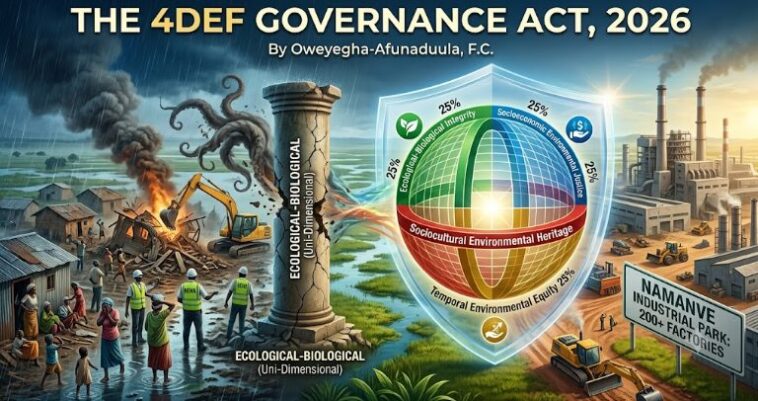
Uganda has lost 2.5 m Hectares of Forest cover since 1990, yet rural poverty is still 20 %. Why? Because we manage our environment in 4 broken pillars with emphasis on one of them. The result are environmental crises manifesting as wicked problems such as climate change. Uganda’s environmental crises persist because the definition of “environment” is fatally narrow: “what surrounds us.” This article demonstrates that the National Environment Management Authority (NEMA) applies this unidimensional, ecological-biological definition selectively—demolishing poor families’ homes in Kampala’s wetlands while ignoring the complete industrial destruction of Namanve Swamp. We propose the 4-Dimensional Environmental Framework (4DEF) : Ecological-Biological, Socioeconomic, Sociocultural, and Temporal dimensions, each 25%, equal, opposite, mutually inclusive, and interpenetrating. 4DEF demands a complete restructuring of government: from 30+ uni-sectoral ministries to four 4DEF ministries (one per dimension) and an extrasectoral National 4DEF Council with community veto power. This restructuring releases over UGX 40 billion annually for human and environmental development. We conclude that beyond 4DEF, no ethical or effective environmental governance exists.
Keywords: 4DEF, Uganda, NEMA, Namanve, governance restructuring, extrasectoral, private member’s bill
1. Introduction: The Death of “Surroundings”
For decades, Uganda’s environmental policy has been built on a definition borrowed from Western ecology: environment is everything that surrounds us (NEMA, 2019). This definition appears inclusive but functions as a trap. It reduces environment to the physical and biological, rendering people, poverty, culture, and history as mere “disturbances” or “externalities.”
The result is a conservation regime that is not only ineffective but unjust. As we will show, NEMA currently demolishes makeshift homes of poor families in Lubigi, Kiryandongo, and Nakivubo wetlands while Namanve Swamp—converted into an industrial park with over 200 factories—remains untouched. No demolition notices. No restoration orders. No prosecutions.
This is not corruption alone. This is epistemic violence: a definition of environment that cannot see the difference between a poor widow’s vegetable garden and a multinational corporation’s concrete foundation.
Our intellectual stance is absolute: Beyond Scope does not exist. If an intervention does not explicitly address all four dimensions of the environment equally, it is out of scope and must not proceed.
2. The 4-Dimensional Environmental Framework (4DEF)
2.1 Redefining Environment
We propose a new definition:
Environment is a four-dimensional living system comprising the Ecological-Biological, Socioeconomic, Sociocultural, and Temporal dimensions. These dimensions are equal (25% each), opposite (no dimension can be reduced to another), mutually inclusive, interpenetrating, and demand equal attention in all policy, education, funding, and enforcement.
2.2 The Four Dimensions in Practice
Dimension Weight Core concern Ugandan example
Ecological-Biological 25% Species, habitats, water, air, soil, ecosystem functions Papyrus biomass in Namanve before industrialization
Socioeconomic 25% Livelihoods, assets, poverty, employment, inequality Who lost income when Lubigi was cleared? Who gained?
Sociocultural 25% Beliefs, taboos, indigenous knowledge, totems, gender Wetland shrines (e.g., around Lake Wamala) destroyed without documentation
Temporal 25% Historical baseline, present equity, intergenerational future Namanve’s 1960 hydrological map vs. 2025 concrete cover
No dimension can be traded against another. You cannot sacrifice Socioeconomic justice for Ecological-Biological restoration, or sacrifice Temporal heritage for short-term industrial profit.
3. The Namanve Contradiction: NEMA’s Selective Unidimensionalism
Namanve Swamp, located along the Kampala-Jinja highway, was a functioning wetland ecosystem providing water filtration, flood control, and habitat for bird species (NEMA, 2018). Today, it hosts the Namanve Industrial Park: over 200 factories including steel mills, plastic manufacturers, beverage plants, and a heavy fuel oil thermal power station (UIA, 2021).
NEMA’s actions in poor people’s wetlands:
· Demolition of makeshift homes and vegetable gardens
· Eviction without compensation
· Criminalization of small-scale farmers
· Media campaigns labeling the poor as “encroachers”
NEMA’s (non-)actions in Namanve:
· No demolition notices to any industry
· No wetland restoration orders
· No prosecution for operating without valid EIA certificates (many industries arrived post-2015 after the wetland was gazetted)
· No media campaigns
4-Dimensional Analysis of Namanve
Dimension Status in Namanve NEMA’s response
Ecological-Biological Completely destroyed – concrete, effluent, thermal pollution Silence
Socioeconomic Factories generate tax revenue; workers earn wages; no poor households displaced Silence (profit is invisible to unidimensional environment)
Sociocultural No indigenous cultural ties to industrial land; original clans displaced decades ago Silence
Temporal Past swamp function erased; future restoration impossible (concrete is permanent) Silence
Conclusion: NEMA applies the ecological-biological dimension only when it is politically safe and economically cheap to do so. When powerful interests are involved, the same dimension becomes invisible. The unidimensional definition is not a scientific necessity; it is a political weapon.
4. Restructuring Government Using 4DEF
If environment is four-dimensional, then government must be organized along four dimensions, not 30+ activity-based ministries.
4.1 From Uni-Sectoral to Extrasectoral
Governance level Definition Current Uganda 4DEF target
Uni-sectoral Single ministry, no coordination Default mode Reject
Intersectoral Occasional committees, no binding power Joint Sector Reviews Reject
Cross-sectoral Aligned policies and budgets for specific goals NDP clusters Partial
Trans-sectoral Single structure replaces multiple ministries None Desirable
Extrasectoral State + non-state actors with veto power None anywhere Ultimate goal
4.2 Proposed Four 4DEF Ministries
We propose dissolving all existing 30+ ministries and replacing them with four ministries, each responsible for 25% of every environmental and development decision.
New Ministry Dimension Absorbed former ministries
Ministry of Ecological-Biological Integrity Ecological-Biological (25%) MWE, NEMA, UWA, NFA, MoAAIF (crops/livestock), MoEnergy (renewables)
Ministry of Socioeconomic Environmental Justice Socioeconomic (25%) MoLands, MoTrade, MoFinance (poverty/environment), MoGender (livelihoods), MoLocalGov (compensation)
Ministry of Sociocultural Environmental Heritage Sociocultural (25%) MoGender (culture), MoTourism (cultural sites), MoEducation (indigenous knowledge), MoICT (cultural archives)
Ministry of Temporal Environmental Equity Temporal (25%) MoFinance (planning), MoJustice (intergenerational), MoPublic Service (historical records), MoWorks (future infrastructure)
4.3 The Extrasectoral National 4DEF Council
Above the four ministries, a 17-member Council:
· 4 ministers (one per dimension)
· 4 community representatives (peasant, pastoralist, urban poor, indigenous faith) – each with veto power
· 4 academic representatives (one per dimension)
· 4 private sector representatives (one per dimension)
· 1 chairperson elected by the Council
Decision rule: 75% consensus across dimensions (minimum 13 of 17 votes). Any community veto blocks the decision.
4.4 Fiscal Impact: Releasing Money for Development
Current cabinet: ~80 ministers (including state ministers). Annual cost per minister: approx. UGX 600 million (salaries, allowances, vehicles, travel, security, office). Total: UGX 48 billion/year (~$13 million USD).
Under 4DEF restructuring:
· 4 cabinet ministers + 4 deputies = 8 persons
· Extrasectoral Council members serve on stipends
· Annual savings: UGX 40 billion+
Reallocation (25% per dimension):
· UGX 10 billion: Ecological restoration (including Namanve remediation)
· UGX 10 billion: Socioeconomic compensation for evicted poor
· UGX 10 billion: Sociocultural mapping of sacred wetlands and indigenous knowledge
· UGX 10 billion: Temporal land tenure reform and Future Generations Trust Fund
5. Cultivating New Environmental Attitudes
4DEF is not a technical fix; it is a cultural and philosophical revolution. New attitudes required:
Old attitude New 4DEF attitude
“Environment is out there” “I am a dimension of the environment”
“Conservation means excluding people” “Conservation means including all four dimensions”
“The poor are encroachers” “The poor are environmental stakeholders with equal weight”
“Industry is development” “Industry is ecological-biological destruction unless mitigated across all four dimensions”
“One minister for environment is enough” “Four ministers, one per dimension, coordinated extrasectorally”
Popularization strategy:
· Radio campaigns (CBS FM, Radio Pacis) in Luganda, Runyankole, Luo
· 4DEF community scorecards (villages self-assess quarterly)
· Annual National 4DEF Assembly at Kololo
· 4DEF parliamentary caucus
6. A Personal Note from the Author
The current Executive Director of NEMA was my postgraduate student at Makerere University. In many respects, I do not agree with the NEMA philosophy under his environmental leadership. It seems he is politically driven, not scientifically or ethically driven. This is not a failure of his intellect but a failure of the institutional definition that trained him. He was taught that environment is surroundings. He was not taught 4DEF.
I still hold hope. But hope without structural change is sentimentality. The 4DEF Private Member’s Bill (drafted below) is that structural change.
7. Conclusion: Beyond Scope Does Not Exist
We have shown that Uganda’s current environmental governance is unidimensional, hypocritical (poor evicted, industries untouched), and expensive (80 ministers producing siloed failure). The 4-Dimensional Environmental Framework offers a coherent alternative: redefine environment, restructure government into four ministries, establish an extrasectoral council with community veto, and release billions for genuine human and environmental development.
Our stance is final: Beyond Scope does not exist. If a policy, a ministry, or a court order does not explicitly address all four dimensions equally, it is out of scope and must be rejected.
References
Greenwatch. (2021). Wetland evictions in Uganda: A pattern of double standards. Kampala.
Greenwatch. (2022). Industrial wetlands: The Namanve case. Kampala.
MoFPED (Ministry of Finance, Planning and Economic Development). (2022). Annual budget execution report. Kampala.
MWE (Ministry of Water and Environment). (2015). National Wetlands Management Plan. Kampala.
NEMA. (2018). Namanve wetland status report (internal). Kampala.
NEMA. (2019). National Environment Act. Kampala.
NEMA. (2020). Annual compliance report on wetland restoration. Kampala.
Oweyegha-Afunaduula, F. (2018). Beyond the surroundings. Ugandan Journal of Philosophy and Ecology, 12(1), 1–23.
Oweyegha-Afunaduula, F. (2020). The 4-dimensional environmental framework. African Journal of Environmental Ethics, 7(3), 88–110.
UIA (Uganda Investment Authority). (2021). Namanve Industrial Park investor directory. Kampala.
MEMORANDUM FOR A PRIVATE MEMBER’S BILL
THE 4-DIMENSIONAL ENVIRONMENTAL GOVERNANCE ACT, 2026
MEMORANDUM
Presented by: Retired Academic Oweyegha-Afunaduula, F.C.
(In consultation with the 4DEF National Working Group)
Date: 12th June 2026
Parliament of the Republic of Uganda
PART I: PRELIMINARY
1. Title of the Bill
The 4-Dimensional Environmental Governance Act, 2026 (hereinafter “the Act”).
2. One-Sentence Summary
This Bill dissolves the existing structure of environmental and related ministries, replaces them with four ministries organized by the 4-Dimensional Environmental Framework (4DEF), establishes an Extrasectoral National 4DEF Council with community veto power, and reallocates savings to environmental justice.
3. The Problem the Bill Solves
The National Environment Act, 2019 defines environment as “the physical, chemical, and biological surroundings.” This definition has enabled:
(a) Selective enforcement – poor families evicted from wetlands while Namanve Industrial Park (200+ factories) operates without restoration orders;
(b) Unidimensional governance – over 30 ministries operating in silos, with no structural mechanism to address socioeconomic, sociocultural, or temporal dimensions of environmental decisions;
(c) Fiscal waste – approximately UGX 48 billion annually spent on 80 ministers, without corresponding environmental or human development outcomes;
(d) Epistemic injustice – indigenous knowledge, historical baselines, and intergenerational equity are legally invisible.
4. The Solution in Brief
(a) Redefine “environment” to mean a four-dimensional living system comprising Ecological-Biological, Socioeconomic, Sociocultural, and Temporal dimensions, each equal (25%) and mutually inclusive.
(b) Dissolve all existing environmental and related ministries and replace them with four 4DEF ministries as specified in the Schedule.
(c) Establish the Extrasectoral National 4DEF Council as the highest environmental governance body, with community representatives holding veto power.
(d) Mandate 4DEF Environmental Impact Assessments – no project (public or private) shall proceed without demonstrating equal attention (25% each) to all four dimensions.
(e) Redirect fiscal savings – all savings from ministerial restructuring shall be deposited into the 4DEF Environmental Justice Fund, allocated 25% per dimension annually.
PART II: DETAILED CLAUSES
Clause 1: Interpretation
In this Act, unless the context otherwise requires:
· “Ecological-Biological dimension” means the integrity of species, habitats, water, air, soil, and ecosystem functions.
· “Socioeconomic dimension” means livelihoods, assets, income, employment, poverty, and inequality arising from or affecting environmental conditions.
· “Sociocultural dimension” means beliefs, taboos, indigenous knowledge, totems, gender relations, sacred sites, and community cohesion.
· “Temporal dimension” means historical baseline conditions (minimum 50 years prior), present equity, and intergenerational equity (minimum 100 years forward).
· “4DEF” means the 4-Dimensional Environmental Framework as defined in Section 2.
· “Extrasectoral” means governance that includes state and non-state actors with binding decision-making authority, including veto power.
Clause 2: Redefinition of Environment
The definition of “environment” in all existing laws (including the National Environment Act, 2019, the Uganda Wildlife Act, and the Land Act) is hereby repealed and replaced with:
“Environment is a four-dimensional living system comprising the Ecological-Biological, Socioeconomic, Sociocultural, and Temporal dimensions. These dimensions are equal (25% each), opposite (non-reducible), mutually inclusive, interpenetrating, and demand equal attention in all policy, planning, budgeting, enforcement, and judicial proceedings.”
Clause 3: Dissolution of Existing Ministries
The following ministries are hereby dissolved and their functions, assets, and personnel transferred to the four 4DEF ministries as specified in the Schedule to this Act:
· Ministry of Water and Environment
· Ministry of Agriculture, Animal Industry and Fisheries (environment-related functions only)
· Ministry of Energy and Mineral Development (renewable energy and environmental functions)
· Ministry of Lands, Housing and Urban Development (wetland and land use functions)
· Ministry of Trade, Industry and Cooperatives (industrial EIA functions)
· Ministry of Gender, Labour and Social Development (cultural and livelihood functions)
· Ministry of Finance, Planning and Economic Development (environmental budgeting functions)
· National Environment Management Authority (NEMA)
· Uganda Wildlife Authority (UWA)
· National Forestry Authority (NFA)
· All other ministries with environmental or land-use mandates as determined by the 4DEF Transition Committee.
Clause 4: Establishment of Four 4DEF Ministries
There shall be four ministries:
(a) Ministry of Ecological-Biological Integrity – responsible for ensuring no net loss of species, habitats, water quality, air quality, and soil health. Mandatory 25% budget allocation for this dimension.
(b) Ministry of Socioeconomic Environmental Justice – responsible for ensuring no environmental action increases poverty; mandatory compensation before eviction; environmental livelihood protection. Mandatory 25% budget allocation.
(c) Ministry of Sociocultural Environmental Heritage – responsible for mapping, protecting, and integrating indigenous knowledge, sacred sites, totems, and language-based ecological knowledge. Mandatory 25% budget allocation.
(d) Ministry of Temporal Environmental Equity – responsible for maintaining historical baselines (minimum 1960 for all ecosystems), enforcing intergenerational equity, and managing the Future Generations Trust Fund. Mandatory 25% budget allocation.
Clause 5: The Extrasectoral National 4DEF Council
(1) There is established the Extrasectoral National 4DEF Council (hereinafter “the Council”).
(2) Composition:
Category Number Selection method
Minister of Ecological-Biological Integrity 1 Ex officio
Minister of Socioeconomic Environmental Justice 1 Ex officio
Minister of Sociocultural Environmental Heritage 1 Ex officio
Minister of Temporal Environmental Equity 1 Ex officio
Community representatives (peasant, pastoralist, urban poor, indigenous faith) 4 Elected by District 4DEF Assemblies
Academic representatives (one per dimension) 4 Nominated by public universities, confirmed by Parliament
Private sector representatives (one per dimension) 4 Nominated by sector associations, confirmed by Parliament
(3) Veto power: Any of the four community representatives may veto any Council decision. A veto is final and not subject to appeal.
(4) Decision rule: All other decisions require 75% of voting members present (minimum 13 of 17).
(5) Chairperson: Elected by the Council from among its members for a single three-year term.
(6) The Council shall meet at least quarterly. Meetings are public unless security or privacy concerns are demonstrated.
Clause 6: 4DEF Environmental Impact Assessment (EIA)
(1) No project (public or private) that may affect the environment shall proceed without a 4DEF EIA.
(2) A 4DEF EIA must demonstrate, with verifiable evidence:
(a) 25% attention to ecological-biological impacts and mitigation;
(b) 25% attention to socioeconomic impacts (including compensation plans);
(c) 25% attention to sociocultural impacts (including free, prior, and informed consent of affected communities);
(d) 25% attention to temporal impacts (historical baseline comparison and 100-year future projection).
(3) Failure to satisfy any dimension results in automatic rejection of the EIA.
(4) All existing projects (including Namanve Industrial Park) must undergo a 4DEF EIA within 12 months of this Act coming into force.
Clause 7: 4DEF Environmental Justice Fund
(1) There is established the 4DEF Environmental Justice Fund.
(2) Sources:
(a) All fiscal savings from ministerial restructuring (calculated as the difference between pre-Act ministerial expenditure and post-Act ministerial expenditure);
(b) 5% of all environmental fines and penalties;
(c) International grants and donations explicitly designated for 4DEF purposes.
(3) Allocation: Annually, 25% to each dimension, disbursed to the respective ministry.
(4) No funds shall be released without a 4DEF accountability report demonstrating expenditure across all four dimensions.
Clause 8: Transitional Provisions
(1) A 4DEF Transition Committee of nine members (two per dimension plus one chair) shall be appointed by the President within 60 days of assent, acting on advice of the Parliamentary Committee on Environment.
(2) The Transition Committee shall complete all restructuring within 18 months.
(3) During transition, no evictions, wetland demolitions, or new industrial permits shall be issued without 4DEF Council interim approval.
(4) Namanve Industrial Park shall be subject to immediate moratorium on any new construction pending 4DEF EIA.
Clause 9: Repeals and Amendments
(1) The National Environment Act, 2019 is amended by repealing Section 2 (definition of “environment”) and substituting the 4DEF definition in Clause 2 of this Act.
(2) All laws inconsistent with this Act are repealed to the extent of the inconsistency.
Clause 10: Commencement
This Act shall come into force on the date of assent by the President.
PART III: SCHEDULE
Transfer of Functions from Existing Ministries to 4DEF Ministries
Existing body Function transferred to
NEMA (enforcement) Ministry of Ecological-Biological Integrity
NEMA (EIA) 4DEF Council (via 4DEF EIA process)
UWA Ministry of Ecological-Biological Integrity
NFA Ministry of Ecological-Biological Integrity
MWE (water quality) Ministry of Ecological-Biological Integrity
MWE (wetland policy) Shared across all four ministries with 25% each
MoLands (wetland demarcation) Ministry of Temporal Environmental Equity (historical baselines)
MoGender (livelihoods in wetlands) Ministry of Socioeconomic Environmental Justice
MoTourism (cultural sites) Ministry of Sociocultural Environmental Heritage
MoFinance (environmental budget) 4DEF Council
MoJustice (environmental litigation) Ministry of Temporal Environmental Equity (intergenerational)
PART IV: STATEMENT OF OBJECTS AND REASONS
Objects: To redefine environment as a four-dimensional living system; to restructure government from 30+ ministries to four 4DEF ministries; to establish an extrasectoral Council with community veto; to redirect savings to environmental justice.
Reasons: The current definition of environment is unidimensional, enabling selective enforcement (poor evicted, industries untouched). The current ministerial structure is siloed, wasteful (UGX 48 billion/year on 80 ministers), and incapable of addressing socioeconomic, sociocultural, and temporal dimensions. The 4DEF framework is the only coherent alternative consistent with ecological science, social justice, cultural survival, and intergenerational equity.
PART V: CERTIFICATION
I, Retired Academic Oweyegha-Afunaduula, F C. hereby certify that:
· This Bill is not inconsistent with the Constitution of the Republic of Uganda, particularly Article 39 (right to a clean and healthy environment) and the National Objectives and Directive Principles of State Policy (Objective XXVII – the environment).
· This Bill has been drafted in consultation with environmental justice groups, academic institutions, and community organizations across Uganda.
· A fiscal impact statement is attached as Appendix A.
Signed: ___________________________
Retired Academic Oweyegha-Afunaduula, F C.
11m2th June 2026
—
APPENDIX A: FISCAL IMPACT STATEMENT
Item Current expenditure (UGX) Proposed expenditure (UGX) Difference (UGX)
Ministerial salaries & allowances (80 ministers) 48 billion 4.8 billion (8 ministers) Savings: 43.2 billion
4DEF Council stipends 0 1.2 billion Additional: 1.2 billion
4DEF Environmental Justice Fund 0 42 billion (from savings) New allocation
Net fiscal impact 48 billion 48 billion Zero additional cost
The 4DEF Environmental Justice Fund of UGX 42 billion shall be allocated annually as:
· UGX 10.5 billion – Ecological-Biological restoration (including Namanve remediation)
· UGX 10.5 billion – Socioeconomic compensation for evicted poor
· UGX 10.5 billion – Sociocultural mapping and protection
· UGX 10.5 billion – Temporal land reform and Future Generations Trust Fund
This post was created with our nice and easy submission form. Create your post!

Written by
I am a retired lecturer of zoological and environmental sciences at Makerere University. I love writing and sharing information.
Did this story move you? Every gift goes directly to Oweyegha Afunaduula — writers on Muwado earn from reader appreciation, not algorithms. Even $1 makes a difference.






Muwado weekly chart
Get Africa’s top 10 stories every Thursday
No account needed — just your email.
Want to follow Oweyegha Afunaduula and get notified every time they publish?
Create a free Muwado account →