

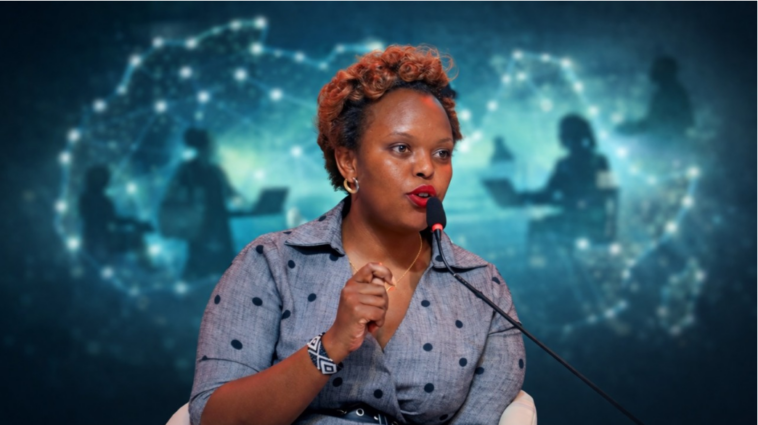
 Rita Ngenzi
For a long time, the narrative has been about the one woman in the room, sometimes two, perhaps five.
That framing was always incomplete. The truth is, we are many.
Women are building everywhere: in markets, in studios, in digital spaces, in communities, and in ecosystems—both visible and unseen. Not as exceptions, but as a constant. Not as outliers, but as the foundation.
The question, then, is not whether women are building. It is whether we are holding space for them in the places that matter, and whether our systems recognize, support, and scale what already exists.
At the center of this is one critical issue: access. Access determines who participates, who is visible, who scales, and who remains at the margins. It is the difference between potential and progress.
And yet, even with limited access, women continue to build.
We often say the dots connect backwards. And yes, they do—but only because we choose to build forward first.
Building is placing dots in uncertainty, choosing without guarantees, failing because failure is not sold separately, and continuing anyway. It is learning in real time, adapting to what we do not yet fully understand, and stepping into what is still unfolding.
This is especially true in a moment like now.
Not long ago, AI felt distant. Today, it is shaping how we work, create, make decisions, and scale. And still, the question remains: what does it mean to build into the unknown—to learn continuously, adapt in real time, embrace tools and systems we do not yet fully understand, and build anyway?
What sustains that journey is not the thrill, it is the necessity.
It is the moment when you begin to see the dots connect, even briefly, in retrospect, and that becomes the reason to keep going.
Because even two days of clarity can fuel months of continued building.
Where hope exists, progress follows. Where hopelessness persists, exclusion deepens. But when people begin to see possibility, they build.
And across Africa, this building is not marginal.
The informal sector, where many women and young people operate, accounts for over 80% of employment in many African economies. What we often call “informal” is, in reality, foundational.
Which raises a critical question: Where is this contribution measured?
Whether in Uganda, across East Africa, or on the continent, women building are not operating in isolation. They are already advancing Uganda’s National Development Plan IV (NDP IV) and its ten-fold growth ambition, strengthening regional integration through the East African Community, and driving the realization of African Union Agenda 2063.
And yet, across all these frameworks, one thing remains consistently undervalued: the enterprise, not as an idea, but as lived reality. These are not small stories. They are livelihoods, agency, and the infrastructure of resilience and growth.
If we are set on achieving the ambitions we have defined, then we must be intentional about where we place our bets.
We must bet on enterprise. On innovation as a lived practice. On the creative economy as both a cultural and economic force. On ecosystems that move beyond inclusion and actively enable access, investment, and scale.
For many of us, myself included, this work is both systemic and personal. Identity, too, is not confined to a single place.
Mine has been shaped across the continent, from Uganda to Rwanda, from Kenya to South Africa, not as fragments, but as an integrated whole. And it is this whole that informs how I build and how I see what is possible.
One thing is clear: this is not a one-woman journey. It never was.
This year’s theme, “Give to Gain,” calls for more than recognition. The giving is not symbolic—it is access, opportunity, and trust. The gain is what happens when women, not as a few but as many, are fully enabled to build, scale, and lead.
So we build.
Not in the margins. Not in isolation. But in systems that must evolve to meet the reality of who is already building.
We place the dots in uncertainty, in necessity, in courage.
And when they begin to connect—even slightly—we keep going.
Forward.
#WomensMonth #GiveToGain
This post was created with our nice and easy submission form. Create your post!

Written by
Ecosystem Builder I Innovation Strategist I Advancing Africa’s Entrepreneurship, Innovation, and Creative Economies
Did this story move you? Every gift goes directly to Rita Ngenzi — writers on Muwado earn from reader appreciation, not algorithms. Even $1 makes a difference.



Muwado weekly chart
Get Africa’s top 10 stories every Thursday
No account needed — just your email.
Want to follow Rita Ngenzi and get notified every time they publish?
Create a free Muwado account →