

 Oweyegha Afunaduula

Abstract
This article presents a multidimensional environmentalist critique of the escalating food crisis in Uganda’s Busoga sub-region. Drawing on ecological-biological, socioeconomic, sociocultural, and temporal analytical dimensions, the analysis examines how globalisation of food production, biotechnology, monoculturalisation, and the erosion of traditional ecological knowledge have systematically undermined food security. The article argues that Busoga’s crisis is not merely a production failure but a systemic collapse of agroecological systems historically sustained by clan-based governance, seed sovereignty, and seasonally attuned rain-fed agriculture. With sugarcane and oil palm cultivation displacing diverse food systems, soils degrading, youth abandoning farming, and government fiscal commitments wavering, the crisis demands urgent multidimensional intervention. Among the ecological-biological solutions proposed, the restoration of multi-storeyed, forest-like farming systems—known internationally as analog forestry—emerges as a particularly promising strategy. These systems, which mimic the structure and function of native forests but consist entirely of food, medicine, timber, and other useful species, directly address the interlocking crises of soil degradation, biodiversity loss, climate vulnerability, medicinal plant depletion, and farmer dependency on industrial inputs.
Keywords: Busoga, food crisis, sugarcane, monoculture, traditional ecological knowledge, forest-like farming systems, analog forestry, clan governance, Uganda
—
1. Introduction
The Busoga sub-region of eastern Uganda, stretching from the shores of Lake Victoria northward to Lake Kyoga, has historically been one of the country’s most agriculturally productive areas. The Basoga people developed sophisticated agroecological systems over centuries, systems that integrated food crops—millet, sorghum, cassava, beans, maize, and sweet potatoes—with clan-based land governance, seed saving, and seasonal farming calendars attuned to the region’s bimodal rainfall pattern (Omutwoigo, the wet season, and Omusambya, the dry season).
Today, however, Busoga faces a creeping food crisis that threatens to become a full-blown famine. Farmers report that rainfall has become erratic, with reliable precipitation now concentrated in only April and May, severely disrupting the traditional second planting season of August and September. Land once diverse with food crops has been converted to sugarcane monocultures. Soils are depleted. Youth are fleeing the land. And a cascade of government and donor-funded projects has failed to reverse the trajectory.
This analysis proceeds from a foundational premise: the environment is multidimensional. No single factor—climate change, agricultural policy, market globalisation, or cultural erosion—operates in isolation. Rather, the crisis in Busoga emerges from the intersection of these dimensions, each reinforcing the others. To understand the crisis is to analyse it through four interconnected lenses: the ecological-biological (soils, seeds, rainfall patterns, biodiversity, forest cover); the socioeconomic (markets, labour, credit, land tenure); the sociocultural (clan governance, traditional knowledge, youth aspirations); and the temporal (seasonality, historical memory, future projections).
The article concludes by presenting a practical, locally grounded solution: the restoration of multi-storeyed, forest-like farming systems. These are not foreign technologies requiring expensive inputs. They are systems that mimic the native forests that once covered much of Busoga—forests that built soil, attracted rain, and provided food and medicine in abundance. The difference is that in a forest-like farming system, every tree, shrub, and herb is chosen by the farmer because it serves a purpose: food, medicine, timber, fodder, or market sale. This is not a new invention. It is a return to an older wisdom, adapted to present conditions.
—
2. The Globalisation of Food Production and Its Local Manifestations
2.1 Biotechnology and the Seed Trap
The globalisation of food production has arrived in Busoga with promises of modernisation and yield improvement. Biotechnology, defined as the application of biological systems or living organisms to develop products and technologies, has been promoted by international donors, development agencies, and private corporations as the pathway to food security in Africa. Yet the experience of smallholder farmers in Busoga suggests a more troubling reality.
A decade ago, surveys conducted by the Organisation for Rural Development in Busoga documented farmers’ frustrations with seed access. Climate change was making planting seasons unpredictable. Farmers expressed interest in drought-tolerant varieties. However, the formal seed supply systems were weak, and hybrid seeds sold by private traders with minimal oversight came to dominate the market. Farmers were convinced these hybrids would mature faster and generate higher returns than indigenous seeds.
What followed was a quiet collapse in seed security. Poor-quality hybrid seeds became widespread. Farmers in Bugiri District who had once taken pride in their ability to select and preserve seed found themselves dependent on middlemen and commercial seed companies. Expected yields never materialised, particularly as changing weather patterns made hybrids even less reliable. Families used meagre earnings to purchase seeds, only to absorb losses when harvests failed. Meanwhile, elderly farmers continued to note that traditional maize varieties, though slower to mature, never failed entirely—they always produced something, even during drought. These traditional varieties were also more nutritious and marketable.
This is the biotechnology trap: dependence on commercial seeds that require annual repurchase, that perform poorly under stress conditions, and that displace locally adapted, farmer-bred varieties developed over generations.
2.2 Compulsion to Purchase Industrial Inputs
The compulsion to purchase biogenetically engineered seeds from the market is inseparable from the compulsion to purchase industrial pesticides, herbicides, and fertilisers. Genetically modified and hybrid seeds are typically designed for high-input systems. They presume—and require—synthetic fertilisers to achieve advertised yields and chemical pesticides to manage monoculture-induced pest pressures.
For Busoga’s smallholder farmers, this creates an unsustainable economic model. A farmer who abandons traditional seed saving must purchase seeds each season. A farmer who plants hybrid or GM seeds must purchase complementary inputs. The costs accumulate. When the harvest fails—due to drought, pest outbreak, or poor seed quality—the farmer bears the full loss, with no safety net. Independent assessments of similar green revolution initiatives across Africa have documented that smallholder farmers often find themselves deeper in debt, unable to sustain the cost of commercial inputs.
The result is dependency without resilience, precisely the opposite of what food security requires.
—
3. Monoculturalisation and Ecological Impoverishment
3.1 The Sugarcane Invasion
No single factor has transformed Busoga’s agricultural landscape more dramatically than sugarcane. The sub-region now houses seven operational sugar factories, creating concentrated milling demand that incentivises continuous monoculture clearing over alternative perennial crops. Farmers report that land once used for diverse food crops—maize, beans, millet, groundnuts, cassava—is now dominated by sugarcane, a non-food cash crop that offers little for household food security.
The economics are perverse yet compelling in the short term. A farmer considering land use options confronts sugarcane prices that, despite recent declines, have historically offered reliable cash income. However, as one farmer noted, “Those planting sugarcane are leaving nothing green on Earth”. The replacement of indigenous vegetation with vast sugarcane fields has deforested the landscape, eliminated habitat for pollinators and beneficial insects, and disrupted local hydrological cycles.
Farmers recognise the consequences. “Before sugarcane took over, we had trees and natural vegetation that helped maintain rainfall patterns,” explained Baguma Davis, a long-time farmer in Kamuli District. “Now, everything is cleared, and we’re seeing the consequences”.
The ecological transformation represents biocultural and biological desertification. As diverse food crops and indigenous vegetation disappear, so too does the knowledge associated with their cultivation, preparation, and use. Traditional varieties of millet, sorghum, and beans that once formed the backbone of household food security are no longer planted because they are no longer available. The biocultural heritage of Basoga agriculture is being lost in real time.
3.2 The Emerging Oil Palm Frontier
If sugarcane has been the primary driver of monoculturalisation, oil palm threatens to extend and deepen the crisis. Under the government’s 10-year National Oil Palm Project (NOPP), a Shs 780 billion investment funded by the International Fund for Agricultural Development (IFAD), farmers in Busoga are being urged to switch from sugarcane to oil palm.
Ministry officials promote the project with familiar promises: free seedlings and fertilisers, access to cash loans, guaranteed markets. Farmers with five acres or less are the target. Officials assure that mixed farming alongside palm oil—including crops such as beans and maize—is permitted.
Yet the warning signs are evident. Farmers report delays in seedling delivery stretching three years, with some having dug planting holes only to wait through multiple rainy seasons. Others express concern about pesticide supply gaps despite pest and disease pressure on their crops. And the fundamental question remains: will oil palm, like sugarcane, displace food crops, degrade soils, and lock farmers into cash crop dependency while food insecurity deepens?
The Bugiri District Resident District Commissioner, Richard Gulume Balyainho, explicitly identifies sugarcane as the primary driver of poverty in Busoga, noting that landowners have been leasing land to sugarcane growers at low rates for seven-year terms, and that even farmers with as little as one acre dedicate their entire plots to sugarcane. But replacing sugarcane with oil palm does not automatically restore food security. It risks substituting one monoculture for another.
3.3 Soil Degradation and Declining Productivity
The soils of Busoga are in crisis. Since 1985, the local population has more than tripled, resulting in deforestation, reduced farm sizes, and decreased crop diversity. Yields have declined, with farmers now harvesting approximately half of what they did a few decades ago.
The mechanisms of soil degradation are well understood. Monoculture sugarcane and maize deplete specific nutrients without rotation or replenishment. Continuous tillage breaks down soil structure. Deforestation eliminates organic matter inputs and accelerates erosion. The drive to maximise short-term cash yields forces farmers onto marginal land, further lowering agricultural recovery rates.
Fertiliser affordability and soil rehabilitation costs increasingly outpace raw cane revenue for uncapitalised smallholders. Mills must source cane from wider geographic radii as soils in immediate vicinities become exhausted, compressing processor margins and increasing transport costs. The institutional response—including the distribution of tree seedlings for boundary planting—attempts to stabilise soil mechanics but does not structurally address the monoculture imperative that drives degradation.
—
4. The Erosion of Traditional Ecological Knowledge and Governance
4.1 Seed Sovereignty Under Siege
Before the advent of commercial seed systems, Basoga farmers maintained and exchanged diverse local seed varieties. They selected for traits that mattered in their specific environments: drought tolerance, pest resistance, storage quality, cooking properties, and taste. This was not primitive agriculture; it was sophisticated plant breeding conducted by farmers for farmers, embedded in local knowledge systems and social networks.
The commercial seed system has systematically undermined this seed sovereignty. Hybrid seeds are sold by private traders with little oversight. Farmers who purchase these seeds must return to the market each season because hybrid seeds do not breed true, and because the companies that produce them design them for planned obsolescence. The elderly farmers who warned that traditional varieties “never fail at all times to produce something, even during drought” were speaking from accumulated wisdom that the commercial system has no interest in preserving.
The loss of traditional seeds is not merely a loss of genetic diversity. It is a loss of autonomy. A farmer who saves seed is a farmer who controls production. A farmer who must purchase seed each season is a farmer who depends on markets, credit, and the continued operation of supply chains. Seed sovereignty and food sovereignty are inseparable.
4.2 Traditional Ecological Knowledge and Climate Resilience
Traditional Ecological Knowledge (TEK) encompasses the accumulated knowledge, practices, and beliefs about relationships between living beings and their environments, transmitted across generations through cultural practice. In Busoga, TEK included detailed understanding of rainfall patterns, soil types, pest cycles, and the performance of different crop varieties under varying conditions.
This knowledge is not static; it evolves. But it is being lost as elders die and youth migrate to towns. The knowledge of when to plant, which varieties to plant together, how to read weather signs, and how to manage soil fertility without synthetic inputs is disappearing. The INSPIRE project, funded by the Embassy of the Kingdom of the Netherlands, has attempted to revive farmer learning through demonstration plots where traditional and improved methods are compared side by side. Such initiatives are valuable but cannot replace the systematic intergenerational transmission of TEK that characterised pre-industrial Basoga agriculture.
4.3 Destruction of Clan-Based Environmental Governance
Perhaps the most profound loss has been the destruction of clan-based environmental management and conservation. Historically, Basoga clans (ebika) exercised authority over land allocation, resource use, and conflict resolution. Clan leaders (abataka) ensured that farming practices respected ecological limits, that wetlands and forests were preserved as community resources, and that households in distress received support.
This system has been systematically undermined by colonial and post-colonial land policies, by the expansion of cash crop economies that individualise land use, and by the erosion of clan authority in the face of state and market power. When former Vice President Specioza Wandera Kazibwe recently engaged Busoga clan leaders in a malaria control initiative, she explicitly noted that clans are powerful entities in Busoga and that programs working through traditional structures achieve greater sustainability. “When the community is directly involved in any program,” she observed, “it becomes easy to implement it”.
The same principle applies to environmental governance. Clan-based systems are not romanticised relics; they are functional governance mechanisms that mediated human-environment relationships for centuries. Their destruction has left a governance vacuum that neither the state nor the market has filled.
—
5. The Temporality of Crisis: From Seasonality to Aseasonality
5.1 Rain-Fed Agriculture Under Stress
Busoga’s agriculture has always been rain-fed. The traditional farming calendar recognised two distinct seasons: Omutwoigo (the wet season) and Omusambya (the dry season), typically occurring between February and June. Farmers planted according to these predictable patterns, with the first rains triggering land preparation and the onset of the dry season signalling harvest and storage.
This predictable cycle has become increasingly erratic. Farmers now report reliable rains only in April and May. The traditional second planting season in August and September is severely disrupted. “This irregularity threatens food production,” one farmer explained, “and many households may soon face food shortages”.
The shift from seasonality to aseasonality—from predictable patterns to erratic variability—is perhaps the most challenging aspect of climate change for rain-fed agricultural systems. Farmers cannot plan when they cannot predict. Investments in land preparation, seed purchase, and labour become gambles. The knowledge of when to plant, painstakingly accumulated over generations, becomes obsolete.
5.2 Historical Memory and Future Vulnerability
The temporal dimension of the crisis encompasses not only present variability but also the relationship between past, present, and future. Farmers remember when soils were fertile, when rains were reliable, when diverse food crops sustained households through dry years. Older farmers recall how cassava saved millions from hunger during the dry spells of 1980 and 2017. That memory is itself a resource, a repository of resilience strategies.
But memory is not enough. The future requires adaptation: new crop varieties, new water management strategies, new forms of social organisation. The farmers who suggest integrating trees with sugarcane—planting along field edges to restore ecological balance, retain soil moisture, and attract rainfall—are demonstrating adaptive capacity. The question is whether institutional and policy environments will support such adaptations or continue to privilege short-term cash crop production.
—
6. Youth Exodus and the Labour Question
6.1 Agriculture as Unattractive Livelihood
Busoga’s young population is increasingly not attracted to agriculture. The reasons are multiple and mutually reinforcing. Farming is perceived as hard work with uncertain returns. Land fragmentation and sugarcane expansion have reduced opportunities for young people to access productive land. Education—particularly formal schooling modelled on Western curricula—has systematically devalued agricultural knowledge and oriented youth toward urban formal employment.
The effect of education on agricultural participation is complex. Schooling provides literacy, numeracy, and skills that can enhance agricultural productivity. But it also raises aspirations beyond farming, particularly when educated youth observe that farmers remain poor while civil servants and businesspeople enjoy higher status and income. The curriculum rarely includes practical agriculture or agribusiness training. The message, implicit and explicit, is that education is the pathway away from the farm.
6.2 The Elderly Left Behind
The young leave, and the old and elderly remain on the land, hoping to make ends meet. Households headed by grandparents, with prime-age adults absent, are increasingly common. These households have less labour capacity, less access to information and credit, and less ability to adopt new technologies or respond to market opportunities.
Some youth entering domestic and international labour markets are effectively entering slave markets—vulnerable to exploitation, trafficking, and debt bondage in the hope of remitting earnings to families back home. The push factors originate on the land: poverty, landlessness, lack of opportunity. The pull factors include the promise (often false) of better wages and conditions elsewhere.
6.3 Agribusiness Projects as Partial Response
Recognising the youth exodus, several projects have attempted to make agriculture more attractive. The Stimulating Agribusiness for Youth Employment (SAYE) project, a $48 million partnership between Heifer International and the Mastercard Foundation, aims to empower 250,000 young people aged 16 to 35 in Busoga by improving skills, expanding market access, and offering inclusive financing in poultry, horticulture, oilseed, dairy, and beef value chains. Young women will constitute 70 per cent of participants.
The project explicitly targets sectors with low entry barriers and high market potential, seeking to diversify away from low-value crops like sugarcane. It embraces technology solutions and climate-smart agriculture. Such initiatives are necessary but not sufficient. They operate at the margins of a system whose fundamental dynamics—land concentration, monoculture expansion, input dependency, price volatility—remain unaddressed.
—
7. The Paradox of Agricultural Projects
Despite decades of agricultural development projects in Busoga, food insecurity has worsened. The list is long: the National Agricultural Advisory Services (Naads), Operation Wealth Creation (OWC), the INSPIRE project, the SAYE project, the National Oil Palm Project, the Dei BioPharma cassava project, and numerous others.
Each project arrives with promises. The Dei BioPharma cassava project in Kamuli District, for example, promises to process 500–600 tonnes of cassava daily for starch, ethanol, and pharmaceutical products. Promoters urge farmers to embrace cassava over sugarcane, noting that cassava matures in eight months (compared to sugarcane’s 18 months) and offers higher returns per acre: 4–5 million shillings per season versus sugarcane’s 1.6–2.5 million.
The cassava project is instructive. It offers a potential alternative to sugarcane. It provides a market, processing infrastructure, and improved varieties (Narocas 1, Narocas 2, NASE 14). But it also represents another cash crop, another demand on land, another potential displacement of food crops. The question of whether cassava for industrial processing will improve household food security—or simply replace one cash crop with another—remains unanswered.
The proliferation of projects itself creates problems. Coordination is weak. Farmers receive conflicting advice. Project cycles are short; when funding ends, interventions cease. Dependence on external expertise undermines local capacity. And the fundamental drivers of the crisis—the structural dynamics of land, labour, capital, and markets—remain untouched.
—
8. Fiscal Priorities and the Corruption of Development
8.1 Declining Financial Commitment
Government of Uganda fiscal priorities reveal a meteorically declining commitment to agriculture relative to other sectors. The military budget consumes an increasing share of national resources. State House expenditures grow. Meanwhile, agricultural extension services have collapsed, agricultural research is underfunded, and farmers lack access to credit, inputs, and markets.
The disparity between rhetorical commitment and actual resource allocation is stark. Government officials speak of modernising agriculture and achieving food security, but the budget tells a different story. When funds are allocated, leakage is common. The Civil Society Budget Advocacy Group identified Shs 932 million meant for tea seedlings that remained unaccounted for in the 2016/2017 financial year. Operation Wealth Creation officers denied responsibility, pointing to Naads as the accounting entity. Responsibility was diffuse; accountability was absent.
8.2 Corruption as Development
The pattern suggests not merely corruption but what might be termed the corruption of development: a system in which project funds are disbursed, reports are written, workshops are held, and little changes on the ground. Funds for seedlings are spent but seedlings do not reach farmers. Extension workers are paid but do not visit farms. Loans are issued but do not reach smallholders.
Farmers are not fooled. They observe that officials who promote cash crop farming drive new vehicles and build new houses while farmers remain poor. They observe that large-scale processors and traders capture the value while producers receive marginal returns. They observe that projects come and go, and after each departure, they are left with the same degraded land and the same food insecurity.
—
9. Marketing, Pricing, and Policy Failure
9.1 Price Volatility and Farmer Vulnerability
Agricultural marketing and pricing policies in Uganda have systematically disadvantaged smallholder farmers. Sugarcane prices illustrate the problem. In 2021, a tonne of sugarcane sold for 230,000–245,000 shillings. Today, it is 125,000 shillings. Farmers cannot respond to price signals when the signals change rapidly and unpredictably. Investments in land preparation, planting, and management are made months or years before harvest. Price collapses at harvest mean losses that smallholders cannot absorb.
The processing sector is concentrated. Sugar factories in Busoga have substantial market power relative to scattered smallholder growers. Farmers report that they must accept whatever price processors offer because they lack storage, alternative markets, and bargaining power. The same dynamics affect other crops.
9.2 Policies Pushing People Out of Agriculture
Government policies have, intentionally or otherwise, pushed people out of agriculture. Trade policies that allow food imports to compete with local production undercut farm prices. Land policies that facilitate leasing to sugarcane growers have encouraged land concentration. Tax policies favour large-scale processors over smallholder producers. Credit policies exclude smallholders who lack collateral.
The result is that farming becomes less viable year by year. Households that once produced food surpluses now produce deficits. Farmers who once sold to local markets now buy food from those same markets. The transformation from food producer to food consumer is nearly complete, and with it, food insecurity becomes entrenched.
—
10. A Multidimensional Analysis: Synthesising the Dimensions
The preceding analysis has identified multiple, interacting drivers of Busoga’s creeping food crisis. A genuinely multidimensional environmental analysis requires synthesising these drivers into an integrated framework.
10.1 Ecological-Biological Dimension: Restoring Multi-Storeyed, Forest-Like Farming Systems
The ecological-biological dimension encompasses soil health, biodiversity, water cycles, genetic resources, and forest cover. Busoga’s soils are degraded, with yields approximately half of historic levels. Biodiversity has been eliminated by sugarcane monocultures, eliminating habitat, pollinators, and natural pest control. Water cycles are disrupted, with deforestation reducing rainfall infiltration and increasing runoff. Genetic resources—traditional seed varieties—have been displaced by commercial hybrids.
What Are Multi-Storeyed, Forest-Like Farming Systems?
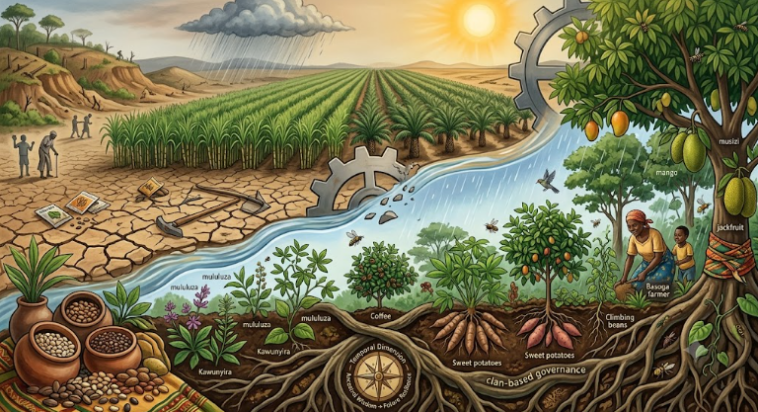
Imagine walking into a mature native forest in Busoga. Above you is a tall canopy of trees. Beneath them, smaller trees. Below those, shrubs. At your feet, herbs and creeping plants. The ground is covered in leaf litter, soft and damp. The air is cool. Even during dry spells, the soil remains moist. Birds and insects are everywhere. Not a single square metre is bare.
Now imagine that every plant in that forest is useful to your family. The tall trees provide timber and firewood, and some bear fruits or fix nitrogen into the soil. The middle-layer trees produce mangoes, jackfruits, avocados, and indigenous fruits like mfyufyu (Vitex doniana). The lower trees are coffee bushes—robusta, which grows naturally under shade—giving you cash income. The shrubs include mululuza (Vernonia amygdalina) for treating malaria and intestinal worms, and kawunyira (Warburgia ugandensis) for coughs and colds. The herbs are cassava, sweet potato, beans, and groundnuts—your daily food. Climbers carry passion fruit and climbing beans.
This is a multi-storeyed, forest-like farming system. It mimics the structure of a natural forest but replaces wild species with domesticated ones chosen by the farmer for food, medicine, timber, fodder, and sale. Scientists sometimes call this “analog forestry” because the farm is analogous to a natural forest in form and function. But for the Basoga farmer, it is simply a smarter, more resilient way of farming—one that many already practice in small ways around their homesteads. The task is to expand these home gardens into full farm systems.
How Forest-Like Farming Systems Revitalise Agroecological Farming:
Restoring soil health without industrial inputs. In a forest-like system, the ground is never bare. Leaves, twigs, and fruit falls continuously, decomposing into rich organic matter. Deep-rooting trees pull nutrients from deep in the soil and deposit them on the surface through leaf fall. Leguminous trees such as Calliandra, Leucaena, and the native Sesbania sesban capture nitrogen from the air and add it to the soil. The farmer never buys fertiliser.
Eliminating pesticide dependence. In a sugarcane monoculture, pests find endless fields of their favourite food. In a forest-like system with hundreds of species, pests cannot find large patches of any single crop. Birds, wasps, beetles, spiders, and bats—all present in the system—eat any pests that appear. The farmer never buys pesticide.
Regulating water and microclimate. The multi-layered canopy intercepts rain, allowing it to drip gently onto the forest floor instead of pounding bare soil. The leaf litter soaks up water like a sponge, releasing it slowly into the soil and groundwater. During hot days, the canopy shades the ground, reducing evaporation. During cold nights, the canopy traps warmth. The microclimate is buffered. Even when rains fail outside, the forest-like farm stays moist longer.
Building climate resilience. Because many species are present, the farmer is not betting everything on one crop. In a dry year, some species will struggle but others will thrive. In a wet year, a different set performs well. The farm is a portfolio, not a gamble. This is the opposite of the sugarcane or maize monoculture, where a single drought or pest outbreak can destroy an entire season’s income and food supply.
Restoring biological connectivity. A patchwork of forest-like farms across the landscape creates corridors for wildlife. Birds, bees, and butterflies can move from one farm to another, pollinating crops and controlling pests. The biological desertification of the sugarcane landscape begins to reverse.
How Forest-Like Farming Systems Improve Traditional Healthcare:
Perhaps the most immediate benefit for Busoga families is the return of medicinal plants to the farm. When elders and traditional healers (abasawo ba kiganda) treat malaria, they need mululuza (Vernonia amygdalina). When they treat coughs and fungal infections, they need kawunyira (Warburgia ugandensis). For wounds and burns, they need kigagi (Aloe vera). For toothache and sexually transmitted infections, ntalugya (Zanthoxylum chalybeum). For respiratory infections, kamunye (Hoslundia opposita). For malaria and liver disorders, akakamulali (Momordica foetida).
These species and many others can be planted as the shrub and herb layers of a forest-like farm. A farmer with such a system has a living pharmacy at the doorstep. When a child has malaria at midnight, the mother does not need to find transport to a distant clinic or afford expensive drugs. She steps outside, harvests mululuza, prepares a remedy, and treatment begins within minutes. The family’s dependence on expensive, distant, often unreliable pharmaceutical systems is reduced.
Moreover, when medicinal plants are present in the farm, knowledge of their uses is preserved. Elders teach the young to identify, harvest, and prepare remedies. The knowledge lives. When the plants are absent, the knowledge dies. Forest-like farming is therefore not only an agricultural intervention but a cultural and medical one.
Practical Steps for Busoga Farmers:
Implementing forest-like farming systems does not require waiting for government programs or donor projects. Farmers can begin with small patches:
· Start around the homestead: Enrich existing home gardens with additional tree, shrub, and herb layers.
· Use boundaries and marginal lands: Plant multi-purpose trees along field edges, on slopes, and in areas too steep or rocky for annual crops.
· Convert gradually: Begin by converting one acre of sugarcane or maize to forest-like farming each year. Over five years, the entire farm transforms.
· Learn from neighbours: Farmers who already maintain diverse home gardens can serve as teachers. Clan-based learning networks can be revived.
· Establish community nurseries: Clans can pool resources to propagate the 50–200 species needed for a fully diverse system.
Government and donor programs can support these efforts by: recognising forest-like farming systems in agricultural policy; providing seedlings of useful tree, shrub, and herb species through Naads and OWC; training extension workers in forest-like farming principles; and funding demonstration plots on clan-owned land with clan leaders as champions.
10.2 Socioeconomic Dimension
The socioeconomic dimension encompasses markets, credit, land tenure, labour, and fiscal policy. Farmers face volatile prices, concentrated processing, inadequate credit, insecure land rights, and a fiscal environment that privileges other sectors. Youth cannot access land or credit and migrate away.
Forest-like farming systems address some of these constraints directly. They reduce cash expenses (no fertiliser, no pesticide, no annual seed purchase). They produce multiple products for sale (coffee, fruit, timber, medicinal plants, food crops), diversifying income sources and reducing vulnerability to price crashes in any single commodity. They can be established incrementally, requiring minimal cash investment. However, structural reforms remain necessary: land tenure reform that secures smallholder rights, credit systems that reach the landless, market regulation that prevents processor exploitation, and fiscal reallocation that prioritises agriculture.
10.3 Sociocultural Dimension
The sociocultural dimension encompasses traditional ecological knowledge, clan governance, gender relations, and youth aspirations. TEK is being lost. Clan authority over environmental management has been undermined. Youth view farming as unattractive and aspire to urban employment.
Forest-like farming systems are uniquely suited to revitalising TEK because they depend on it. Knowledge of which species to plant together, which are medicinal, which fix nitrogen, which tolerate drought—this is precisely the knowledge held by elders. Implementing forest-like systems creates a context for elders to teach and youth to learn. Clan leaders, who historically managed forests and farmland collectively, can be re-empowered as stewards of these systems. And for youth, forest-like farms offer more attractive work: diverse tasks, year-round activity, higher-value products (specialty coffee, timber, medicinal plants), and the dignity of practising an intelligent, ecological agriculture rather than brute-force monoculture.
10.4 Temporal Dimension
The temporal dimension encompasses seasonal variability, historical memory, and future adaptation. Rainfall patterns are increasingly erratic, moving from seasonality to aseasonality. Historical memory of resilience strategies is fading. Future adaptation requires anticipatory governance.
Forest-like farming systems are inherently temporal. They are not planted and harvested in a single season. They are established over years and mature over decades. The farmer planting a musizi tree today is thinking of timber for their children. The farmer establishing a coffee layer under mango trees is thinking of cash income for the next twenty years. This long-term orientation stands in sharp contrast to the short-term logic of sugarcane (18 months to harvest, then replant) and the even shorter cycle of maize (3–4 months). By lengthening the farmer’s temporal horizon, forest-like farming systems encourage stewardship rather than exploitation.
—
11. Conclusion and Recommendations
The creeping food crisis in Busoga is not inevitable. It is the product of specific policies, practices, and power relations that have systematically undermined agroecological systems, traditional knowledge, and smallholder livelihoods. Reversing the crisis requires action on multiple fronts simultaneously.
Multi-storeyed, forest-like farming systems offer Busoga a concrete, ecologically sound, and culturally familiar pathway out of the monoculture trap. They restore ecological function while producing food, medicine, timber, and income. They revitalise the agroecological knowledge and traditional healthcare systems that monoculture has eroded. They build climate resilience where current systems crumble under stress. They provide dignified, rewarding work for the youth now fleeing the land.
The question is not whether such systems are technically possible in Busoga—they are, and farmers already practice simplified versions of them in remnant home gardens. The question is whether policymakers, donors, clan leaders, and farmers themselves will recognise them as a viable alternative and invest the resources needed to scale them. The creeping food crisis will not be resolved by more of the same. It requires a fundamentally different vision: one in which agriculture and conservation, food production and forest protection, modern science and traditional knowledge, cash income and family medicine, are not opposed but integrated.
11.1 Summary of Recommendations
Ecological-Biological (Forest-Like Farming Systems):
· Promote multi-storeyed, forest-like farming systems as the preferred agroecological model for Busoga
· Establish demonstration plots on clan-owned land with clan leadership
· Train master farmers through farmer-to-farmer diffusion networks
· Create community nurseries propagating 50–200 useful species
· Recognise forest-like farming systems within Uganda’s National Forestry and National Agricultural Policies
· Compensate farmers for ecosystem services (carbon, water, biodiversity) where possible
· Establish community seed banks for traditional food and medicinal plant varieties
Socioeconomic:
· Regulate processor pricing to ensure farmers receive fair returns
· Establish a smallholder agricultural credit facility without collateral requirements
· Reallocate fiscal resources to agriculture commensurate with the sector’s employment share
· Remove policy biases that favour monoculture cash crops over diverse food systems
Sociocultural:
· Recognise and empower clan-based environmental governance structures as stewards of forest-like farming systems
· Integrate traditional ecological knowledge into formal agricultural extension
· Reform education curricula to include practical agriculture, agroecology, and traditional medicine
· Document medicinal plant knowledge before it is lost
Temporal:
· Develop climate early warning systems tailored to smallholder needs
· Fund participatory research on drought-tolerant traditional varieties
· Establish long-term (10+ year) funding cycles for agricultural interventions
· Support oral history projects to preserve intergenerational farming knowledge
The food crisis in Busoga is a crisis of development itself. It reflects a model of agricultural transformation that prioritises cash crops for processing and export over food crops for local consumption, commercial inputs over local knowledge, and short-term profit over long-term sustainability. Reversing the crisis requires a different model: one that starts from the land, from the farmers who know it, and from the foods and medicines that have sustained Basoga families for generations. Multi-storeyed, forest-like farming systems provide the ecological blueprint. Clan governance provides the institutional framework. Traditional ecological knowledge provides the cognitive map. What is required is the political will to implement them.
—
References
allAfrica.com. (2025, May 30). Uganda: Environmental Impact of Sugarcane Farming Raises Famine Fears in Busoga.
allAfrica.com. (2024, May 22). Uganda: Ex-Vice President Kazibwe Engages Busoga Clan Leaders On Fighting Malaria.
ChiniMandi. (2026, April 28). Uganda: Ministry of Agriculture urges Busoga sugarcane farmers to switch to palm oil under IFAD-funded project.
CropGPT. (2026, May 9). Uganda – Sugar: Busoga Capacity Expansion and Ecological Constraints.
Daily Monitor. (2021, January 13). Army denies misuse of seedlings funds.
DailyTech.ng. (2025, August 18). Crossroads in Africa’s Bioeconomy: Innovation or Extraction?
Elevitch, C. R., & Wilkinson, K. M. (2018). Analog forestry: Creating productive, biodiverse, resilient landscapes. In Agroforestry and Biodiversity Conservation in Tropical Landscapes. Permanent Agriculture Resources.
Farmbizafrica. (2026, May 7). Heifer International extends agribusiness opportunities to 250,000 Uganda youth.
GOAL Global. (2025, July 25). Learning by Doing: Uganda’s Busoga Farmers Transform Their Farms through INSPIRE Project.
Herren, H. R., & Muchnik, J. (2020). Analog Forestry: An Introduction. International Analog Forestry Network.
International Analog Forestry Network. (2019). Analog Forestry: A Training Manual for Practitioners. IAFN, San José, Costa Rica.
New Vision. (2025, November 29). Cassava project to change lives in Busoga, Northern Uganda.
Senanayake, R. (2012). Analog forestry as a conservation and development tool. Journal of Tropical Forest Science, 24(3), 421–433.
Declaration of conflicting interests: The author declares no potential conflicts of interest.
Funding: The author received no financial support for the research, authorship, and/or publication of this article.
This post was created with our nice and easy submission form. Create your post!

Written by
I am a retired lecturer of zoological and environmental sciences at Makerere University. I love writing and sharing information.
Did this story move you? Every gift goes directly to Oweyegha Afunaduula — writers on Muwado earn from reader appreciation, not algorithms. Even $1 makes a difference.






Muwado weekly chart
Get Africa’s top 10 stories every Thursday
No account needed — just your email.
Want to follow Oweyegha Afunaduula and get notified every time they publish?
Create a free Muwado account →