

 Odoki Jimmy
On January 26, 2026, the National Resistance Movement (NRM) marks 40 years of being in power uninterrupted. The main event to celebrate the NRA LIBERATION DAY is scheduled to take place at Kololo Independence Grounds under the theme: Tribute to the patriots who ushered in a fundamental change. For their sacrifices and service to the country, 33 individuals are expected to be awarded national medals in various categories. President Yoweri Museveni who was declared the winner in the just concluded presidential election with 71.6 %, will be the chief guest.
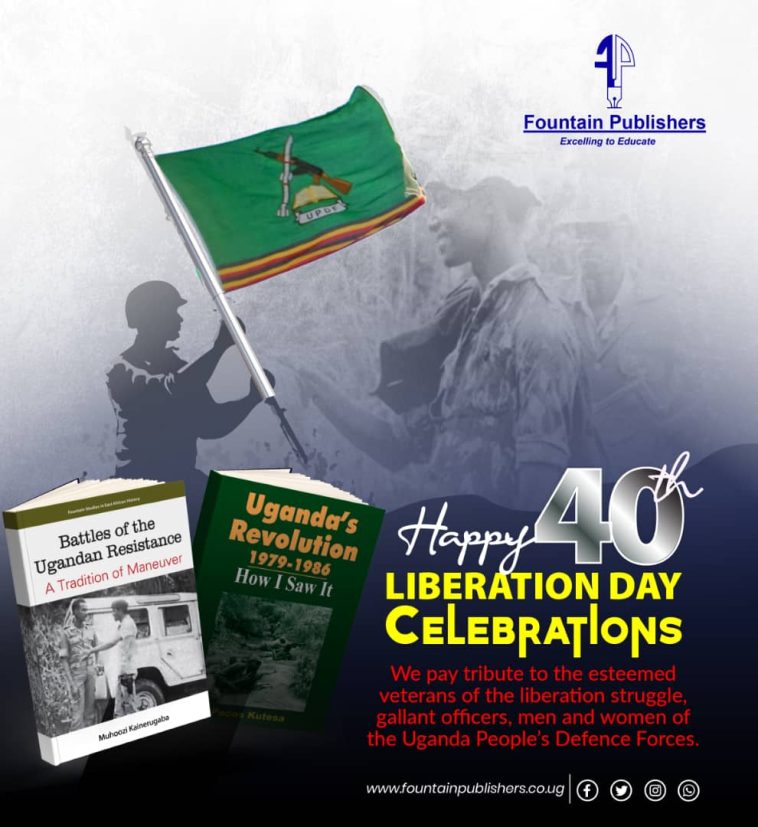
Knowing Uganda’s political history is important to appreciate the current state of affairs. One of the candidates, Yoweri Museveni, was dissatisfied with the results of Uganda’s general election held in December 1980. Dr Apollo Milton Obote of the Uganda Peoples Congress had been declared winner. However according to some historians and political analysts, Dr Paul Kawanga Ssemogerere of the Democratic Party (DP) was the most popular candidate, and was most likely the rightful winner of that election. Museveni, whose Uganda Patriotic Movement (UPM) had performed poorly, protested the outcome of the election results claiming they were not free and fair. Immediately, he started organizing a guerrilla war which began on February 6, 1981, with 27 men only initially. Gen.Paul Kagame, now President of Rwanda, Col. Fred Mwesigye, Brig. Andrew Lutaaya, Jack Mucunguzi, to mention a few, are among some of the surviving original fighters. The ‘Bush war’, as it came to be known and sometimes popularly referred to as the People’s Protracted War, took a toll on the lives of many Ugandans. The National Resistance Army/Movement (NRA/M) eventually defeated the National Liberation Army (UNLA) led by Gen.Tito Okello Lutwa and stormed Kampala on January 25, 1986, but the announcement of change in regime was officially made on January 26, 1986. Yoweri Museveni Kaguta became the president of Uganda at 42, and has now ruled the country for 40 years. He has secured a new mandate to lead for five more years. Museveni’s campaign focused on “PROTECTING THE GAINS”, and Making a qualitative leap into high middle-income status. The previous election campaign had focused on SECURING YOUR FUTURE(of Ugandans). At the start of the NRA/M administration, the National Resistance Movement Ten-Point Program was used as a guide for implementing political programs in the one party system-the Movement system established.
Ours Is a Fundamental Change was a very deep and insightful speech which President Museveni delivered in the early days of the National Resistance Movement regime, explaining their agenda, and what they were up to; “No one should think that what is happening today is a mere change of guard: it is a fundamental change in the politics of our country. In Africa, we have seen so many changes that change, as such, is nothing short of mere turmoil. We have had one group getting rid of another one, only for it to turn out to be worse than the group it displaced. Please do not count us in that group of people: The National Resistance Movement is a clearheaded movement with clear objectives and a good membership.”
Indeed, at the time, the National Resistance Movement was composed of many intellectuals and hardworking cadres with revolutionary ideals. In an interview on 91.3 Capital FM, Desert Island Discs in December 17, 2023, the former long-serving CEO of the Vision Group, William Pike acknowledged how focused, development-oriented, and patriotic members of NRM were in the first couple of years. Money was not the driving factor, but conviction to work for a better country. He mentioned individuals like Mr Ben Matogo, Hon. Eria Kategaya, who are now deceased.
Some of their 10-Point Program included; Restoration of Democracy, Restoration of Security, Consolidation of National Unity and Elimination of all forms Sectarianism, Defending and Consolidating National Independence, Building an Independent, Integrated, and Self-Sustaining National Economy, Elimination of Corruption and Misuse of Power, Cooperation with Other African Countries, Restoration, and Improvement of Social Services, and Rehabilitation of War-Ravaged Areas, etcetera. How these programs were implemented can be a good basis through which the longevity in power of the NRM can be evaluated and the pros and cons assessed.
Socio-economic transformation is one area that the National Resistance Movement has been working hard to deliver. Infrastructure in the country is better. Universal Primary Education (UPE) and Universal Secondary Education (USE) were introduced. In the early years of the NRM, the President always reminded Ugandans about ‘jolo pii kot’, ‘okulembeka’, then programs like Bonna Bagaggawale, Emyooga, Operation Wealth Creation (OWC), and the current flagship program, the Parish Development Model (PDM), among others, followed to help better the lives of Ugandans.
The National Resistance Movement largely restored peace and security in Uganda, except the Northern and Eastern parts of the country which had extended periods of insecurity and insurgency because of the Holy Spirit Movement (HSM) of Alice Lakwena, the Lord’s Resistance Army (LRA) rebels and other rebel groups which terrorized those regions. According to renowned journalist, Caroline Lamwaka(RIP), in her book, “The Raging Storm”, the capital city, Kampala, was a mess and very insecure in the previous regime and was akin to Beirut. The NRM restored peace, security, and sanity. According to the National Resistance Movement Spokesperson, Hon. Emmanuel Dombo, “We have delivered on peace, security, and stability in Uganda. Ugandans can now sleep peacefully in their homes, which was not the case before. Twebake otulo as you may have heard in Buganda is in appreciation for the improvement in living conditions and homes. The country had almost collapsed in the previous regimes. Uganda is now respected and highly regarded in the region, Africa and the world because of its contribution in stabilizing security in the region; South Sudan, Somalia, DRC, Rwanda etc. Under the National Resistance Movement, there is more unity and less sectarianism in politics, religion, among others. NRM works with everyone, regardless of tribe, and religion. The marginalized, especially the women, and youth have benefited from affirmative actions by the NRM government. We established democracy that works, and soon President Museveni will leave. (When the new term ends?)
Staying in power for a very long time comes with its peculiar challenges, and the NRM has not been spared. The party is grappling with many challenges. With longevity, attending to many demanding tasks comes fatigue and associated increased ageing from the stressful demanding roles. President Museveni is not immune to these biological processes despite the apparent show of strength he has demonstrated before through push-ups exercises, fast-paced walks etc. Subsequent elections organized by the government since 1996, have been contested in the courts for irregularities, the fraudulent nature, and violence meted on opposition supporters. There is an election petition in the Supreme Court by former presidential candidate, Moses Kasibante of the National Peasants’ Party, contesting Museveni’s victory. It is ironical that Mr Museveni who went to the bush to fight because of alleged election rigging, is now implicated in the same practice, not once but many times. His rebellion was ostensibly to fight vices like electoral malpractices and restore good governance. Hon. Dombo says, “Museveni didn’t have access to a judicial system to lodge his complaints, whereas today’s opposition politicians have access to competent courts. Those with legitimate concerns have been attended to, and the issues addressed. People who lose elections generally complain; Donald Trump, Raila Odinga (RIP), etc.” In the 2021 general election, the leading opposition party, the National Unity Platform (NUP), led by Hon. Robert Kyagulanyi withdrew its election petition for lack of confidence in the independence of some of the Judges of the Supreme Court. Following the declaration of the 2026 election results, the whereabouts of the strongest challenger to Museveni’s hold on power, Kyagulanyi (Bobi Wine), is unknown. What does it show about the validity of the election?
On a positive note, hosting of the Commonwealth Heads of Government Meeting (CHOGM in 2007, the Conference of Speakers and Presiding Officers of the Commonwealth, the 19th Summit of Non-Aligned Movement (NAM) and the G77+China summits in Kampala this month (January, 2024) is a plus for the National Resistance Movement regime. Uganda should make the best use of the opportunity to lead NAM and the G77. It is a golden opportunity to showcase and market Uganda on the World stage opines a retired career diplomat.
However, Uganda under the National Resistance Movement was among four African countries which were called a “beacon of hope” with a “new breed of leaders” in the 1990’s by the West. Years later the country has fallen out with the U.S., the European Union (EU), the World Bank, and the International Monetary Fund (IMF). The Office of the United Nation High Commissioner of Human Rights in Kampala was closed in 2023. The issue of violation of human rights by the regime has come to the fore, notably the 56 people killed in the November 2020 riots. Uganda was struck off the list of African countries benefiting from the trade agreement, the African Growth and Opportunity Act (AGOA) which promotes economic growth. The agreement with the U.S. dated from 2000. It is time for the NRM to take a critical look at its record since 1986, reflect upon it, and learn appropriate lessons.
The legacy of the National Resistance Movement rule for this long period of time is being tainted by massive corruption scandals. “Corruption is the elephant in the room. Many sectors of government have been affected, public service, politicians, the Police extorting money from the public etc. However the NRM does not tolerate corruption,” adds the NRM Spokesperson. Rt. Hon. Richard Todwong who was then the National Resistance Movement Party, Deputy Secretary General lamented publicly a number of times about corruption in the National Resistance Movement. In one explosive interview on NTV, Todwong said, “Corruption, greed, nepotism are things making Ugandans disgusted in the leadership of our party. If we don’t restrain, control our greed, and steal with impunity, Ugandans will push us out. The mushrooming buildings, structures privately owned by ministers, commissioners, Permanent Secretaries and others while schools and health centres are shrinking. To be honest, I have told the President/Chairman NRM about these.” However the NRM Chairman, Museveni through his system of patronage and buying off some opposition politicians, is culpable of corruption too. “Look, who hasn’t Museveni silenced using money?”-Hon. Ssemujju Ibrahim Nganda(Kira Municipality MP) The Observer February 1-2,2017
Uganda’s Foreign Policy was favourable in the early years of the NRM to the 1990’s but regrettably not anymore. Uganda was the first country to benefit from the “Heavily Indebted Poor Countries, HIPC” debt cancellation by the World Bank in 1996. The expenditures and priorities of the NRM government have come under intense scrutiny because of the lavish nature of lifestyles of some of its officials. It is a burden to Ugandan taxpayers.
The National Resistance Movement’s Pan-African agenda has been lauded and earned President Museveni respect among his peers. Under the NRM, Uganda has intervened to restore peace in some African countries; Somalia, Liberia, South Sudan, Democratic Republic of Congo, and Rwanda to mention a few. These are African countries which Uganda helped contribute towards their peace in the spirit of Pan-Africanism.
With all that the National Resistance Movement has achieved in 40 years, something critical still remains to be tackled. The lack of transition at the pinnacle of the party leadership is the elephant in the room. The President and Chairman of the NRM party should give room for a smooth transition having led for decades. He is not immortal. What will happen if Uganda does not have a smooth, democratic transition? It requires deep thought and we should ponder over it now more than ever before.
Jimmy Odoki Acellam (@OdokiJ)
This post was created with our nice and easy submission form. Create your post!

Written by
Jimmy Odoki Acellam is Coordinator of Heartsounds Uganda and a Mental Health Advocate.
Did this story move you? Every gift goes directly to Odoki Jimmy — writers on Muwado earn from reader appreciation, not algorithms. Even $1 makes a difference.


Muwado weekly chart
Get Africa’s top 10 stories every Thursday
No account needed — just your email.
Want to follow Odoki Jimmy and get notified every time they publish?
Create a free Muwado account →