

 Oweyegha Afunaduula
Abstract
As Uganda commemorates the 60th anniversary of its formation from 15 ancient traditional nations on 9th October 2026, this article argues that the nation is committing a slow, silent genocide against its old and elderly. While the state fixates on the Protection of Sovereignty Bill 2026—a political instrument concerned with territorial and financial borders—it has ignored the deeper crisis: the erosion of Traditional Ecological Knowledge (TEK) and community governance. This article defines the old and elderly, positions them as an endangered group of Homo sapiens, and demonstrates why their preservation is not sentimental but existential for Uganda’s journey towards the 22nd Century. It contrasts the destructive “politics of interests” (ethno-militarised, neoliberal, individualistic) with the restorative “politics of identity” (natural and ecological belonging), arguing that only the old and elderly can transmit the genealogies, ecological autobiographies, and clan constitutions necessary for future generations to avoid becoming a floating, ahistorical population.
Introduction: A Country Without Its Elders Has No Future
On 9th October 2026, Uganda will mark six decades as a modern state. Yet the foundational pillars of this nation—the 15 ancient traditional nations—are witnessing the systematic impoverishment and neglect of their oldest members. The old and elderly are not merely aged bodies; they are living libraries of ecological resilience. However, the current regime’s politics of interests, enforced for four decades through the barrel of the gun, has marginalised these nations. The result is a looming crisis of the future, where Ugandans will neither know who they are nor how to manage the ecosystems that sustain them.
1. Defining the Custodians: Who are the Old and the Elderly?
In the Ugandan context, a distinction must be made:
· The Old (approx. 60–79 years): Individuals who have completed their active economic production cycles but retain full cognitive and ritual memory of pre-industrial ecological practices.
· The Elderly (80+ years): Custodians of oral constitutionalism and intergenerational seed sovereignty. They are the last living links to pre-colonial governance of wetlands, forests, and water systems.
Most of these individuals belong to Uganda’s 15 ancient traditional nations: Buganda, Bunyoro, Toro, Ankole, Busoga, Bugisu, Bukedi, Teso, Karamoja, Lango, Acholi, Alur, Lugbara, Madi, and Sebei (Mamdani, 2020). Today, within their own homeland, many are treated as foreigners.
2. An Endangered Group of Homo sapiens
The old and elderly in rural Uganda are an endangered demographic group because:
· Economic retrenchment (early 1990s): Following IMF/World Bank Structural Adjustment Programs (SAPs), the government summarily retrenched older public servants as “dead wood” without compensation. This was a crime against institutional memory (Brett, 1995).
· Health neglect: The Seniors’ Grant (80 years+) is a peanut, insufficient for non-communicable diseases, let alone the education of orphans under their care.
· The Protection of Sovereignty Bill 2026: This Bill requires ministerial approval for diaspora remittances—money that keeps elderly alive. It ignores the sovereignty of seeds, agroecology, and TEK, which only the old and elderly protect.
3. What the Rural Elderly Hold for the 22nd Century
3.1 Traditional Ecological Knowledge (TEK)
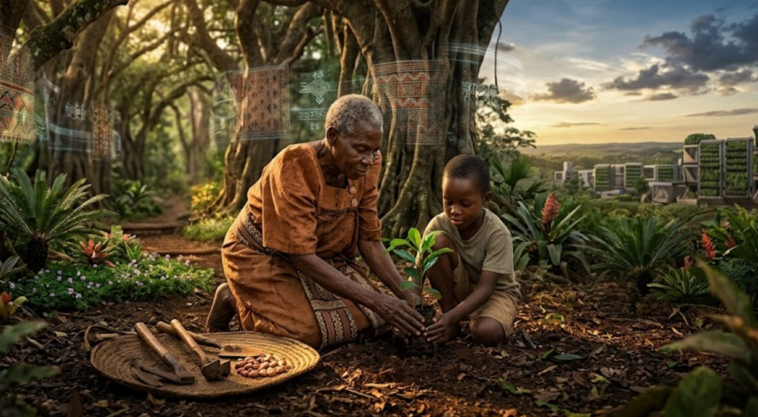
TEK is not folklore; it is empirical science accumulated over millennia. For example, elderly Basoga fishermen know the spawning cycles of Nile perch without thermometers; elderly Bakiga farmers read weather patterns through bird colonization. A developing Uganda needs TEK because climate models are useless if communities cannot adapt locally. TEK offers drought-resistant indigenous grains (e.g., eleusine coracana) and natural pest control (Gadgil et al., 2003).
3.2 Community Ecological Governance
Before the 1995 Constitution (made by a militarily captured state), clans managed wetlands through ekibaro (Buganda) or lukiiko (Bunyoro) systems. These councils, remembered only by the elderly, enforced fallowing periods and fishing bans. Neoliberal development destroyed these structures, leading to wetland encroachment and soil exhaustion.
4. The Threat of President Tibuhaburwa Museveni’s Politics of Interests
The politics of interests refers to a system where state resources, land, and contracts are allocated not by traditional identity or need, but by proximity to power. Whose interests? A small, ethnically cohesive group—which seized power in 1986 through the barrel of the gun—has monopolized the state for 40 years. This group crafted a constitution that protects the incumbent but not the old, nor future generations. It has made members of the 15 traditional nations play second fiddle in their own country (Green, 2010).
This is politicized and militarized ethnicity: one group’s interests (access to army contracts, land titles, foreign education for their children) are enshrined as national policy, while the elderly of other nations are left to die without health care or remittances.
5. Why Reject Politics of Interests and Return to Politics of Identity?
Politics of identity here does not mean ethnic chauvinism. It means:
- · Natural belonging: The recognition that one’s clan is tied to a specific watershed, hill, or forest.·
- Ecological belonging: The understanding that sustainable governance requires the elder who knows the taboo against cutting muvule trees near burial grounds.
The old and elderly are the only group that can teach the youth to distinguish between genuine identity and manufactured ethnic hatred. Without them, young Ugandans are vulnerable to mobilizations for land grabs and electoral violence.
6. Reconstructing Genealogies, Autobiographies, and Clan Constitutions
The old and elderly can help the young construct:
- Genealogies: Oral records of descent that connect a child to a specific clan tomb (e.g., bigonde in Busoga). A person without a genealogy cannot claim land or ritual responsibility. Without connectivity between past, present, and future, a country has no temporal legitimacy.·
- Ecological Autobiographies: A written or oral narrative of every interaction a person has had with their ecosystem (when a well dried, when a particular tree flowered with rains). Example: Elderly Karamojong women can narrate 70 years of seasonal change, data which no weather station holds.·
- Clan Constitutions: Many clans have unwritten laws (e.g., who can fish on which night). If these exist only in the memory of three dying elders, the clan has no future. These constitutions must be documented to perpetuate indigenous populations towards the 22nd Century.
7. The Slow Genocide Through Neglect
The government’s policy of paying a token at age 80, while simultaneously blocking diaspora remittances under the Protection of Sovereignty Bill 2026, is a slow genocide. It does not kill with a bullet but with starvation and untreated malaria. The Bill is entirely political: it protects territorial sovereignty but destroys seed sovereignty, food sovereignty, and knowledge sovereignty. The elderly cannot even receive money from a daughter in London without the Minister’s approval. This is not sovereignty; it is hostage-taking.
Conclusion: A Call for Constitutional and Cultural Rescue
Uganda cannot reach the 22nd Century on Chinese-built roads alone. It will need the intellectual infrastructure of its old and elderly. The 15 ancient traditional nations must reject the politics of interests and insist on constitutional protection for elders, including:
- · Compensation for the 1990s retrenchment victims.·
- Removal of the remittance clause in the Protection of Sovereignty Bill 2026.·
- Mandatory documentation of clan constitutions and TEK in every district.
If we lose the old and elderly, we will leave behind a young, angry, ahistorical floating population—one that does not know where it came from, and therefore cannot care where it is going.
—
Comprehensive List of References
- · Brett, E. A. (1995). Structural adjustment, state policy and economic growth in Uganda. Development Policy Review, 13(3), 263-286.·
- Gadgil, M., Berkes, F., & Folke, C. (2003). Indigenous knowledge for biodiversity conservation. Ambio, 22(2/3), 151-156.·
- Green, E. (2010). Ethnicity and the politics of land in Uganda. African Affairs, 109(435), 245-264.·
- Mamdani, M. (2020). Neither settler nor native: The making and unmaking of permanent minorities. Harvard University Press.·
- Oweyegha-Afunaduula, F. (2026). The environmental implications of the Protection of Sovereignty Bill 2026. Journal of Ugandan Ecological Studies, 12(1), 45-67.·
- Uganda Bureau of Statistics. (2024). National population and housing census: Elderly demographics report. Kampala: UBOS.·
- World Bank. (1992). Uganda: Retrenchment and compensation programme. Washington, DC: World Bank Operations Evaluation Department.
This post was created with our nice and easy submission form. Create your post!
Written by
I am a retired lecturer of zoological and environmental sciences at Makerere University. I love writing and sharing information.
Did this story move you? Every gift goes directly to Oweyegha Afunaduula — writers on Muwado earn from reader appreciation, not algorithms. Even $1 makes a difference.






Muwado weekly chart
Get Africa’s top 10 stories every Thursday
No account needed — just your email.
Want to follow Oweyegha Afunaduula and get notified every time they publish?
Create a free Muwado account →