

 Shadreck Chikoti

Do not fear your history. Telling our stories ourselves.
Scholars have not reached a definitive conclusion on the origins of the word Malawi. In attempting to reconstruct the obscured landscapes of pre-colonial Central African history, historians, linguists, and anthropologists have proposed a number of interpretations, many of them hovering between history and myth. Some have argued that the name emerged from the shimmering appearance of sunlight reflected upon the waters of Lake Malawi, flames of light dancing upon the lake’s surface at sunrise and sunset. Others have associated the term with the glow of ancient iron smelting furnaces that illuminated the night skies of the Maravi world. While these explanations capture important symbolic imagery associated with the region, they may only represent surface manifestations of a much older and deeper political-spiritual tradition rooted in the statecraft of Central Africa.
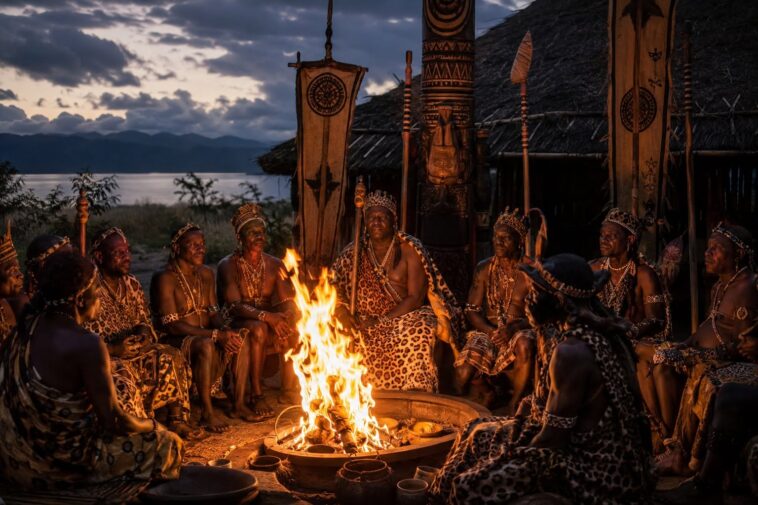
The pre-colonial history of Central Africa is dominated not merely with migration routes and military conquests, but with portable political systems and deeply spiritual metaphors. At the very heart of this statecraft was a physical and metaphysical element, the sacred, unceasing royal fire. Emerging from the sophisticated cultural crucible of the Luba-Lunda empires in the Katanga region of modern-day Democratic Republic of the Congo, this fire-centric model of governance traveled southward, carried by migrating royal clans. While the history of the Bemba of Zambia explicitly documents this tradition, the parallel history of their close cousins, the Maravi, offers a profound, unspoken mirror. By tracing the migration paths, analyzing the dramatic royal rift at Mankhamba under King Undi, and evaluating the etymology of the word Malawi, a compelling historical argument emerges: the name Malawi, “Flames of Fire,” did not merely derive from the physical reflection of the sun on a lake or ancient iron-smelting kilns. Instead, it was the linguistic and spiritual manifestation of a perpetual royal flame, an ember of sovereignty carried out of Uluba that was destined to burn for eternity.
The Luba Blueprint and the Bemba Mirror
To understand the Maravi fire, one must first examine the political-religious blueprint established in the Luba heartland. As the Luba Empire expanded, its supreme monarchs, the Balopwe, governed not through sheer military terror, but through a highly sophisticated administrative system centered upon sacred legitimacy. One of the most important instruments of this authority was the distribution of royal embers. Subordinate rulers across the savanna became known as balopwe wa mudilo, “Fire Kings” [1]. As historian Thomas Reefe documents in The Rainbow and the Kings: A History of the Luba Empire to 1891, these client states were given the physical royal embers of the Luba kings to establish in their new territories, thereby linking provincial authority both legally and spiritually to the royal center [1]. Fire represented continuity, legitimacy, fertility, and the living essence of kingship itself.
This exact cultural blueprint survives with remarkable clarity among the Bemba people of northern Zambia. Migrating out of the Luba court in a later wave, the Bemba royal clan, the Bena Ng’andu or Crocodile Clan, carried these sacred embers with them as symbols of political independence and dynastic continuity. In A History of the Bemba, historian Andrew D. Roberts demonstrates how central to Bemba statecraft was the concept of the Mulilo wa Lubemba, the Fire of the Bemba Nation [2]. This fire was intended never to cease burning during the lifetime of the monarch, serving as a physical manifestation of the health of the kingdom and the fertility of the land [2]. Audrey I. Richards further confirms the rigor of this ritual structure in her anthropological work. At the death of the supreme king, the Chitimukulu, the royal fire was deliberately extinguished, plunging the nation into symbolic darkness until a successor was ritually installed and a new fire kindled from traditional fire sticks [3]. The continuity of the kingdom was therefore inseparable from the continuity of the flame.
The Unspoken Flame of the Maravi: The Mankhamba Rift
The ancestral Maravi belonged to an earlier migration wave from the same Luba-Lunda heartland, moving through northern Zambia before eventually settling around Lake Malawi. Given that they shared a common political vocabulary, metallurgical heritage, and sacred cosmology with their Bemba relatives, it is historically plausible that they carried with them the same institution of the perpetual royal fire.
Although colonial records frequently overlooked the sacred dimensions of Maravi kingship, evidence of this tradition survives in oral traditions and in the political fragmentation of the Maravi Empire itself. At Mankhamba, the ancient Maravi capital, a major succession dispute emerged between the Kalonga, the paramount ruler, and Undi, Kalonga’s uncle and one of the most powerful members of the royal lineage. When Undi did not want to engage himself with the family disputes concerning succession to the throne he orchestrated a deliberate political separation in order to establish an independent sphere of authority.
Undi’s departure from Mankhamba was not simply the migration of warriors into new territory. It was the transplantation of an entire political and spiritual order. To legitimize his sovereignty, Undi reportedly left with some of the central pillars of the Maravi state itself. Oral traditions and historical reconstructions suggest that Nyangu, the Queen Mother and matriarch of the royal Phiri clan, accompanied him, together with the major rain shrine associated with Maravi spiritual authority. More significantly, traditions preserved in works such as K. M. Phiri’s Chewa History indicate that Undi’s faction carried away sacred embers from the Kalonga’s royal fire.
Upon establishing his capital at Mano in present-day eastern Zambia, Undi is believed to have rekindled a new perpetual royal flame from these sacred embers. From this center, he reproduced the same political model inherited from the Luba-Lunda world. Chiefs who submitted to Undi were granted sacred embers from the royal fire at Mano to establish their own political legitimacy. Rebellious chiefs, conversely, could have their fires extinguished, symbolically stripping them of divine authority and political recognition. The scale and organization of Undi’s state in eastern Zambia and Tete Province strongly suggest that the Maravi polity at Mankhamba had itself been organized around a comparable sacred fire institution.
Ethno-History and Etymology: The True Meaning of Malawi
For generations, popular interpretations have explained the word Malawi or Maravi as a reference either to the reflection of sunlight upon the lake or to the glow produced by ancient iron smelting furnaces. While these interpretations are not entirely implausible, they may confuse symbolic imagery with the deeper ideological source of the name itself.
The word Malawi broadly conveys meanings associated with flames, blazing light, or reflected brightness. Within the context of Central African sacred kingship, however, such imagery carried profound political and spiritual significance. The “Flames” were not simply physical phenomena. They represented the sacred continuity of civilization itself, the portable sovereignty carried southward from Uluba by migrating royal clans.
Among the ancestral Chewa and Maravi, ritual fire possessed cosmological significance. Seasonal bush burnings conducted at the end of the dry season were not merely agricultural acts, but sacred performances connected to rain rituals and ancestral communication. The rising columns of fire and smoke formed symbolic bridges between the living and the ancestral world, rituals overseen by political and spiritual authorities linked to the Kalonga himself.
When one compares the Mulilo wa Lubemba of the Bemba with the migratory and political traditions of the Maravi, a striking continuity emerges. Both societies appear to have been structured around the politics of the sacred hearth. Fire embodied kingship, continuity, legitimacy, fertility, and the endurance of the state.
The name Malawi therefore stands not merely as a geographical description, but as a historical memory. It may represent the verbal echo of an ancient Luba ember carried across forests and savannas, surviving royal conflicts at Mankhamba, crossing the plateaus of Zambia under Undi, and eventually settling upon the shores of Lake Malawi. In this interpretation, Malawi is not simply the land of reflected sunlight or iron furnaces. It is the land of the eternal flame, the embers of sovereignty that refused to die. Malawi.
This post was created with our nice and easy submission form. Create your post!

Written by
Did this story move you? Every gift goes directly to Shadreck Chikoti — writers on Muwado earn from reader appreciation, not algorithms. Even $1 makes a difference.






Muwado weekly chart
Get Africa’s top 10 stories every Thursday
No account needed — just your email.
Want to follow Shadreck Chikoti and get notified every time they publish?
Create a free Muwado account →