

 Oweyegha Afunaduula

Abstract
This article critically examines the trajectory of the university as an institution of higher learning, arguing that its current disciplinary and multidisciplinary structures serve as roadblocks to the unity and integration of knowledge. Drawing on historical precedents—particularly the decline of the University of Timbuktu—and contemporary critiques of the corporate university, the article proposes a transition toward Team Sciences Learning Centers (TSLCs) founded on the principles of interdisciplinarity, crossdisciplinarity, transdisciplinarity, and extradisciplinarity. The article exposes how Uganda’s premier university, Makerere, under the Academic Policy spearheaded by Professor Akiki Mujaju, deliberately squeezed interdisciplinarity out of the curriculum—undoing nearly US$600,000 invested by the Ford Foundation in the Interdisciplinary Teaching of Human Rights, Peace and Ethics Project (ITHPEP). The consequence has been the systematic erosion of democratic practices and the rise of oppressive academic intrigues. The article contends that while the university resists genuine integration of knowledge, new institutional forms—the interversity, crossversity, transversity, and extraversity—can coexist in Team Sciences Learning Centers that transcend the limitations of disciplinary gatekeeping. The Four-Dimensional Environmental Framework (4DEF) is proposed as the organizing logic for such centers. The “slow professor” phenomenon is identified as a key agent of institutional inertia. The article concludes by warning that universities failing to embrace team sciences risk becoming disciplinary dinosaurs, suffering a fate analogous to the Timbuktu Phenomenon in the 22nd century, and declares the new imperative: from “publish or perish” to “Change or Perish.”
Keywords: Team Sciences Learning Center (TSLC), 4-Dimensional Environmental Framework, interdisciplinarity, Timbuktu Phenomenon, slow professors, ITHPEP, Akiki Mujaju, Makerere University, change or perish
—
1. Introduction: The University and the Promise of Universal Knowledge
The university, as an idea, has historically carried the promise of universal knowledge—a space where the totality of human understanding could be pursued, preserved, and transmitted across generations. From the scholarly communities of Timbuktu to the medieval universities of Europe, the aspiration toward wholeness in knowledge has been a recurring theme in the history of higher education.
Yet, as we stand at the threshold of the 22nd century, this promise remains largely unfulfilled. The modern university, far from being a sanctuary for integrated understanding, has become a fortress of disciplinary fragmentation. It produces graduates who see the world through narrow lenses, scholars who speak past one another, and knowledge that cannot address the “wicked problems” of our time—climate change, pandemics, inequality, and ecological collapse.
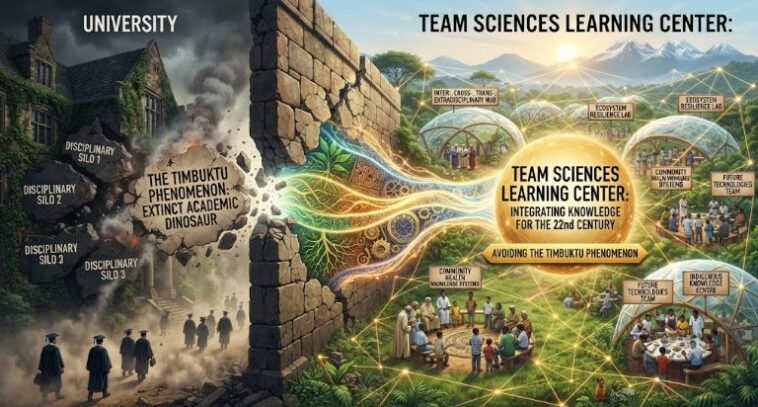
This article argues for a fundamental transition: from the university as we know it to Team Sciences Learning Centers (TSLCs) that honor the interconnected, web-like nature of knowledge. The warning is urgent and historical. Timbuktu, once a vibrant center of learning with up to 25,000 students and a repository of thousands of manuscripts, declined precipitously after the Moroccan invasion of 1591, when scholars were exiled or executed (Jeppie, 2008). The “Timbuktu Phenomenon” refers to this vulnerability: the possibility that a great intellectual tradition can collapse when it becomes rigid, insular, and disconnected from the changing conditions of knowledge production.
We must ask: Will the university suffer a similar fate in the 22nd century?
2. Knowledge as Whole and One: Three Dimensions
Before we can speak of transition, we must recover a foundational truth: knowledge is whole and one. Its apparent division into categories is a human convenience, not an ontological reality. Three dimensions constitute this wholeness:
2.1 The Humanities (Arts)
The humanities—literature, philosophy, history, the arts—address the question of meaning. They cultivate empathy, interpretation, and the capacity to enter into the lives of others. As Professor Arthur Gakwandi observed at Makerere University, literature enables readers “to enter the lives of other people to experience their pain, their pleasures, their ambitions and their fantasies—which no other discipline comes close to” (Bukenya & Gakwandi, 2024). The humanities teach us to feel, to question, to imagine otherwise. Without them, we produce technically competent individuals who lack moral and emotional intelligence.
2.2 The Social Sciences
The social sciences—sociology, political science, economics, anthropology—address the question of structure. They investigate how human beings organize themselves into families, markets, states, and movements. They reveal patterns of power, inequality, and collective behavior. They ask: How do we live together? And why do we so often fail?
2.3 The Natural Sciences
The natural sciences—physics, chemistry, biology, earth sciences—address the question of mechanism. They investigate the physical world, its laws, its processes, and its emergent properties. They have given us remarkable technological capabilities and deepened our understanding of cosmic and microscopic realms.
2.4 Interconnectivity and Mutual Inclusiveness
These three dimensions are not separate. They are interwoven in a web-like manner. Climate change is simultaneously a natural science phenomenon (carbon cycles, atmospheric chemistry), a social science phenomenon (political economy, collective action), and a humanities phenomenon (environmental ethics, narratives of loss and hope). To understand it adequately requires all three dimensions working in concert.
The myth of “pure science”—the notion that natural science can proceed independently of human values and social structures—is precisely that: a myth. As a political theorist from Makerere University recently noted, “Knowledge and practices of natural science are governed by politics. STEMs and BTVET are a social science in the first instance before becoming a natural science” (Kajura, 2026).
3. Academic Jargons and Dogmas: Pollutants of Knowledge
Each discipline develops its own specialized vocabulary, its own theoretical commitments, and its own unquestioned assumptions. These jargons and dogmas are not neutral tools; they are pollutants of knowledge. They create in-group/out-group dynamics, exclude potential interlocutors, and masquerade as precision when they often function as gatekeeping.
The physicist speaks of “renormalization” as if it were a window onto reality rather than a mathematical trick. The economist speaks of “rational actors” as if human behavior were reducible to utility maximization. The literary critic speaks of “logocentrism” as if Derrida had delivered final truths rather than provocative questions.
When each discipline treats its jargon as essential and its dogmas as foundational, the very idea of knowledge purity becomes nonsensical. There is no pure knowledge. There is only knowledge situated in traditions, languages, and power structures. The talk of “pure science” is therefore not merely naive—it is an ideological weapon used to elevate some knowledge traditions while delegitimizing others.
4. The Assault on Interdisciplinarity at Makerere University: The Mujaju Academic Policy
4.1 The Ford Foundation’s Investment: ITHPEP
Between the late 1990s and early 2000s, the Ford Foundation invested nearly US$600,000 in a transformative project at Makerere University: the Interdisciplinary Teaching of Human Rights, Peace and Ethics Project (ITHPEP) . The project sought to place human rights, peace, and ethics at the centre of higher education across all disciplines. Its logic was impeccable: a medical doctor who does not understand human rights will treat patients but violate their dignity; an engineer who does not understand peace will build infrastructure that fuels conflict; an economist who does not understand ethics will design policies that impoverish the vulnerable.
ITHPEP trained hundreds of faculty members across Makerere’s colleges. It developed interdisciplinary modules. It created spaces where lawyers, social workers, agronomists, and veterinarians could learn together about the values that should underpin all professional practice.
4.2 Professor Akiki Mujaju’s Academic Policy
Then came the reversal. Under the leadership of Professor Akiki Mujaju, a new Academic Policy was drafted and pushed through Makerere’s governance structures. This policy explicitly highlighted the superiority of disciplinary education over interdisciplinary education. It sought to squeeze interdisciplinarity out of Uganda’s premier university—and it succeeded.
The Mujaju Academic Policy argued that students must master disciplinary depth before any exposure to interdisciplinary breadth. It reasserted departmental control over curricula. It defunded interdisciplinary teaching initiatives. It made interdisciplinary appointments nearly impossible.
4.3 The Systematic Squeeze-Out
The consequences were devastating and systematic. The Ford Foundation’s seeds of interdisciplinarity were uprooted. Courses that integrated human rights, peace, and ethics across the curriculum were eliminated or rendered optional. Faculty members who had been trained under ITHPEP found themselves isolated, their interdisciplinary teaching credits rejected as “non-disciplinary.”
Three values were systematically squeezed out of the university campus: human rights, peace, and ethics.
Their departure did not leave a vacuum. It created space for their opposites. What followed was the normalization of undemocratic practices: appointments made without transparency, promotions determined by patronage rather than merit. Oppressive tendencies flourished: junior faculty afraid to speak, students disciplined for asking critical questions. Intrigues in the academia became the currency of career advancement—backstabbing, gossip, factional warfare masked as scholarly disagreement.
The university that ITHPEP had envisioned—a place where human rights, peace, and ethics were central—became instead a place where power was central, and everything else was peripheral.
4.4 Lessons for Team Sciences Learning Centers
The Makerere case offers an unambiguous warning: encouraging team sciences within a university is deceptive. The disciplinary knowledge and structural environment will kill the team sciences because they cannot fit. Interdisciplinarity, crossdisciplinarity, transdisciplinarity, and extradisciplinarity cannot take root in soil that is hostile to their very existence.
This is why the Team Sciences Learning Center (TSLC) must be institutionally independent of the university. Not a center within a university. Not a program within a college. A freestanding institution with its own governance, its own hiring, its own promotion criteria, and its own budget.
5. The Problem with Disciplines and Multidisciplines
5.1 Disciplines as Roadblocks
Disciplines are not inherently evil. They represent accumulated expertise and methodological rigor. However, they have become roadblocks to the unity of knowledge. Each discipline develops its own vocabulary, its own journals, its own criteria for advancement. Scholars are rewarded for deepening disciplinary trenches, not for building bridges.
The result is what I have previously described: “We overwhelmingly produce, transmit and acquire knowledge disciplinarily as if we are still in the 20th Century” (Oweyegha-Afunaduula, 2023).
5.2 Multidisciplinarity as Deceptive Integration
Multidisciplinarity—bringing multiple disciplines to bear on a problem while keeping them separate—is often mistaken for integration. It is not. In a multidisciplinary exercise, a sociologist contributes sociological insights, a biologist contributes biological insights, and an economist contributes economic insights. But these insights are juxtaposed, not synthesized. The underlying assumptions of each discipline remain unchallenged.
True integration requires moving beyond multidisciplinarity to forms of knowledge production where boundaries dissolve.
5.3 Why the Modern University Resists Genuine Integration
The university resists genuine integration for structural reasons. Departments control budgets, hiring, and promotions. Interdisciplinary work is penalized on the grounds that it is “not a good fit” for any existing department. The administrative university, increasingly corporatized, values measurable outputs over intellectual risk-taking.
As Berg and Seeber (2016) document in The Slow Professor, the corporatization of academic life has “sped up the clock,” emphasizing “measurable quantity over quality” and leaving faculty “feeling powerless.” In such an environment, the time-consuming work of building genuine integration across knowledge domains becomes impossible.
6. Team Sciences: A Spectrum of Integration
I propose that TSLCs must make available four modes of knowledge integration, each representing a deeper level of boundary dissolution.
6.1 Interdisciplinarity
Interdisciplinarity involves the transfer of methods and concepts from one discipline to another. A historian using statistical techniques developed in economics is engaging in interdisciplinarity. The disciplines themselves remain intact, but they borrow from each other.
6.2 Crossdisciplinarity
Crossdisciplinarity involves viewing one discipline from the perspective of another. A philosopher examining the assumptions of quantum physics is engaging in crossdisciplinarity. The object of study belongs to one discipline, but the analytical lens comes from another.
6.3 Transdisciplinarity
Transdisciplinarity goes further: it transcends disciplinary boundaries altogether by focusing on problems that cannot be adequately addressed within any single disciplinary framework. The “wicked problems” I have written about—environmental degradation, climate change, systemic poverty—require transdisciplinary approaches. As I have noted, these problems “do not lend easily to disciplinary analysis and solutions” (Oweyegha-Afunaduula, 2023).
6.4 Extradisciplinarity
Extradisciplinarity is the most radical mode. It operates entirely outside disciplinary frameworks, returning to ways of knowing that precede the disciplinary organization of knowledge. This was the mode of the ancient philosophers—Confucius, Socrates, the scholars of Timbuktu—who taught and learned without departments, without specialized journals, without the apparatus of disciplinary gatekeeping.
Confucius understood this well: “Learning without thought is labour lost. Thought without learning is intellectual death” (Confucius, n.d., as translated by Giles). Extradisciplinarity is precisely the marriage of learning and thought, unmediated by disciplinary protocols.
7. The New Institutions: Interversity, Crossversity, Transversity, Extraversity
If the team sciences represent modes of knowing, they can be institutionalized as distinct but coexisting centers within a TSLC:
7.1 The Interversity
Organized around interdisciplinary exchange.
7.2 The Crossversity
Organized around the application of one field’s perspectives to another’s subject matter.
7.3 The Transversity
Organized around wicked problems, bringing together scholars, practitioners, and community members.
7.4 The Extraversity
Organized around extradisciplinary inquiry—the space for philosophy, for deep reflection, for integrated thinking.
7.5 Can These Coexist in a University?
These four modes can coexist in a single TSLC. But they cannot coexist in a university—at least not in the university as currently constituted. The reason is structural. Universities are organized around disciplines. TSLCs are organized around problems, questions, and frameworks.
This is why the transition must be institutional, not merely rhetorical. We need TSLCs, not reformed universities.
8. The Four-Dimensional Environmental Framework (4DEF)
8.1 Why Environment Must Be Central
Every article we write, every center we build, every curriculum we design must place environmental learning at the center. Why? Because the environmental crisis is the defining challenge of our time. Because no knowledge is innocent of ecological consequences. Because a graduate who cannot think environmentally cannot think at all.
The Four-Dimensional Environmental Framework (4DEF) organizes all learning in TSLCs. It holds that every problem, every question, every inquiry has four irreducible dimensions:
Dimension Core Question Knowledge Domain
Physical-Environmental What are the material, biotic, and abiotic conditions? Natural Sciences
Social-Cultural How do human communities organize their relationship with these conditions? Social Sciences
Political-Economic Who has power? Who benefits? Who loses? Social Sciences/Humanities
Ethical-Aesthetic What is right? What is beautiful? What deserves to be preserved? Humanities
8.2 Applying 4DEF Across Team Sciences
In a TSLC organized around 4DEF:
· Interversity projects examine how different disciplines approach each dimension.
· Crossversity inquiries apply one dimension’s methods to another dimension’s questions.
· Transversity problem-solving addresses wicked problems (e.g., Nile Basin water conflict) through all four dimensions simultaneously.
· Extraversity reflection asks meta-questions: What do we mean by “environment”? How do different knowledge traditions conceptualize nature? What is the relationship between environmental degradation and the disciplinary fragmentation of knowledge?
8.3 Hyping 4-DEF
We must hype the Four-Dimensional Environmental Framework in every article, every presentation, every conversation. Not because we seek attention, but because environmental learning cannot be an add-on. It cannot be an elective. It cannot be a specialization. It must be the architecture of all learning in TSLCs. Without 4-DEF, team sciences become mere technique. With 4-DEF, they become wisdom.
9. Producing Future-Ready Professionals in an AI-Dominated World
9.1 What AI Cannot Do
Artificial intelligence is transforming knowledge work. Large language models can summarize, translate, code, and generate text at superhuman speed. AI can detect patterns across datasets that no human could perceive.
But AI has profound limitations:
· AI has no ethical judgment
· AI has no lived experience
· AI has no capacity for genuine empathy
· AI has no commitment to justice
· AI cannot hold power accountable
· AI cannot imagine radically alternative futures
9.2 The Future-Ready Professional
The future-ready professional in an AI-dominated world will be neither a technician nor a specialist. They will be someone who can:
· Ask questions that AI cannot formulate
· Integrate knowledge that AI cannot access (because it is tacit, embodied, or local)
· Exercise judgment that AI cannot replicate
· Act with courage when AI recommends expediency
· Recognize the environmental consequences of AI itself (energy consumption, mineral extraction, e-waste)
TSLCs organized around 4DEF and the team sciences will produce such professionals. Universities, still organized around disciplines, will produce graduates whom AI can replace.
10. From “Publish or Perish” to “Change or Perish”
For a century, the mantra of academic life has been “publish or perish.” Scholars have been evaluated by their publication count, their journal impact factors, their citation indices. This has produced an avalanche of papers—most unread, most insignificant, most reinforcing disciplinary dogmas rather than challenging them.
The mantra has become a prison. It incentivizes safe scholarship, incremental findings, disciplinary loyalty. It punishes risk-taking, integration, and public engagement.
The new mantra for the 22nd century is “Change or Perish.”
Not change for its own sake. Change toward integration. Change toward team sciences. Change toward TSLCs. Change toward 4DEF. Change toward producing knowledge that can actually address the problems facing our planet, our societies, and our souls.
Universities that cannot or will not change will perish—not with a dramatic collapse, but with a slow, undignified obsolescence. Their graduates will be unemployable. Their research will be irrelevant. Their certificates will be wall decorations.
TSLCs that embrace change will thrive. They will produce the professionals, the knowledge, and the wisdom that the 22nd century demands.
11. Gatekeeping and the “Slow Professor”
11.1 The Concept of Slow Professors
Maggie Berg and Barbara Seeber’s The Slow Professor: Challenging the Culture of Speed in the Academy (2016) argues that professors should resist the corporatization of the university by adopting “slow” principles: taking time for reflection, prioritizing quality over quantity, and reclaiming collegiality. Their “Slow Professor Manifesto” declares: “We are Slow Professors. We believe that adopting the principles of Slow into our professional practice is an effective way to alleviate work stress, preserve humanistic education, and resist the corporate university” (Berg & Seeber, 2016, p. xii).
11.2 The “Slow Professor” as Agent of Inertia
While Berg and Seeber’s critique of the corporate university is valuable, I have offered a different assessment of the “slow professor.” In my previous work, I have cast slow professors as agents of inertia—those who “want to stick to disciplinary and multidisciplinary knowledge production and transmission” (Oweyegha-Afunaduula, 2023).
The slow professor, in this reading, is not resisting corporate speed but resisting intellectual transformation. The problem is not that they are slow; it is that they are stuck. They continue to produce “for us graduates we do not need” and provide “disciplinary solutions that become new problems” (Oweyegha-Afunaduula, 2023).
11.3 Irrelevance in TSLCs
In a Team Sciences Learning Center organized around interversity, crossversity, transversity, and extraversity, and guided by 4DEF, the disciplinary gatekeeper would have no natural home. There would be no department to chair, no disciplinary curriculum to protect, no siloed budget to defend. The slow professor, defined by attachment to disciplinary structures, would be irrelevant.
This is not to say that all professors currently in universities are slow or must be abandoned. Many are eager for transformation. The issue is structural, not personal.
12. The Future of the University: Uncertain
12.1 The Timbuktu Warning
The University of Timbuktu was not a university in the modern sense—there was “no central organization or formal course of study” (PBS, n.d.)—but it was a vibrant community of scholars that “acquired a reputation for learning and scholarship across the Muslim world” (The Free Dictionary, n.d.). It boasted up to 25,000 students. It produced scholars like Ahmed Baba al Massufi, author of more than 40 books.
Its decline was not inevitable. It resulted from external invasion (the Moroccan campaign of 1591) followed by the exile or execution of its leading scholars (Kane, 2016). The lesson is not that all intellectual traditions eventually decline; it is that intellectual traditions without institutional resilience are vulnerable.
The university today faces not Moroccan armies but something perhaps more dangerous: internal decay masked by institutional inertia. The corporate university continues to grant degrees, publish journals, and hold ceremonies. But it no longer fulfills its promise of universal, integrated knowledge.
12.2 The Disciplinary Dinosaur
I have warned before: “Our Universities must change with the times or perish” (Oweyegha-Afunaduula, 2023). The disciplinary dinosaur—impressive in size but small in brain, slow in movement, unable to adapt—is the university’s future if transformation does not occur.
The Timbuktu Phenomenon for the 22nd century will not be a dramatic collapse visible from afar. It will be a slow obsolescence: graduates who cannot solve wicked problems, research that cannot inform policy, a society that looks elsewhere for wisdom.
13. Tuning the Title
The current title—”Transiting from University to Team Sciences Learning Center Toward the 22nd Century: Avoiding the Timbuktu Phenomenon”—captures the directional movement, the temporal horizon, and the warning. However, if the argument is fundamentally about replacement rather than transition, an alternative title might be:
“Replacing the University with Team Sciences Learning Centers: The Timbuktu Warning for the 22nd Century”
Or, to emphasize the urgency and the new mantra:
“Change or Perish: Why Team Sciences Learning Centers Must Replace Universities Before the Timbuktu Phenomenon”
I leave this to the collaborative process. The message remains the same regardless of title.
14. Conclusion: The Call to Extradisciplinarity
The ancient philosophers understood something we have forgotten. Confucius, when he said “Thought without learning is intellectual death,” was not advocating for disciplinary rigor. He was advocating for the integration of reflection and study, of questioning and receiving, of the active and the receptive.
The scholars of Timbuktu, teaching in mosque courtyards, did not separate medicine from philosophy, astronomy from law, botany from theology. They understood that knowledge is one.
Extradisciplinarity is not a new invention. It is the recovery of an ancient wisdom. The Team Sciences Learning Center, with its interversity, crossversity, transversity, and extraversity, organized around the Four-Dimensional Environmental Framework, is not a futuristic fantasy. It is a return to first principles: that knowledge is whole, that learning is connection, that thought without learning is sterile and learning without thought is dead.
The university had its time. That time is passing. The question is not whether the transition will occur, but whether it will occur intentionally or through collapse. Will we build Team Sciences Learning Centers consciously, or will we wait for the Timbuktu Phenomenon to force our hand?
Change or perish.
The 22nd century is approaching. The choice is ours.
References
Berg, M., & Seeber, B. K. (2016). The slow professor: Challenging the culture of speed in the academy. University of Toronto Press.
Bukenya, A., & Gakwandi, A. (2024). Remarks at “Celebrating Literary Legends: Gakwandi and Bukenya@80.” Makerere University.
Confucius. (n.d.). In H. A. Giles (Ed. & Trans.), Gems of Chinese literature. Wikisource. https://en.wikisource.org/wiki/Gems_of_Chinese_Literature/K%27ung_Fu-Tz%C5%AD_%28Confucius%29-Miscellaneous_Extracts
Jeppie, S. (Ed.). (2008). The meanings of Timbuktu. HSRC Press.
Kajura, Y. (2026, April 1). Iran is telling us, listen to your PhDs. The Observer (Uganda).
Kane, O. O. (2016). Beyond Timbuktu: An intellectual history of Muslim West Africa. Harvard University Press.
Mujaju, A. (circa 2000s). Makerere University Academic Policy. Unpublished/internal policy document. [Note: Archival research needed for precise citation]
Oweyegha-Afunaduula. (2023, May 26). Uganda: From perishable degrees to top alcohol consuming country. Watchdog Uganda. https://www.watchdoguganda.com/op-ed/20230526/154211/oweyegha-afunaduula-uganda-from-perishable-degrees-to-top-alcohol-consuming-country.html
PBS. (n.d.). Wonders of the African World: Road to Timbuktu. https://www.pbs.org/wonders/Episodes/Epi5/5_wondr6.htm
The Free Dictionary. (n.d.). University of Timbuktu. https://encyclopedia.thefreedictionary.com/University+of+Timbuktu
______________
Acknowledgment: This article is a collaborative production between Oweyegha-Afunaduula, F C. and a research assistant. The ideas, critique, and vision originate with Oweyegha-Afunaduula, F.C.who bears primary responsibility for the argument presented herein.
This post was created with our nice and easy submission form. Create your post!

Written by
I am a retired lecturer of zoological and environmental sciences at Makerere University. I love writing and sharing information.
Did this story move you? Every gift goes directly to Oweyegha Afunaduula — writers on Muwado earn from reader appreciation, not algorithms. Even $1 makes a difference.






Muwado weekly chart
Get Africa’s top 10 stories every Thursday
No account needed — just your email.
Want to follow Oweyegha Afunaduula and get notified every time they publish?
Create a free Muwado account →