

 Ochieng Umira

For more than a century, cinema has been defined by the architecture of the “Big Screen”: the dark theater, the fixed seat, the horizontal frame, and the economics of expensive infrastructure.
But what if Africa’s future in global storytelling does not depend on replicating that model?
What if our greatest cinematic advantage is that we never fully entered the traditional cinema era in the first place?
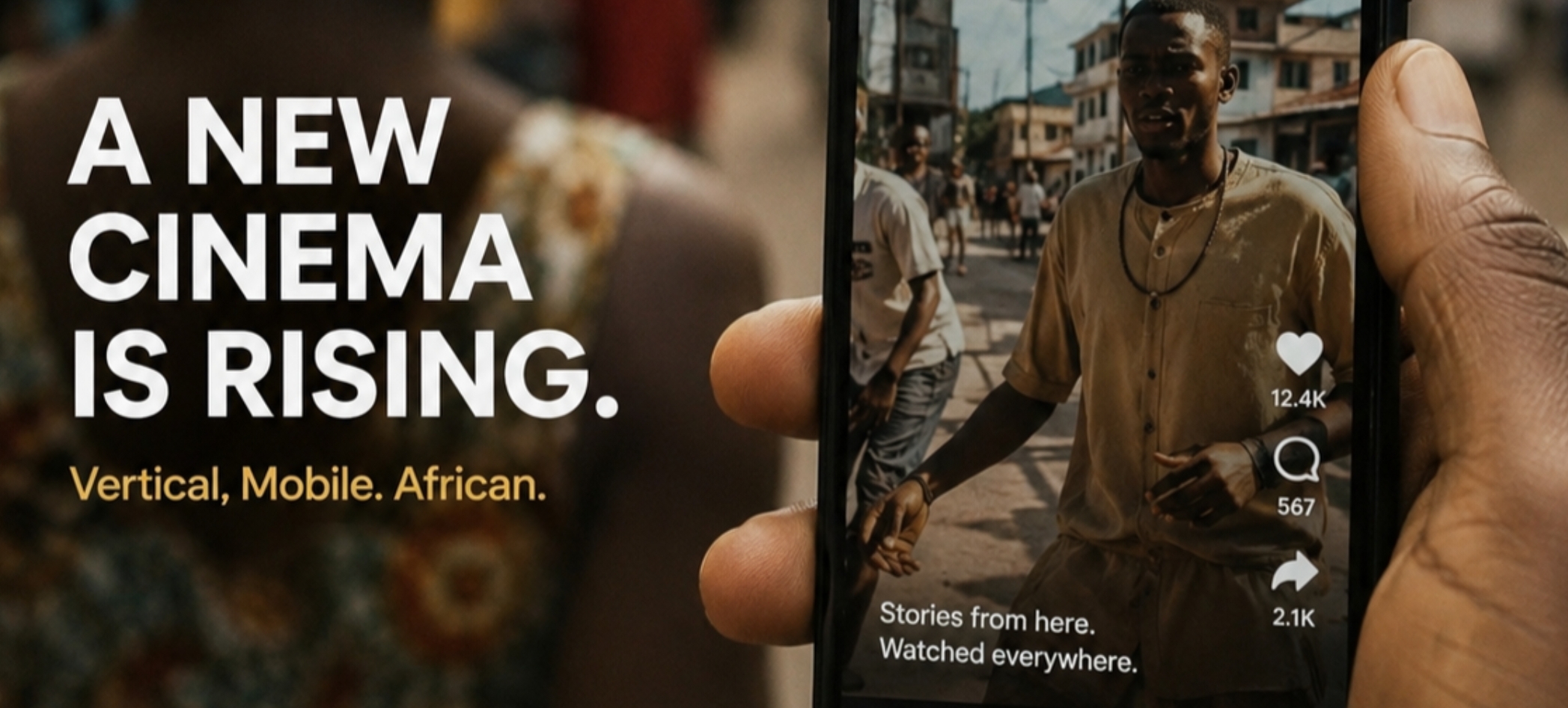
Across much of Africa, storytelling is already becoming mobile-first. Audiences increasingly experience visual narratives through smartphones rather than theaters. From TikTok creators in Lagos to YouTube filmmakers in Nairobi and digital content startups in Kigali, the smartphone is evolving from a communication device into a primary cinematic space.
At the same time, global media industries are quietly shifting in the same direction. Recent reports that Netflix is increasingly experimenting with vertical storytelling formats and mobile-centered viewing strategies signal that what was once dismissed as “social media content” is now entering mainstream streaming culture. Platforms such as Netflix, Disney+, and Peacock are recognizing that younger audiences increasingly consume stories through phones rather than television screens.
This raises an important intellectual question for scholars of media and cinema:
Are these platforms adapting to a new attention economy—or are they unintentionally converging toward media realities that have long existed across the Global South?
The Philosophy of the “Vertical Moment”
In many Western media contexts, vertical video is often interpreted as a symptom of shrinking attention spans. Yet within African digital cultures, it may represent something more historically significant: the democratization of narrative production.
The traditional feature film model depends on costly infrastructures:
- cinemas
- stable electricity
- subscription systems
- uninterrupted leisure time
- centralized distribution networks
- Vertical storytelling disrupts these assumptions.
A creator with a smartphone, mobile data, and algorithmic visibility can now circulate narratives across borders without waiting for institutional gatekeepers. In this sense, vertical video is not merely a format shift; it may constitute a transformation in the political economy of storytelling itself.
Importantly, this transformation also resonates with longstanding African narrative traditions. Oral storytelling cultures across the continent have historically emphasized rhythm, immediacy, compression, participation, and communal circulation. The rise of short-form mobile storytelling may therefore represent not the abandonment of African storytelling traditions, but their digital reconfiguration.
The Paradox of Connectivity
However, technological optimism alone is insufficient.
If this transition unfolds without addressing the realities of high mobile data costs, platform dependency, and algorithmic inequality, Africa risks entering a new phase of digital asymmetry.
The issue is no longer simply the “digital divide” understood as access versus exclusion. Increasingly, it concerns unequal participation within platform economies themselves:
- Who controls visibility?
- Who owns distribution infrastructures?
- Which stories become algorithmically amplified?
- Under what economic conditions do creators operate?
Without critical engagement, vertical storytelling could democratize production while simultaneously deepening dependence on foreign-owned digital ecosystems.
Are Film Schools and Media Scholars Teaching This Shift?
Perhaps the most urgent question is not technological but pedagogical.
If streaming giants such as Netflix are now investing in vertical and mobile-first storytelling, are universities and film schools adapting quickly enough? Are scholars of cinema, media, and communication studies adequately preparing students for a future in which storytelling increasingly occurs through smartphones rather than traditional cinema screens?
Much of film education across the world—including in Africa—still privileges:
- widescreen composition
- theatrical exhibition
- classical editing structures
- legacy production models
Yet contemporary audiences are increasingly consuming narratives vertically, interactively, and algorithmically.
This does not mean abandoning cinematic traditions. Rather, it suggests expanding film and media curricula to critically engage:
- vertical cinematography
- mobile-first aesthetics
- platform economies
- algorithmic distribution
- short-form narrative structures
- digital audience behavior
For scholars, this moment presents an important intellectual challenge: should vertical storytelling be treated merely as a commercial trend, or as an emerging cinematic language worthy of theoretical and pedagogical attention?
If academia ignores these transformations, there is a risk that universities will continue teaching twentieth-century cinematic frameworks while the future of visual culture evolves elsewhere—on smartphones, social platforms, and streaming ecosystems.
Beyond Consumption: Toward Platform Sovereignty
The deeper challenge for African filmmakers, scholars, and policy makers is therefore not whether vertical video is “good” or “bad.” The real question is whether African media industries can shape this emerging cinematic language on their own terms.
If treated merely as a passing social media trend, the continent risks becoming a passive consumer within global attention economies. But if understood strategically—as both a technological and cultural form—vertical storytelling could become part of a broader reimagining of African media infrastructures.
Perhaps the future of African cinema will not emerge from copying Hollywood’s industrial model, but from developing forms rooted in the continent’s own technological realities, audience behaviors, and storytelling traditions.
The next global film revolution may not begin in the cinema hall.
It may already be unfolding on the smartphones in African hands.
What do you think: Are film schools and media scholars adapting quickly enough to the rise of vertical storytelling, or are we still teaching cinema through frameworks designed for a disappearing media environment?
This post was created with our nice and easy submission form. Create your post!

Written by
I am a film scholar and educator investigating the convergence of digital technology, media policy, and creative economics in Africa
Did this story move you? Every gift goes directly to Ochieng Umira — writers on Muwado earn from reader appreciation, not algorithms. Even $1 makes a difference.






Muwado weekly chart
Get Africa’s top 10 stories every Thursday
No account needed — just your email.
Want to follow Ochieng Umira and get notified every time they publish?
Create a free Muwado account →