

 Oweyegha Afunaduula

Introduction: Understanding Traditional Culture and Cultural Practices
Culture constitutes the foundational fabric of any society—the shared beliefs, values, behaviours, customs, symbols, and artefacts that bind people together across generations. Among the indigenous nations of Uganda, traditional culture represents far more than ceremonial practices or folkloric expressions. It encompasses the complete spectrum of human manifestation within the biocultural landscape: language as a vehicle of intergenerational wisdom, frameworks for understanding reality, environmental and ecological adaptation mechanisms, systems for producing human energy, conservation methodologies, healthcare practices, and artistic expressions spanning music, dance, drama, literature, paintings, and crafts.
Traditional education in indigenous Ugandan societies operated through what we may term “extradisciplinarity”—learning that transcended artificial boundaries between knowledge domains. Children and youth acquired understanding through immersion in lived experience, observing elders, participating in community activities, and internalizing wisdom transmitted through folklore, proverbs, and practical demonstration. This educational model produced traditional public intellectuals—elders, herbalists, historians, and cultural custodians whose intellectual achievements served community wellbeing rather than individual advancement.
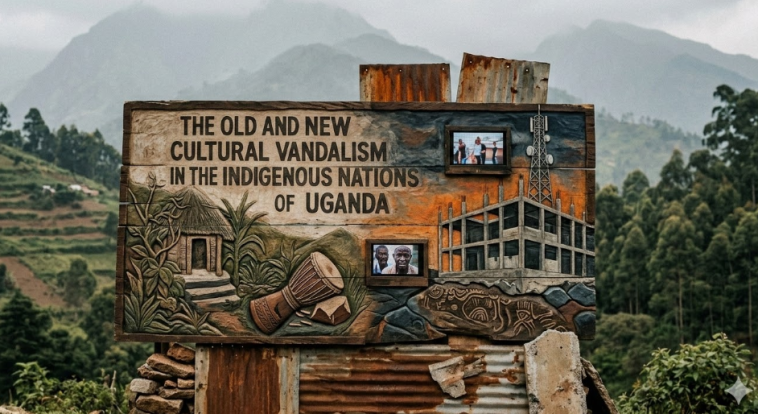
The contemporary crisis, characterized by what might be termed “supersonic intellectual death” in rural areas, stems from government prioritization of money culture and disciplinary fragmentation of knowledge. This essay examines two successive waves of cultural vandalism that have systematically dismantled indigenous cultural foundations: the colonial era (1894-1962) and the post-1986 period under the National Resistance Movement government.
Part One: Old Cultural Vandalism (1894-1962)
Agricultural Dispossession and Ecological Transformation
The British colonial project in Uganda initiated systematic cultural destruction through agricultural transformation. The introduction of British-style agronomy disregarded millennia of indigenous agricultural knowledge, replacing sophisticated intercropping systems with monocultural plantation agriculture. Colonial authorities vandalized forests, swamps, lakes, and rivers—ecosystems that were not merely resources but constituted the very context of indigenous cultural existence.
The introduction of the Nile Perch into Lake Victoria represents a particularly profound act of cultural vandalism. This predatory fish decimated native species, disconnecting lakeside communities from their preferred fish varieties that had sustained them nutritionally and culturally for centuries. The destruction of traditional fisheries paralleled broader patterns of resource alienation.
Conservation as Dispossession
Perhaps the most pernicious colonial innovation was the redefinition of indigenous relationships with their ancestral lands. Colonial authorities designated forests, game reserves, and national parks—spaces where indigenous communities had sustainably harvested resources, gathered medicines, and practiced their cultures for millennia—while simultaneously criminalizing indigenous presence as “poaching.” The irony remains stark: the same colonial administration that excluded indigenous people from these areas continued extracting resources, as evidenced by Ugandan Mvule timber adorning buildings in London.
Botanical Theft and Seed Sovereignty
The colonial project engaged in systematic appropriation of Uganda’s botanical heritage. Traditional women biotechnologists—the unsung heroes who domesticated plants as food crops and medicines, who served as the real environmental conservationists—found their knowledge and practices constrained, marginalized, or actively suppressed. Colonial authorities introduced foreign crops—coffee, tea, sugarcane—that reoriented agricultural production toward export markets rather than community sustenance.
Simultaneously, colonial and post-colonial powers engaged in what can only be described as botanical theft: appropriating traditional culturally relevant seeds, transferring them to seed banks in Europe, Russia, Australia, and the Americas. Kew Gardens stands as a monument to this appropriation, housing countless Ugandan plant species. This theft creates profound future vulnerabilities: as our food resources become increasingly eroded, these stolen genetic resources may be weaponized, forcing Ugandans into political positions contrary to our interests. What we call “food aid” may already function as such a weapon. The colonial project thus created a new politically dangerous seed culture supplanting our socioecologically and socioculturally sensitive seed varieties.
Part Two: New Cultural Vandalism (1986-Present)
Genetic Modification and Agricultural Homogenization
Since 1986, Uganda has witnessed unprecedented proliferation of Genetically Modified Organisms (GMOs), accompanied by multiplying institutions devoted to introducing numerous GMO varieties. These are imposed on our people through propaganda characterizing our time-tested crops as “primitive.” The statistical reality is staggering: where indigenous Ugandans once survived on approximately eighty-five food varieties before colonial invasion, we now subsist on roughly six, including millet—itself distorted through genetic modification.
This agricultural homogenization represents not merely biodiversity loss but cultural annihilation. Each lost crop variety carries generations of accumulated knowledge—planting seasons, preparation methods, medicinal applications, ritual significance, and culinary traditions. When the seed disappears, so does the knowledge embedded within it.
Foreign Governance and Leadership Culture
The new cultural vandalism manifests profoundly in governance structures. Uganda has adopted foreign leadership culture characterized by centralized control masquerading as decentralization. The Local Council system, rather than empowering communities, functions primarily as a surveillance mechanism. This governance model operates through what might be termed “Bantustanisation”—the creation of fragmented, dependent administrative units—and militarisation that prioritizes regime security over human security.
Indigenous leaders, where they exist at all, play second fiddle to leaders whose legitimacy derives from exogenous origins and connections. This foreign governance culture extends to peace and security frameworks that consume public money, generate spiraling indebtedness, and expand surveillance and militarisation while neglecting social, political, economic, and environmental development.
The Money Culture and Development Deception
The present regime’s exacerbated interest in the foreign sterile culture of money finds expression in government programs: Entandikwa, Operation Wealth Creation, the Parish Development Model, and various Emyooga initiatives. These programs enforce a money culture that crushes the weak and highly vulnerable cultures of indigenous communities, accompanied by systematic impoverishment of these same communities.
The deception operates through targeting programs to partisan individuals—those known to be members of the ruling party—while propagating the falsehood that individual wealth will eventually “trickle down” to benefit communities. The total communities do not benefit from these preferred development programs; instead, they witness the enrichment of politically connected individuals while collective wellbeing deteriorates.
Dispossession and the Creation of Human Pollutants
Land grabbing, dispossession, and displacement have converted indigenous communities into “human pollutants” within their own ancestral territories. Communities are transformed into internal refugees or, worse, into new modern nomads—people physically present but culturally unattached to land that once defined their identity, sustained their livelihoods, and anchored their spiritual existence. This detachment from land represents perhaps the most complete form of cultural vandalism, as indigenous identity remains inseparable from territorial connection.
The Destruction of Natural Life-Death Ecological Cycles
Traditional burial practices among Ugandan indigenous nations reflected profound ecological understanding. The Basoga, for instance, would place deceased community members under the canopies of the Ficus tree (Omugaire) at the base of the stem, allowing natural decomposition to release nutrients into the soil. Water flowing down the stem would wash these chemicals into the earth. Animals—domestic dogs, wild dogs, foxes, jackals—would consume the flesh; birds of prey would consume the eyes. This practice integrated death into the cycle of life, returning bodily resources to the ecosystem that sustained the community.
Later, the Basoga buried their dead in backcloth at six feet depth, understanding that at that depth, bacteria and fungi necessary for decomposition remained active. Even by 1962, they maintained this practice. Similarly, nomadic pastoralists traditionally left their dead to nature, moving onward rather than interrupting the ecological cycle through burial.
Contemporary burial practices have disrupted this natural life-death ecology. Modern methods handle dead bodies through:
- Chemical preservation
- Plastic coffins
- Wooden coffins
- Nylon and non-cotton cloth
- Concrete graves, sometimes tiled, at three to four feet depth
These interventions prevent trees from accessing the resources of dead bodies and reintegrating them into the life-death cycle. This disruption contributes to what might be termed “biological desertification”—a process explaining, in part, why the Sahara Desert advances southward. It also illuminates diminishing food resources in both urban and rural areas, as nutrients that should enrich soils are sealed away from ecological circulation.
The Closed Society Culture
Contemporary Uganda has witnessed the mushrooming of closed society culture preferred by present-day rulers, replacing the open society that characterized indigenous governance. This occurs paradoxically alongside new technologies—Internet, social media, artificial intelligence—that theoretically enable unprecedented openness. The closed society culture operates through surveillance, selective information access, and the cultivation of fear, undermining the participatory, transparent decision-making processes that characterized indigenous governance systems.
Analysis: Continuities and Transformations in Cultural Vandalism
Patterns of Rupture
Both old and new cultural vandalism share fundamental characteristics: the imposition of exogenous values and practices, the devaluation of indigenous knowledge systems, and the reorientation of Ugandan societies toward external centers of power and accumulation. Colonial vandalism operated through direct administrative control and physical violence; contemporary vandalism operates through economic coercion, ideological manipulation, and the creation of dependent client classes.
The Question of Agency
A crucial distinction lies in agency. Colonial vandalism was perpetrated by foreigners openly pursuing imperial interests. Contemporary vandalism is perpetrated by Ugandans—often claiming to represent indigenous interests—who have internalized exogenous values and prioritize personal accumulation over community wellbeing. This makes contemporary cultural vandalism more insidious and potentially more destructive, as it attacks indigenous culture from within while claiming to defend it.
Resistance and Survival
Despite systematic assault, indigenous cultural elements persist. Traditional medicine continues serving communities excluded from or unable to afford globalized healthcare. Indigenous languages, though threatened, carry forward knowledge and worldview. Traditional agricultural practices survive in marginal spaces, maintaining seed varieties and cultivation techniques. This persistence testifies to the resilience of indigenous cultures and provides foundations for renewal.
Recommendations
1. Seed Sovereignty and Agricultural Renewal
Establish a National Seed Sovereignty Commission mandated to:
- Document and preserve indigenous seed varieties
- Prohibit GMO introduction until comprehensive cultural and ecological impact assessments are completed
- Support community seed banks managed by traditional women biotechnologists
- Challenge foreign seed banks’ claims to Ugandan genetic resources through international legal forums
2. Educational Transformation
Reform educational curricula to:
- Integrate indigenous knowledge systems across disciplines
- Support traditional public intellectualism through recognition and resources for cultural elders
- Develop extradisciplinary approaches transcending artificial boundaries between knowledge domains
- Establish community-based learning centers where indigenous knowledge is transmitted through practice
3. Governance and Leadership
Transform governance structures to:
- Genuinely decentralize power to indigenous governance institutions
- Replace surveillance-focused Local Council systems with community accountability mechanisms
- Recognize and resource traditional leadership structures alongside formal governance
- Demilitarize development and peace-building approaches
4. Ecological Restoration
Implement programs to:
- Restore traditional burial practices where communities choose them, removing legal and health regulatory barriers
- Reconnect communities with ancestral lands through genuine land reform
- Support indigenous conservation practices that maintained biodiversity for millennia
- Challenge the exclusionary conservation model that criminalizes indigenous presence in ancestral ecosystems
5. Economic Transformation
Redirect development approaches to:
- Prioritize endogenous development over externally dependent models
- Replace individual-targeted programs with community-focused investments
- Challenge the money culture through support for diverse economic practices
- Reject “trickle-down” assumptions in favor of direct community benefit
6. Repatriation and Restitution
Pursue international claims for:
- Return of genetic materials held in foreign seed banks
- Repatriation of cultural artefacts and documentation of appropriated knowledge
- Recognition of historical injustices in resource extraction and knowledge theft
- Compensation for biological and cultural resources appropriated without consent
References
- Mamdani, M. (1996). Citizen and Subject: Contemporary Africa and the Legacy of Late Colonialism. Princeton University Press.
- Rodney, W. (1972). How Europe Underdeveloped Africa. Bogle-L’Ouverture Publications.
- Mafeje, A. (2001). Anthropology in Post-Independence Africa: End of an Era and the Problem of Self-Definition. African Sociological Review.
- Shiva, V. (2016). Stolen Harvest: The Hijacking of the Global Food Supply. University Press of Kentucky.
- Ngũgĩ wa Thiong’o. (1986). Decolonising the Mind: The Politics of Language in African Literature. Heinemann.
- Mazrui, A. (1986). The Africans: A Triple Heritage. Little, Brown and Company.
- Byaruhanga-Akiiki, A.B.T. (1975). Religion in Bunyoro. Kenya Literature Bureau.
- Kiggundu, J. (2007). Indigenous Knowledge in Conservation and Development. Fountain Publishers.
- Musisi, N. (1991). “Colonial and Missionary Education: Women and Land in Uganda, 1900-1945.” African Economic History.
- Oweyegha-Afunaduula, F.C. (2003). Environment and Development: A Critical Analysis. Unpublished manuscript.
Conclusion
The old and new cultural vandalism visited upon Uganda’s indigenous nations represents a continuous project of dispossession—dispossession of land, of seeds, of knowledge, of governance, of life itself. Colonial vandalism established the patterns and extracted the resources; contemporary vandalism completes the work through the agency of Ugandans who have internalized foreign values and prioritize individual accumulation over community survival.
Yet indigenous cultures persist. The eighty-five food varieties may be reduced to six, but those six carry forward genetic memory and cultural practice. The Ficus tree may no longer receive the dead, but communities remember. Traditional women biotechnologists may be constrained, but their knowledge survives in those who observed and learned.
The task before Uganda is not merely cultural preservation in the sense of freezing practices in museum displays. It is cultural renewal—the active reconstruction of indigenous ways of knowing, being, and relating to the world, adapted to contemporary circumstances but grounded in the wisdom that sustained these nations for millennia before colonial interruption. This renewal requires recognition of the vandalism visited upon these cultures, restitution for what has been stolen, and restoration of the conditions under which indigenous cultures can flourish.
The alternative is the completion of the vandalism project: fully deracinated Ugandans, detached from land and knowledge and community, consuming globalized culture and genetically modified foods, governed by imported institutions, buried in concrete tombs that seal nutrients from the ecological cycle—human pollutants indeed, in our own land and to our own posterity.
For God and My Country
This post was created with our nice and easy submission form. Create your post!

Written by
I am a retired lecturer of zoological and environmental sciences at Makerere University. I love writing and sharing information.
Did this story move you? Every gift goes directly to Oweyegha Afunaduula — writers on Muwado earn from reader appreciation, not algorithms. Even $1 makes a difference.






Muwado weekly chart
Get Africa’s top 10 stories every Thursday
No account needed — just your email.
Want to follow Oweyegha Afunaduula and get notified every time they publish?
Create a free Muwado account →